Hans Holbein - Die Gesandten ( The Ambassadors ) & Martin Luther
Автор: musicksmonument
Загружено: 2016-08-16
Просмотров: 6934
Erstanden ist der heilig Christ- Luther lute
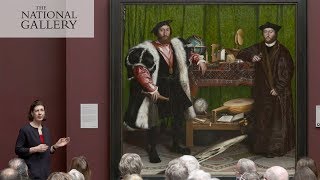
On the lower table, you can see an 11-stringed lute and an open book of music. But notice the broken string: this is commonly regarded as evoking ecclesiastical disharmony during the Reformation. Would things be improved simply if the reformers returned to the fold? Is this more Catholic propaganda? Well, the fascinating thing is that the book is in fact a Lutheran hymnal and the hymn is Luther’s own composition KOM HEYLIGER GEYST
Katharina von Bora - Paula Bär - Giese soprano & portative
Luther - Hans Meijer lute
Johann Walter - Hein Hof organ & virginal
In 1524 Johan. Walt(h)er(n) was called to Wittenberg by Martin Luther to assist him in framing the German Mass. The result of this was his Geystlich Gesangk Buchleyn for four voices (1524), the earliest Protestant hymn - book. Luther wrote a preface to this collection of 43 polyphonic works by Walter. Planned for young people in Lutheran schools, the collection went through many editions, the last one of which (1551) contained 47 Latin and 74 German pieces. In 1525 Luther consulted Walter about a projected sacred service in German, a service that was published as the Deutsche Messe (1526).
Music and Martin Luther
As with most music students of his time, Luther had a grounding in both singing and the lute and was recognized as a skilled lute-player with a pleasant tenor voice.
For Luther, music was not a ‘dark art’ but one which he grasped as well as any other educated person of his time. He enjoyed singing and playing his lute at home.
Luther’s detailed knowledge of polyphonic works may well have links with his proficiency on the lute. A substantial portion of the pieces found in German tabulations of the period, both in manuscript and published, are drawn from vocal models.
There is therefore the possibility that Luther played such lute transcriptions as well as singing the vocal polyphony with his family, friends and colleagues
After his death, as his body was being transported back to Wittenberg from Eisleben where he was died, the people in Halle appropriately marked his passing by singing one of the hymns he created: Aus tiefer Not schrei ich zu dir.
KATHARINA VON BORA
With or without her husband, Katharina was a woman of faith, stature, and conviction that often moved her to action. Katharina was born into a poor but noble family in the German state of Saxony. When her mother died, little “Katie,” at around five years old, was sent to a Benedictine convent school near Halle. At age ten she was transferred to a Cistercian nunnery in Nimbschen, and in 1515, at the young age of 16, was consecrated as a nun.
Katharina lived as a nun for the following eight years, but as an intelligent woman and deep thinker, she could not ignore the news of Dr. Martin Luther and his campaign to reform the wayward teaching and practices of the Church.
“When Katherine was seventeen, Dr. Luther had come as near to their convent as Grimma, six miles away, and reports of his sermons in that church seeped into the convent. One of the nuns was Magdalene von Staupitz, niece of the vicar-general of the Augustinians, the man who gave Luther his first Bible with the words, “Let the study of the Scriptures be your occupation.” From this had stemmed Luther’s conversion and devotion to the Bible. Magdalene had received some of Luther’s writings and had eagerly imbibed the Reformed doctrines. She gradually and secretly drew as many as eight other nuns to her way of thinking. Katherine was one of them. Over their endless embroidery, patient distilling of herbs, and so on, they contrived to whisper together, and were alert to every bit of ecclesiastical news from the outside world.”
The escape of Katharina and eleven other nuns on Holy Saturday in 1523 is an exciting story and only the beginning of many courageous decisions and actions she would need to take during her life as the wife and widow of Dr. Luther. The reformer’s many houseguests, moods of depression and other physical ailments, endless travels for the sake of the Church, and of course his time in hiding at Wartburg Castle, provided endless challenges for this devoted wife and mother. Testifying to her perseverance in life, Kenneth Taylor wrote:
“At his death Luther had been receiving a pension annuity from King Christian III of Denmark. King Christian III continued the pension after Luther’s death, making the payments to Katie. When the pension stopped coming in 1548, two of Luther’s colleagues sought to get the pension restored, to no effect. Katie took up the cause in letters to King Christian III in 1550 and 1552, to which the king finally assented. Katie was clearly a force to be reckoned with, a bit like the New Testament’s persistent widow.”

Доступные форматы для скачивания:
Скачать видео mp4
-
Информация по загрузке: