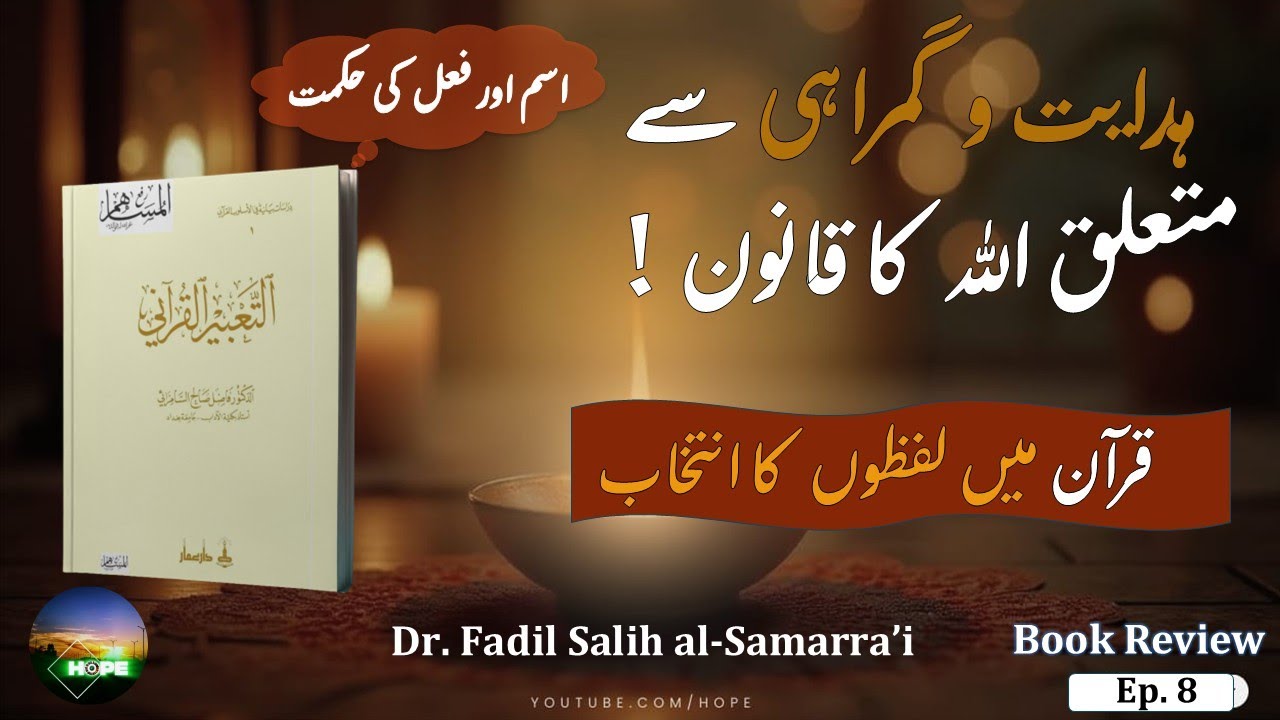
Qur’anic Eloquence: فعل اور مصدر | Dr. Fāḍil al-Samarra’ī | Ep. 11|
Автор: HOPE
Загружено: 2026-01-23
Просмотров: 21
In this episode, we explore how the Qur’an deliberately uses verb and verbal pronoun (masdar) to convey precise meanings, revealing divine wisdom and unmatched eloquence.
The Qur’an employs linguistic forms with extraordinary precision, where even closely related words are never interchangeable.
Here, Dr. Al-Samarra’i directs our attention to Allah’s statement in Surah An-Nissa, Aaya 60:
“And Satan wishes to lead them far astray.” [An-Nisa 4:60]
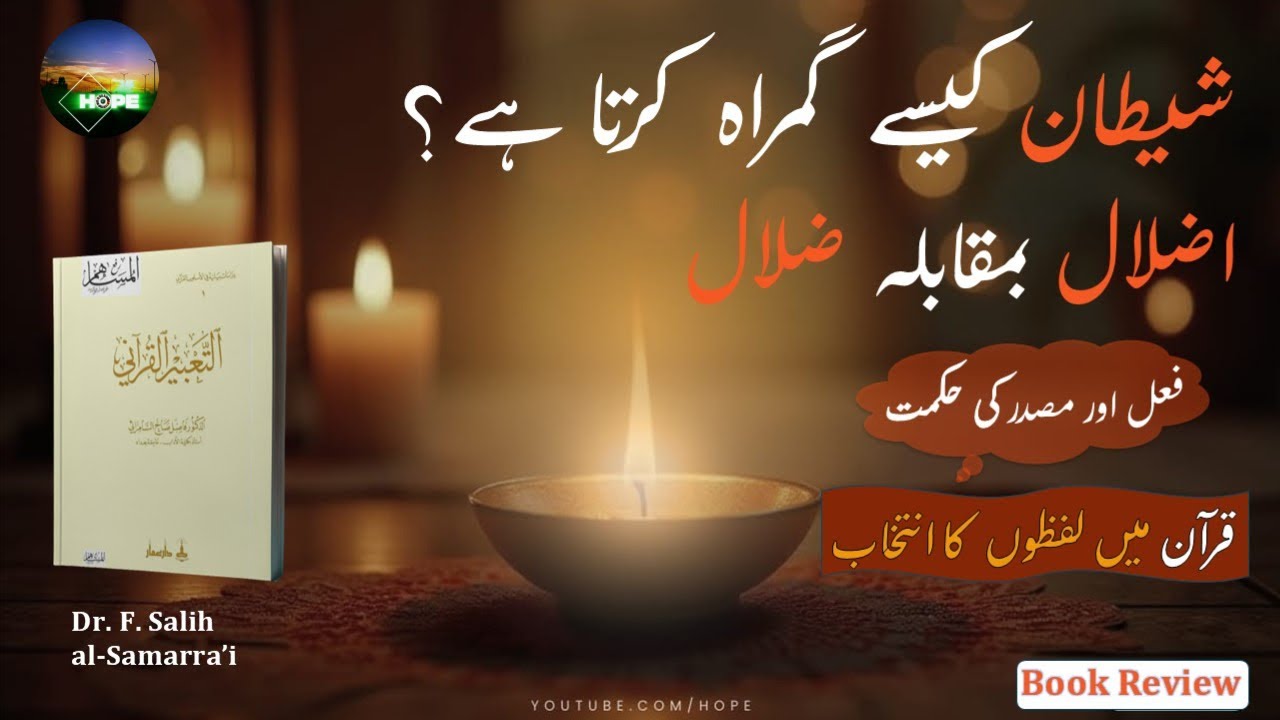
By analogy, one might say: “to lead them astray far away” (iḍlālan baʿīdan), because iḍlāl is the verbal noun of aḍalla (to mislead).
iḍlāl (إِضْلَال) and ḍalāl (ضَلَال)—two forms derived from the same root, yet conveying distinct grammatical and semantic meanings.
Iḍlāl ((إِضْلَال), act of causing misguidance, is the maṣdar of verb aḍalla (– أضلّ), a causative verb.
Grammatically, this form introduces agency and causation.
It does not merely describe misguidance as a state, but rather the act of causing someone to go astray.
Thus, iḍlāl is dynamic and transitive—it requires a doer and an affected party.
It highlights process, influence, and responsibility.
In Qur’anic usage, iḍlāl often appears in contexts involving Shayṭān, false leaders, or human choices that result in misleading others.
Whereas Ḍalāl (ضَلَال), state of being misguided, is a verbal noun (maṣdar) of the basic verb ḍalla (ضلّ).
Grammatically, it refers to a state or condition, not an action tied to a specific agent or moment in time.
Semantically, ḍalāl describes being lost, straying, or existing in error—a condition in which a person finds himself.
Thus, ḍalāl is static and intransitive—it does not require a doer or an affected party.
Because it is a maṣdar detached from time, ḍalāl conveys continuity and permanence.
It presents misguidance as an established state, not necessarily emphasizing how one arrived there.
This form is therefore used when the Qur’an describes the condition of people who are already astray, or the reality of deviation as a settled fact.
The distinction between iḍlāl and ḍalāl is not stylistic variation but semantic architecture.
Through grammar alone, the Qur’an differentiates between causing deviation and being deviated, between process and outcome, between moral responsibility and spiritual condition.
This precision reminds us that in the Qur’an, every form carries theology, and every grammatical choice reflects divine wisdom.
Because in the Qur’an, grammar is never accidental.
Join us on HOPE as we reflect on the miracle of the Qur’an—one expression at a time.
#QuranicArabic #QuranLinguistics #AtTabeerAlQurani #DrFadilAlSamarrai
#QuranicWisdom #QuranReflection #quranmiracle
#IslamicKnowledge #IslamicReminder #hope
Доступные форматы для скачивания:
Скачать видео mp4
-
Информация по загрузке: