How to Identify the Biggest Files in Your PostgreSQL Cluster
Автор: vlogize
Загружено: 2025-10-11
Просмотров: 0
Discover effective methods to find the largest files in your PostgreSQL cluster across multiple databases. Learn to manage and optimize your disk space with this helpful guide.
---
This video is based on the question https://stackoverflow.com/q/68498895/ asked by the user 'Andrus' ( https://stackoverflow.com/u/742402/ ) and on the answer https://stackoverflow.com/a/68499177/ provided by the user 'Laurenz Albe' ( https://stackoverflow.com/u/6464308/ ) at 'Stack Overflow' website. Thanks to these great users and Stackexchange community for their contributions.
Visit these links for original content and any more details, such as alternate solutions, latest updates/developments on topic, comments, revision history etc. For example, the original title of the Question was: How to find biggest files in cluster
Also, Content (except music) licensed under CC BY-SA https://meta.stackexchange.com/help/l...
The original Question post is licensed under the 'CC BY-SA 4.0' ( https://creativecommons.org/licenses/... ) license, and the original Answer post is licensed under the 'CC BY-SA 4.0' ( https://creativecommons.org/licenses/... ) license.
If anything seems off to you, please feel free to write me at vlogize [AT] gmail [DOT] com.
---
How to Identify the Biggest Files in Your PostgreSQL Cluster
When managing a PostgreSQL database cluster, especially one with multiple databases like a PostgreSQL 13 setup on a Debian Linux server, one of the most essential tasks can be to determine which files are occupying the most space. This is particularly relevant when you notice performance issues or when disk space is running low. Below, we will dive into the questions around this problem and provide a clear solution to help you effectively manage your database files.
The Challenge
In a PostgreSQL environment containing numerous databases, each with multiple schemas, it can be cumbersome to identify the largest files that consume disk space. A common approach might involve using SQL queries to extract this information; however, one major drawback becomes apparent quickly—when you run a query, it only applies to the currently connected database. This limitation can lead to frustration when trying to assess the overall disk usage across all databases in a cluster.
Understanding the Limitation
The initial query you might use can look something like this:
[[See Video to Reveal this Text or Code Snippet]]
While this query effectively lists sizes for objects in the connected database, it highlights that you are limited to querying one database at a time – referring back to the problem of disk space evaluation across the whole cluster.
The Solution: Script to Access All Databases
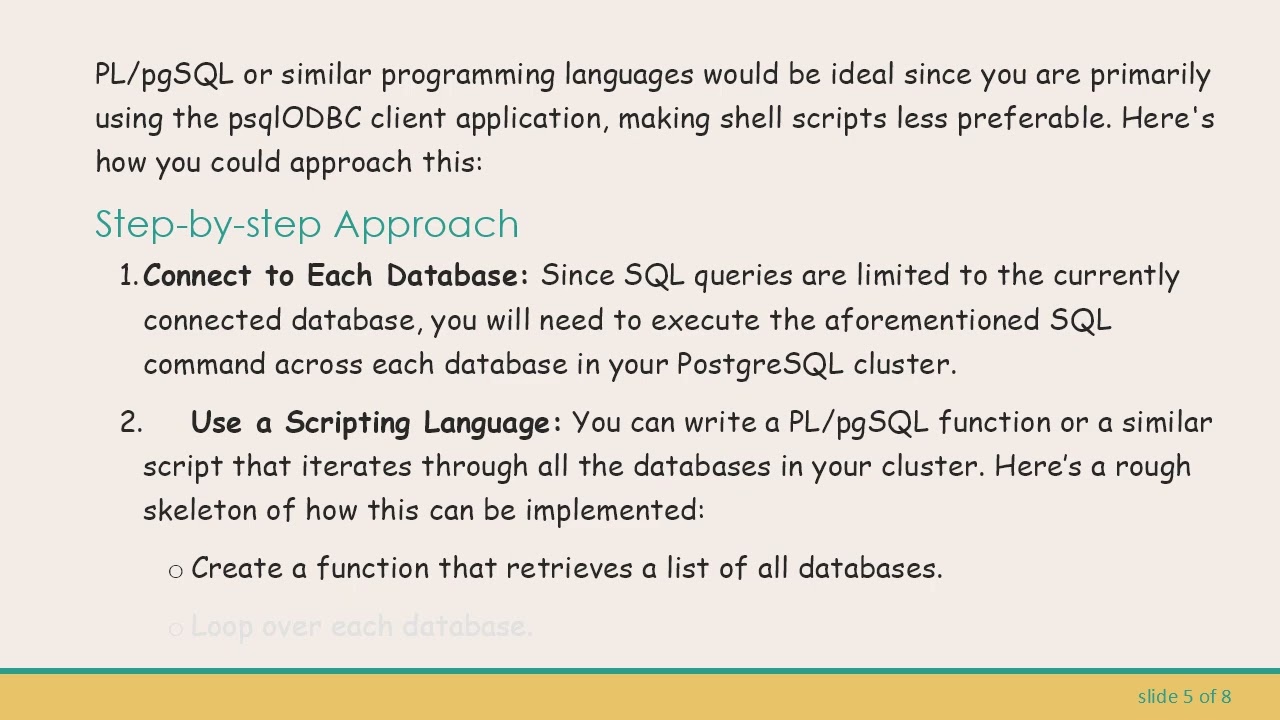
The workaround for this limitation is to run a script that connects to each database within the cluster individually. However, as noted, a solution that uses PL/pgSQL or similar programming languages would be ideal since you are primarily using the psqlODBC client application, making shell scripts less preferable. Here's how you could approach this:
Step-by-step Approach
Connect to Each Database: Since SQL queries are limited to the currently connected database, you will need to execute the aforementioned SQL command across each database in your PostgreSQL cluster.
Use a Scripting Language: You can write a PL/pgSQL function or a similar script that iterates through all the databases in your cluster. Here’s a rough skeleton of how this can be implemented:
Create a function that retrieves a list of all databases.
Loop over each database.
Execute the original SQL query in each iteration and collect results.
Include Database Names in Output: Modify your SQL query to include the database name in the results. This could involve storing the database name alongside the file sizes in your output.
Sample PL/pgSQL Snippet
Here’s a conceptual example of how this could look in a PL/pgSQL script:
[[See Video to Reveal this Text or Code Snippet]]
Considerations
Performance: Running this query over all databases can be resource-intensive, so ensure to schedule it during off-peak hours.
Security Permissions: Ensure you have the necessary permissions to access all databases; otherwise, some may fail to return results.
Conclusion
While it can be challenging to analyze disk usage for multiple databases in a PostgreSQL cluster, using a PL/pgSQL script that iterates through all databases can provide a comprehensive insight into which files are the largest. By carefully planning your script and understanding your database structure, you can achieve effective disk management and optimization in your PostgreSQL environment.
With this approach, you'll surely have a better grip on managing your database sizes and ultimately enhance performance and resource utilization across your cluster.
Доступные форматы для скачивания:
Скачать видео mp4
-
Информация по загрузке: