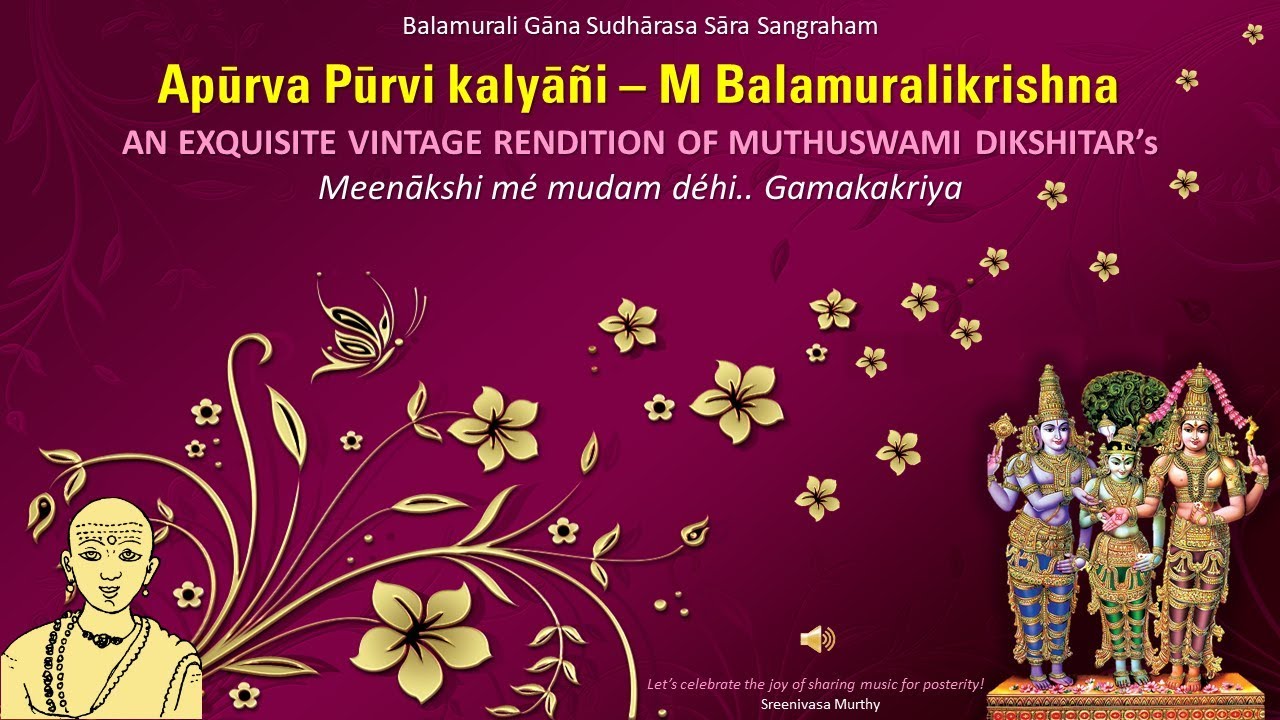
Apoorva Purvikalyani - Dikshitar's "Meenakshi - Gamakakriya" - A Vintage Rendition (1968) - BMK
Автор: Music for Posterity : Sreenivasa Murthy
Загружено: 2018-12-14
Просмотров: 6336
Among the many compositions of Sri Muthuswami Dikshitar that have been masterly rendered by Dr. M Balamuralikrishna (BMK), perhaps, the kriti “Meenākshi mé mudam déhi” in the rāga Gamakakriya (Pūrvikalyāñi) stands out as one of the best examples to portray the quintessence of Muralīgānam.
The facets of Muralīgānam that we experience in the rendition of this kriti do not merely introduce the musical aspects, but they take us through the journey in its length and breadth.
BMK might have rendered this celebrated composition of Dikshitar dozens of times during his long musical career spanning several decades, but the recordings that have survived over time and are available to listen are a few.
On listening to the various renditions (spanning over 45 years) of the same kriti available today, we could classify these renditions into 5 groups.
1.Renditions focussed on exploring the rāga Pūrvikalyāñi in detail;
2.Renditions focussed exclusively on the kriti itself to bring out the beauty of rāga, laya and sāhitya;
3.Renditions that are best examples of the optimum tempo;
4.Renditions that creatively explore the various possibilities of Sāhitya- vinyāsam (Neraval), and
5.Renditions that dwell on elaborate Svara-vinyāsam in both slow and fast tempo.
Each rendition excels in providing a wholesome listening experience of one of these aspects (Rāga, Kriti, Neraval, Svara and Tempo) primarily and a combination of some of these aspects secondarily.
In our endeavour, we have found a vintage rendition which perhaps has all the above 5 aspects built into it and lasts over 70 minutes.
The rendition presented here, in my humble opinion, is both a descriptive and a prescriptive presentation of Rāga, Kriti and Laya with a right balance of emotion and brilliance.
In this rendition, the 70 minutes are distributed as follows:
1. Rāga : 16 minutes,
2. Kriti (halfway) : 9 minutes,
3. Sāhitya- vinyāsam (Neraval) : 10 minutes,
4. Svara-vinyāsam – II speed : 8 minutes,
5. Svara-vinyāsam – III speed : 14 minutes, and
6. Laya- vinyāsam (Tani āvartanam) : 13 mintues.
We have no details about this recording other than that the old tape from which it was restored itself is about 45 years old. So, we can say, the rendition might be from the mid 1970s.
I started to work on this audio from January 2018 and have spent many days of long sessions working on restoring the audio from the old cassette tape. But I still feel the audio quality is wanting. It is said that “one should know when to stop while painting or while worrying about something.” So, I would like to pause here and release this as 2018 Version and continue to explore newer methods to improve it further. I sincerely hope that the audio quality presented here would not majorly hamper your wholesome listening experience.
This kriti is on the Goddess at Madurai – Meenākshi (whose eyes resemble the shape of a fish). The rāga, Gamakakriya is the 53rd mélakarta in the asampūrna rāga scheme followed by Dikshitar. It is now commonly known as Pūrvikalyāñi.
Now, here is something interesting that I read about the history of this composition.
Legend has it that as Dikshitar left his body from this world, he requested his disciples to sing this kriti, in particular the line “meenalóchani pāshamóchani” (the divine mother who liberates one from the bondage of ignorance).
On his 59th birthday, in 1835, Dikshitar had a premonition that his end was nearing. He went to Madurai and sang his song of total surrender to the Goddess through his last song “Meenākshi mé mudam déhi” pleading for the release. Then he proceeded to Ettiyapuram. On the Naraka chaturdashi day, after completing all the rituals of oblation and worship to his personal deity, he started singing and playing on veena, along with his disciples.
In the end, all started singing his last song “Meenākshi mé mudam déhi.” At the point of rendering, “meenalóchani pāshamóchani” he wanted his disciples to sing it three times. He then raised his hands in obeisance and uttered “Shivépāhi” thrice and transitioned…
In this particular rendition, there is one place at which, I felt that that the plea of Dikshitar for the release is suggestively captured by BMK. This moment of undefinable emotion can be heard during BMK’s Sāhitya- vinyāsam. Please listen carefully when you approach BMK singing “Madhu-mada-módita hrudayé.. and then he sings “Ha…a…a! at about 31’ 02”.
Perhaps, what music could ultimately do to the human spirit can be experienced while listening to this immortal composition and impeccable rendition.
Please tune in and enjoy.
Доступные форматы для скачивания:
Скачать видео mp4
-
Информация по загрузке: