How the Silk Road Worked
Автор: The Secret Finance History
Загружено: 2026-01-20
Просмотров: 867
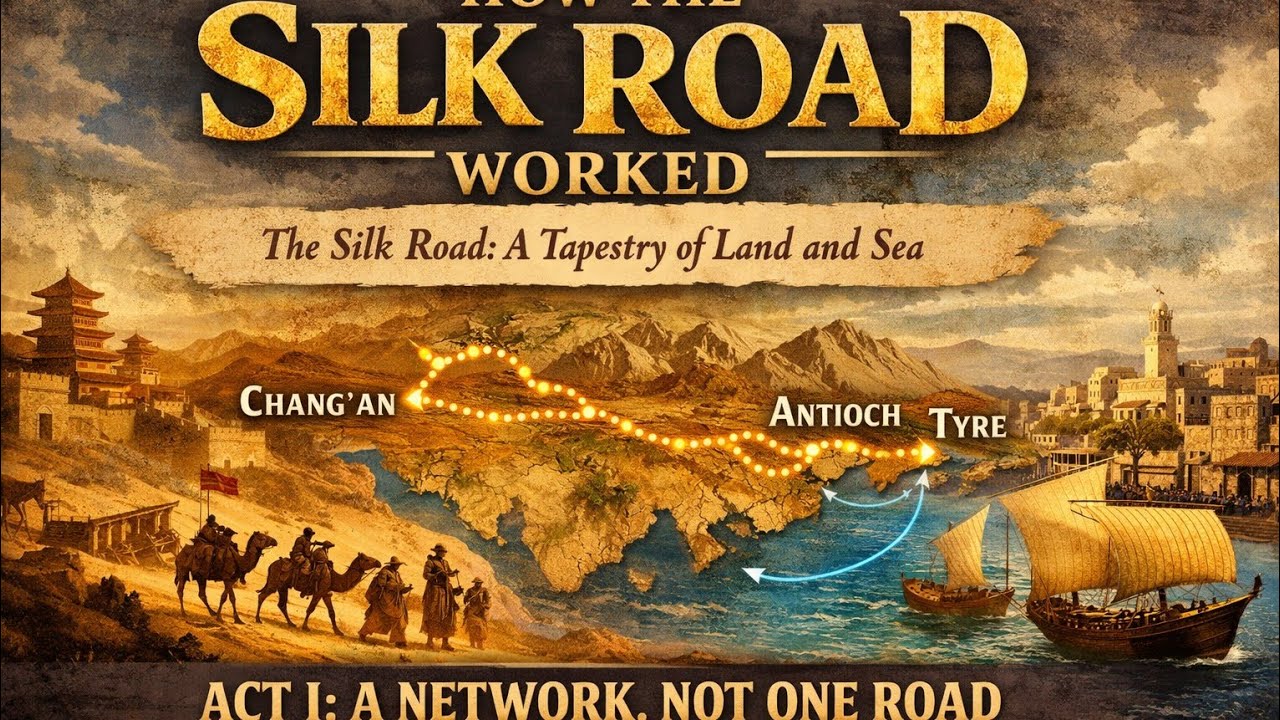
Title: The Silk Road: A Tapestry of Land and Sea
Act I: A Network, Not One Road
The Silk Road was never a single, continuous highway but rather a vast, evolving web of regional routes that shifted over 1,500 years. This network spanned approximately 5,000 miles, stretching from the Chinese capital of Chang’an to the Mediterranean ports of Antioch and Tyre. Because the journey was so treacherous, few individuals traveled its entire length; instead, it operated on a relay system. Goods passed through dozens of hands, changing owners at major hubs like Samarkand and Bukhara before reaching their final destination. Historians now describe these routes as shifting, unmarked paths across massive expanses of deserts and mountains.
Act II: The Masters of the Middle Ground
Specialized merchant groups thrived in this system, but none were as influential as the Sogdians from the Zeravshan River basin. Dominating trade between the 4th and 9th centuries, they acted as the ultimate middlemen and translators, proficient in languages such as Persian, Chinese, and Turkic. Alongside them, nomadic pastoralists played a critical role, accompanying caravans and providing the animals necessary for transport. While the Chinese supplied silk and porcelain, Arab and Persian traders managed the flow of spices and perfumes, and Mediterranean merchants exchanged fine glassware and wine.
Act III: Beyond the Silk
While silk gave the road its name and served as a form of international currency to pay troops and state debts, it was only a fraction of the story. The exchange was deep and varied:
East to West: China exported paper, gunpowder, and tea.
West to East: The West provided gold, silver, glassware, and the famous "Heavenly Horses" of Ferghana, which were so prized that Emperor Wu sent missions to secure them for his divinity.
Both Directions: Exotic animals like lions, cheetahs, and ostriches were moved along the routes, while cultivated plants like grapes and alfalfa seeds transformed local agricultures.
Act IV: The Daily Grind of Travel
Traveling the Silk Road was slow and seasonal, relying heavily on Bactrian camels to navigate harsh deserts. To ensure safety, caravanserais (roadside inns) were established roughly every 40 km—the distance a camel caravan could travel in a single day. These "fortresses of commerce" featured high walls to repel bandits and provided free food and shelter for up to three days for any traveler, regardless of religion or language. Inside, merchants unloaded goods, watered their animals, and shared commercial news and prices.
Act V: The Financial Revolution
Because it was dangerous to carry large amounts of cash, the Silk Road gave birth to sophisticated financial tools. During the Tang Dynasty, merchants used "flying cash," a precursor to the modern check that allowed them to deposit money in one location and withdraw it elsewhere. By the 10th century, a system of bearer checks emerged, supported by the trust of shared religious communities. Additionally, some of the earliest recorded pawnshops appeared in Chinese monasteries, functioning as charitable commercial banks that offered loans against collateral like clothing or cloth.
Act VI: The Political Engines of Prosperity
The Silk Road thrived only when major empires could ensure stability. The Han Dynasty opened the routes to protect against northern threats, while the Roman Empire created an insatiable demand for luxury goods. Later, the Pax Mongolica (Mongol Peace) unified the continent under a single authority, making the roads so safe that it was said a maiden with a gold nugget could travel the realm unmolested. The Mongols also perfected the "Yam" postal system, a relay of stations every 25 miles that provided the first rapid communication network between the Far East and the West.
Act VII: A Cultural and Biological Superhighway
More than goods, the road carried ideas and faiths. Buddhism spread from India to China with the support of Sogdian sponsors, while Islam expanded through trade polities in Southeast Asia. Technologies like paper-making migrated West, eventually displacing parchment in Europe. However, this connectivity had a dark side: the Black Death was carried west by infected fleas hitching rides in the manes of horses and the cargoes of merchant caravans, eventually devastating the populations of Eurasia.
Act VIII: The Maritime Shift and Decline
By the 1400s, the overland Silk Road began its final decline. A combination of factors ended its golden age:
Climate Change: Shrinking glaciers caused the desert oases that fed trade towns to dry up.
Economic Costs: Moving goods by sea was found to be 27 times cheaper than land travel.
Political Blockades: The rise of the Ottoman Empire and Ming Dynasty isolationism led to exorbitant taxes and the closure of land routes.
The Maritime Explosion: Austronesian sailors and later Portuguese explorers established a Maritime Silk Road using "lashed-lug" ships
Доступные форматы для скачивания:
Скачать видео mp4
-
Информация по загрузке: