3-wire Inductive Proximity Sensor | How to Read the Datasheet
Автор: RealPars
Загружено: 2020-07-27
Просмотров: 108105
▶ C'mon over to https://realpars.com where you can learn PLC programming faster and easier than you ever thought possible!
=============================
▶ Check out the full blog post over at
https://realpars.com/proximity-sensor...
=============================
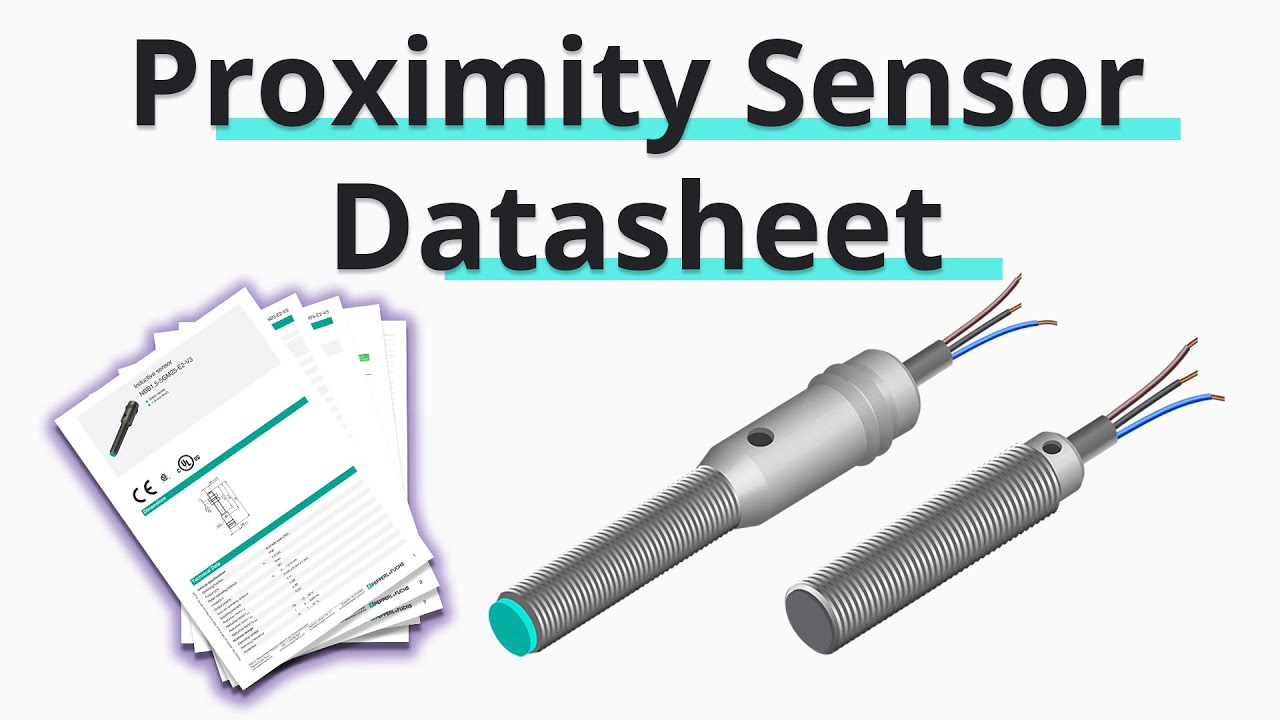
In this video, we’re going to look at two 3-wire proximity sensor datasheet from 2 different vendors, Pepperl+Fuchs and Schneider Electric, and discuss the specifications which are common.
A 3-wire inductive proximity sensor is an electronic device that can detect ferrous (Fe) targets without any physical contact. When it detects that target, it operates an internal electronic switch. Because the sensor is an electronic device it requires a DC power source.
Proximity sensors are being used in industry today to replace devices such as mechanical limit switches.
There are 2 different types of 3-wire Inductive Proximity Sensors NPN and PNP.
Let’s look at 2 typical 3-wire inductive proximity sensor datasheet.
Inductive-sensor-XS108B3NAL2-@schneiderelectric
https://bit.ly/39pIluS
Inductive-sensor-NBB1.5-5GM25-E2-V3- @PepperlFuchsUSA
https://bit.ly/3g0oDIO
Let’s discuss the Output Type specification.
The output type can be PNP or NPN which determines how the load is connected to the sensor. Although they can both look identical physically, they are not interchangeable.
Operating Current or Switching Capacity in mA is another specification to discuss.
Unlike a mechanical limit switch or other similar devices, a proximity sensor can only carry a low amount of current before being damaged. For these sensors, the maximum current allowed is 200 mA.
An important specification is Operating Voltage or Supply Voltage Limits.
As discussed earlier, the 3-wire proximity sensor is an electronic device and requires a DC Power Supply. Sensor datasheets will always provide a range of Power Supply voltages in which the sensor will operate as designed.
Let’s look at the Switching Function or Discrete Output Function specification.
Just like any switch, proximity sensors can have Normally Open (NO) or Normally Closed (NC) contacts.
This datasheet specification indicates the state of the switch before it is activated.
Another important specification is the Voltage Drop or Maximum Voltage Drop.
Most of us assume that a closed switch will have zero volts dropped across it when it is closed. In most cases this is true.
Unfortunately, in the world of electronic proximity sensors, this is not the case.
Another specification to consider is Switching Frequency.
Every time the target gets close to the proximity sensor, the internal switch operates and creates a voltage pulse.
A proximity sensor has a switching frequency specification which limits its use to measure speed. There are sensors designed for speed measurement that operate exactly as proximity sensors.
An important specification is the Rated Operating Distance or Nominal Sensing Distance.
Simply stated, it is the distance under ideal conditions that the sensor can detect the target and successfully operate its internal switch. Keep in mind that this specification does not take into account external conditions such as voltage supply and temperature.
Let’s talk about the specification called Switching State Indicator or Status LED.
Almost every vendor will have an LED indicator of some kind as part of the physical body of the proximity sensor.
The purpose of the LED is to indicate when the proximity sensor is activated.
=============================
You might want to review 2 of our other articles:
1) How to Wire Discrete DC Sensors to PLC – Part 1 https://realpars.com/discrete-sensors...
2) How to Wire Discrete DC Sensors to PLC – Part 2 https://realpars.com/discrete-sensors...
=============================
Missed our most recent videos? Watch them here:
https://realpars.com/allen-bradley-plc/
https://realpars.com/pressure-transmi...
https://realpars.com/safety-plc
=============================
To stay up to date with our last videos and more lessons, make sure to subscribe to this YouTube channel:
http://goo.gl/Y6DRiN
=============================
TWEET THIS VIDEO https://ctt.ac/uQDOd
=============================
Follow us on Facebook: / therealpars
Follow us on Twitter: / realpars
Follow us on LinkedIn / realpars
Follow us on Instagram / realparsdotcom
#Proximity_Sensor #RealPars #Industrial_Sensors
Доступные форматы для скачивания:
Скачать видео mp4
-
Информация по загрузке:


![Как сжимаются изображения? [46 МБ ↘↘ 4,07 МБ] JPEG в деталях](https://image.4k-video.ru/id-video/Kv1Hiv3ox8I)


