Detailed Animation on Tonicity
Автор: MedEd Mastry
Загружено: 2020-04-23
Просмотров: 30014
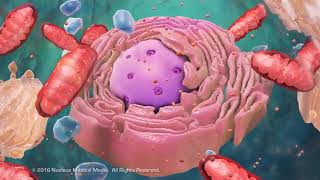
In a normal cell, the osmotic pressure exerted by the cytosol within a cell is equal to the osmotic pressure exerted by the interstitial fluid surrounding it. As a result, there is no net movement of water, and the cell remains the same shape and volume.
If, however, the osmotic pressure exerted by cytosol inside of the cell is different to the osmotic pressure exerted by the interstitial fluid surrounding it, osmosis will occur and the cell will change volume and shape.
If water moves from the cytosol out of the cell and into the surrounding fluid, the cell will shrink, and if water moves from the surrounding fluid into the cell, the cell will expand.
The measure of the difference in this osmotic pressure is known as tonicity.
The tonicity of a solution relative to another solution can be described as isotonic, hypotonic, or hypertonic.
Isotonic solution
The concentration of non-diffusible solutes in an isotonic solution is equal to that of the cytosol within a cell. Therefore, if a cell is placed in an isotonic solution, there is no net water movement and the cell stays the same size.
Hypotonic solution
A hypotonic solution contains a lower concentration of non-diffusible solutes (and, therefore, a higher water concentration) compared with the cytosol within a cell. Thus, if a cell is placed in a hypotonic solution, water moves into the cell, causing it to expand and eventually rupture. This rupturing is known as lysis. When it occurs in erythrocytes it is known as hemolysis.
Hypertonic solution
A hypertonic solution contains a higher concentration of non-diffusible solutes (and, therefore, a lower water concentration) compared with the cytosol within a cell. Thus, if a cell is placed in a hypertonic solution, water is drawn out of the cell, causing it to shrink. This shrinking is known as crenation.

Доступные форматы для скачивания:
Скачать видео mp4
-
Информация по загрузке: