William Catterall (U. Washington) Part 2: Voltage-gated Na+ Channels at Atomic Resolution
Автор: Science Communication Lab
Загружено: 2014-09-25
Просмотров: 36712
https://www.ibiology.org/neuroscience...
Lecture Overview:
How does a baseball player react quickly enough to hit a 90 mph fastball or a tennis player to hit a 60 mph serve? All of the fast events in our bodies, such as vision, hearing, nerve conduction and muscle contraction, involve electrical signals. In Part 1 of his talk, Dr. Catterall explains how the flow of sodium and potassium ions, through specific channels in the cell membrane, creates an electrical signal in nerve and muscle cells. He describes the structure and function of the sodium channel and its important role in physiology and pharmacology.
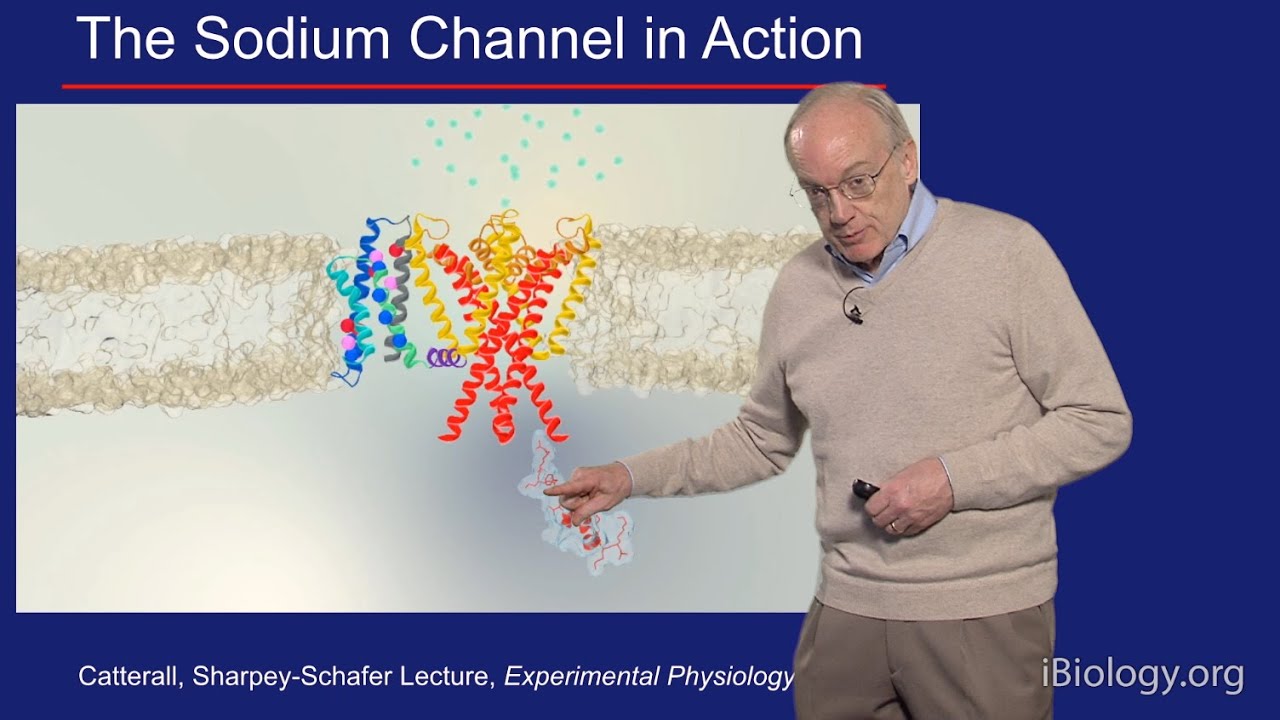
In Part 2 of his talk, Catterall describes how voltage gated sodium channels function at an atomic level. Bacterial Na+ channels in the NaChBac family contain many of the elements of mammalian Na+ channels but in a much simpler form. Using X-ray crystallography to study NaChBac proteins, Catterall and his colleagues determined which domains of sodium channels are responsible for sensing voltage differences across the cell membrane and how these domains trigger the opening of the channel pore. It was also possible to identify the structural changes leading to the slow inactivation of channels after multiple rounds of opening and closing and to understand how NaChBac establishes its specificity for Na+ ions.
In his third talk, Catterall switches his focus to voltage gated calcium channels. Na+ and Ca2+ channels share a common ancestor and consequently, much of the overall structure of the voltage sensing domain and the central pore is conserved. In spite of this homology, the calcium channel selects specifically for Ca2+ ions, even in the presence of an excess of Na+. Upon entry into the cell, Ca2+ ions regulate numerous intracellular processes. Catterall explains how his group was able to engineer a bacterial calcium channel that allowed them to identify the residues required for Ca2+ selectivity. He also describes experiments demonstrating that Ca2+ ions act locally within the cell, allowing for targeted regulation of cellular functions such as learning and memory in the brain and contraction in skeletal and cardiac muscle.
Speaker Bio:
Bill Catterall is Professor and Chair of the Department of Pharmacology at the University of Washington where he has been a faculty member since 1977. Catterall received his BA in Chemistry from Brown University and his PhD in Physiological Chemistry from Johns Hopkins University. He was a post-doctoral fellow with Dr. Marshall Nirenberg and a staff scientist at the NIH for a few years before moving to the University of Washington.
Catterall and his colleagues discovered the voltage-gated sodium and calcium channels responsible for generating the electrical impulses necessary for most physiological functions. His lab continues to study the structure and function of these channels, their physiological regulation, and their interaction with medically important drugs. Catterall is also interested in understanding how impaired channel function may lead to human disease.
Catterall has been recognized with numerous awards and honors for his contributions to the fields of electrophysiology, pharmacology, neuroscience, and cell biology. These include receiving The Bristol-Myers Squibb Award for Distinguished Research in neuroscience in 2003, The Gairdner International Award of Canada in 2010, election to the U.S. National Academy of Sciences in 1989, the Institute of Medicine and the American Academy of Arts and Sciences in 2000, and as a Foreign Member of the Royal Society of London in 2008.
Доступные форматы для скачивания:
Скачать видео mp4
-
Информация по загрузке:











![Пожалуй, главное заблуждение об электричестве [Veritasium]](https://imager.clipsaver.ru/6Hv2GLtnf2c/max.jpg)


