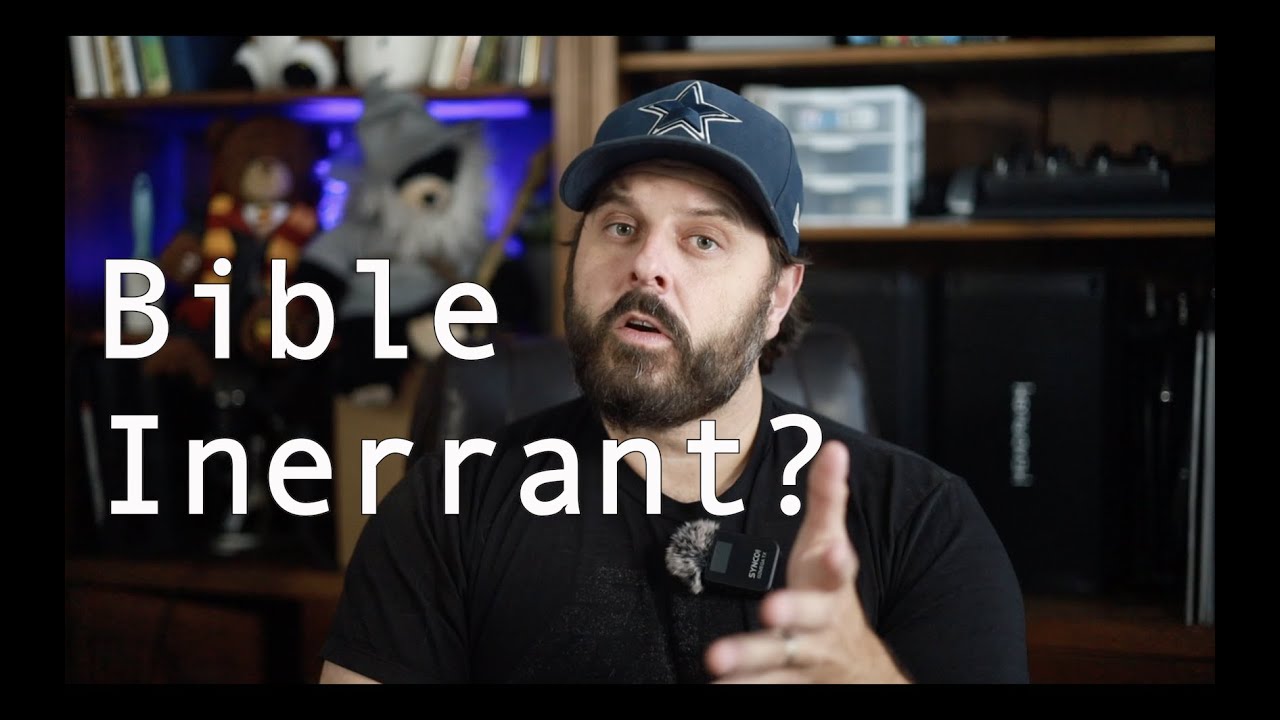
Is the Bible REALLY Inerrant?
Автор: Rev Dr Adam Smith
Загружено: 2026-01-16
Просмотров: 48
How Christians read, engage, and understand the bible shapes their politics, the communities they live in, and the values they adopt. Biblical inerrancy which states that the bible is without error (historical, scientific, theological, etc.) is a doctrine that undergirds how many Christians approach scripture. But what if this doctrine turns the bible into something it was never meant to be?
Several things to note:
There is no ONE canon of the bible that all Christians adhere to. You have the Catholic bible with the Apocrypha, the Eastern Orthodox Bible, the Protestant bible, the Ethiopian Orthodox, and various others. When I mention a finalized canon being established in the 4th and 5th centuries, this should be taken into account.
There are different understandings of inerrancy: from plenary inerrancy (which I primarily speak against in the video [everything: history, science, etc. is error free]), critical inerrancy (uses critical methodologies to assess the accuracy of the Bible which may contain scientific errors, but is error free otherwise), limited inerrancy (affirms the Bible's inerrancy in matters of faith and practice, as well as in matters that can be empirically verified, but does not seek to harmonize every detail), functional inerrancy (emphasizes that the Bible's purpose is to bring people to salvation and growth in grace, and it is sufficient in factual matters to accomplish its purpose), and several others. You might say inerrancy can be viewed on a spectrum. When most apologists speak in support of inerrancy today, they often are speaking of the plenary view, reflected within the Chicago Statement on Biblical Inerrancy. This is the view that this primarily video addresses.
Inerrancy shouldn't assume univocality of the canon, but it often does for many contemporary apologists. In other words, inerrancy assumes there is one unifying voice or framework that harmonizes scripture. This is a theological imposition on the text that inherently changes it. It will necessarily ignore or diminish context, shift the author's original meaning, and force post biblical presuppositions and dogmas on the text. Understandably, univocality is attractive because it seeks to simply and harmonize the text, removing any tension, contradictions, or inconsistencies within the canon, but in doing so, it remakes the scriptures into something they were never meant to be.
For further reading check out:
"The Bible Tells Me So: Why Tell Me the Bible Is True?" or his other work, "The Sin of Certainty" by Peter Enns
"Jesus, Interrupted: Revealing the Hidden Contradictions in the Bible (And Why We Don't Know About Them)" and "Misquoting Jesus: The Story Behind Who Changed the Bible and Why" by Bart Ehrman
The book, "Five Views on Biblical Inerrancy" offers various understandings of inerrancy along the spectrum. One item to note from this resource is Peter Enns criticism of inerrancy and infallibility: in light of overwhelming scholarly consensus, discussion of scriptural veracity is pointless. This is a reality that the other contributors to the book have not answer to.
In the video, I referenced, N.T. Wright's book, "Scripture and the Authority of God: How to Read the Bible Today." Wright's view of inerrancy would fall somewhere on the spectrum of inerrant understandings and away from plenary inerrancy.
For a more detailed look into the Greek term 'theopneustos,' often translated as 'inspired,' check out John C. Poirier's book, "The Invention of the Inspired Text: Philological Windows on the Theopneustia of Scripture."
Доступные форматы для скачивания:
Скачать видео mp4
-
Информация по загрузке:


![CO ROSJANIE MYŚLĄ O POLAKACH - DUMA I UPRZEDZENIE? [SKWIECIŃSKI I BOJKE]](https://imager.clipsaver.ru/XSQhVjgtP9A/max.jpg)