Understanding numpy Array Subtraction: The Overflow Issue Explained
Автор: vlogize
Загружено: 2025-09-07
Просмотров: 2
Discover why subtracting `numpy` arrays can lead to unexpected results, particularly focusing on overflow errors in unsigned integer types.
---
This video is based on the question https://stackoverflow.com/q/63278181/ asked by the user 'cs0815' ( https://stackoverflow.com/u/283538/ ) and on the answer https://stackoverflow.com/a/63286362/ provided by the user 'David Hoffman' ( https://stackoverflow.com/u/5030014/ ) at 'Stack Overflow' website. Thanks to these great users and Stackexchange community for their contributions.
Visit these links for original content and any more details, such as alternate solutions, latest updates/developments on topic, comments, revision history etc. For example, the original title of the Question was: Subtracting numpy arrays produces unexpected results
Also, Content (except music) licensed under CC BY-SA https://meta.stackexchange.com/help/l...
The original Question post is licensed under the 'CC BY-SA 4.0' ( https://creativecommons.org/licenses/... ) license, and the original Answer post is licensed under the 'CC BY-SA 4.0' ( https://creativecommons.org/licenses/... ) license.
If anything seems off to you, please feel free to write me at vlogize [AT] gmail [DOT] com.
---
Understanding numpy Array Subtraction: The Overflow Issue Explained
When working with numpy arrays, you may encounter unexpected results during subtraction, especially when using certain data types. This is not uncommon, but grasping the underlying reasons can help you avoid pitfalls in your calculations. In this guide, we'll examine the issue in detail, breaking it down into organized sections for clarity.
The Problem: Unexpected Results in Array Subtraction
Consider the following code snippet that demonstrates the subtraction of two arrays:
[[See Video to Reveal this Text or Code Snippet]]
In this example, the results appear as expected. The subtraction of v1 from v2 yields [5, 0, 0], while the reverse operation yields [-5, 0, 0].
However, when we switch to a more complex structure involving uint8 data types, the issues begin:
[[See Video to Reveal this Text or Code Snippet]]
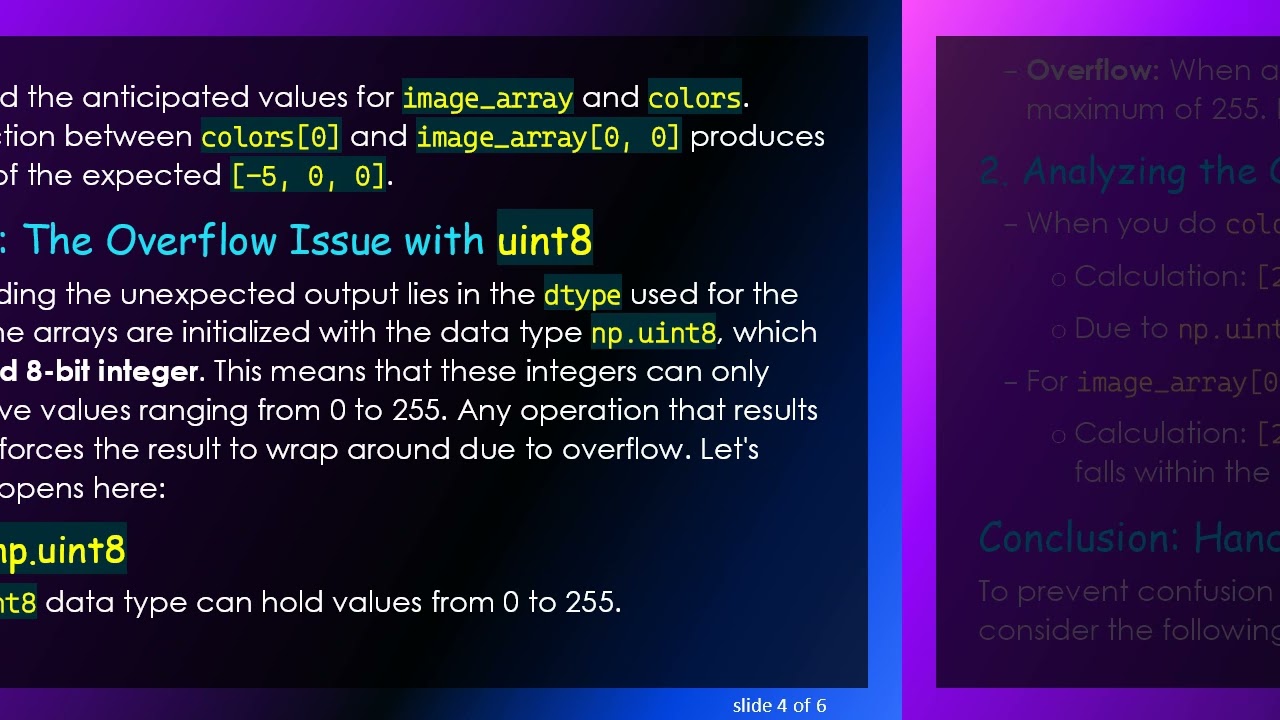
The first two prints yield the anticipated values for image_array and colors. However, the subtraction between colors[0] and image_array[0, 0] produces [251, 0, 0] instead of the expected [-5, 0, 0].
The Explanation: The Overflow Issue with uint8
The key to understanding the unexpected output lies in the dtype used for the arrays. In this code, the arrays are initialized with the data type np.uint8, which stands for an unsigned 8-bit integer. This means that these integers can only represent non-negative values ranging from 0 to 255. Any operation that results in a number below 0 forces the result to wrap around due to overflow. Let's break down what happens here:
1. The nature of np.uint8
Range: The np.uint8 data type can hold values from 0 to 255.
Overflow: When a calculation goes below 0, the value wraps around to the maximum of 255. For example, -5 becomes 255 - 4 = 251 due to overflow.
2. Analyzing the Output
When you do colors[0] - image_array[0, 0]:
Calculation: [250, 0, 0] - [255, 0, 0] results in [-5, 0, 0]
Due to np.uint8, this becomes [251, 0, 0] because of overflow.
For image_array[0, 0] - colors[0]:
Calculation: [255, 0, 0] - [250, 0, 0] produces proper results and falls within the valid range.
Conclusion: Handling uint8 and Subtraction
To prevent confusion and ensure your calculations behave as expected, consider the following best practices:
Use a larger integer type: If you expect negative results, use np.int32 or a similar data type that can handle negative numbers.
Understand data types: Being mindful of the behavior of different data types in numpy can significantly enhance your coding experience and accuracy in calculations.
Error checking: Implement checks after array operations to identify unexpected values.
By understanding the nuances of numpy array arithmetic, you can prevent encountering such unexpected results. Happy coding!
Доступные форматы для скачивания:
Скачать видео mp4
-
Информация по загрузке: