Geochemical Fingerprinting of the Earth's Oldest Rocks
Автор: Virtual Seminars in Precambrian Geology
Загружено: 2026-01-22
Просмотров: 49
Geochemical Fingerprinting of the Earth's Oldest Rocks
Julian Pearce
Cardiff University
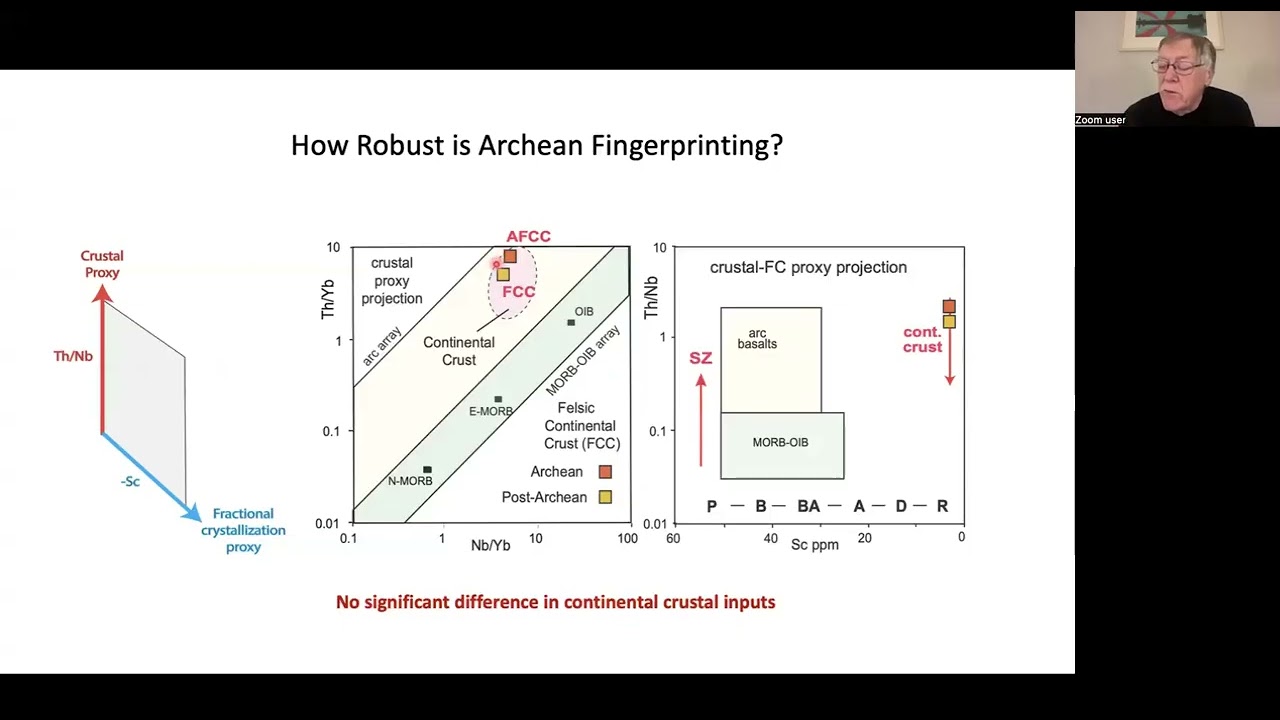
One of the most contentious questions in geology remains that of whether plate tectonics operated in the Archean and, if so, whether it was continuous and how it differed from present day plate tectonics. One of the few ‘smoking guns’ available to ground-truth the various Archean global tectonic models is the nature and composition of the magmatic rocks, which make up a significant proportion of the small preserved and accessible volume of Archean crust. This talk will focus on the search for volcanic arcs (a key plate tectonic indicator) using proxy-based geochemical fingerprinting methodologies. Here, Th/Nb (a crustal proxy) is used to highlight subduction-enrichment, Sc (a fractionation proxy) is used in combination with Th/Nb to distinguish subduction from crustal assimilation, and Cs/Nb (a mobility proxy) is used, again in combination with Th/Nb, to distinguish subduction from the high-grade metamorphic mobilization of Th found in many of the oldest volcanic rocks. Geochemical modelling is used to test non-uniformitarian hypotheses, and geological constraints are incorporated into fingerprinting decisions. The results provide evidence for significant subduction-enrichment in the source of many Archean volcanic rocks but with only a small proportion being due to ‘active’ subduction in a volcanic arc, the rest being inherited. An episodic model best fits the data, post 3.2 Ga at least, whereby the mantle metasomatism associated with rare ‘active’ subduction events is reactivated many times over long periods by subsequent extension and/or plume activity.
Доступные форматы для скачивания:
Скачать видео mp4
-
Информация по загрузке: