Mass, Weight, and Gravity Concepts base video-1
Автор: MDCAT with. Dr sheen
Загружено: 2026-01-10
Просмотров: 2
Mass, Weight, and Gravity
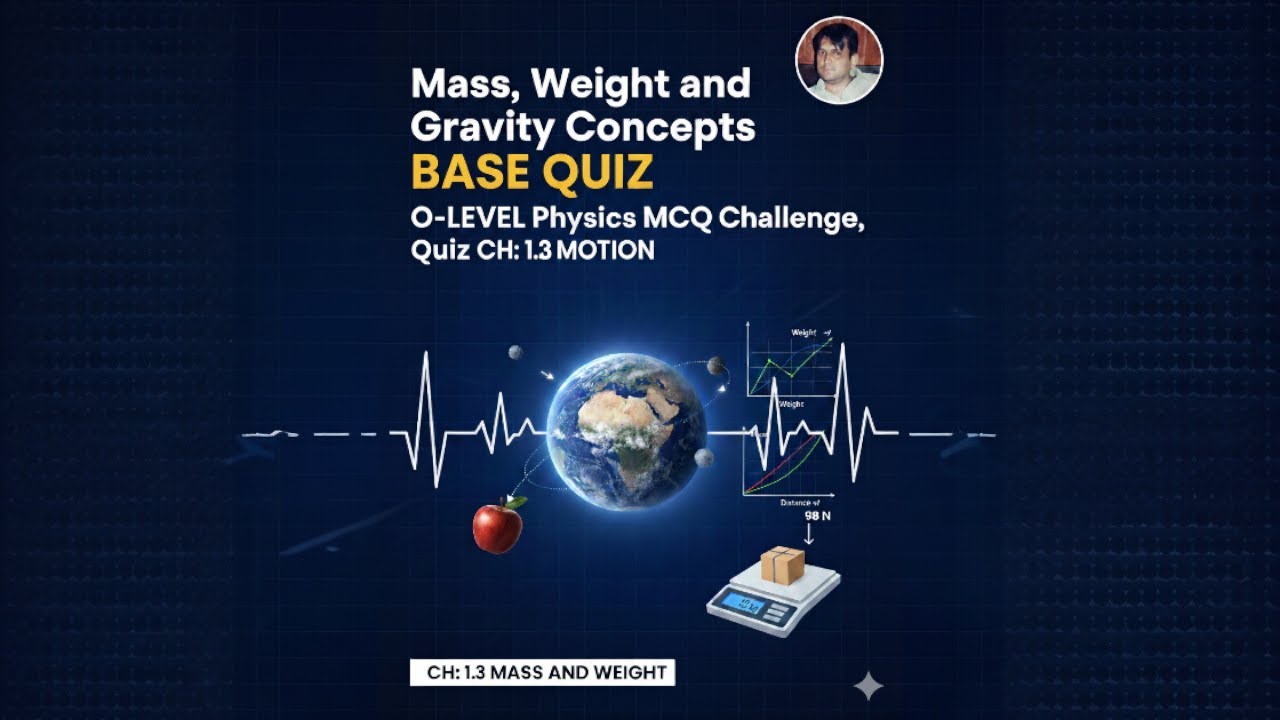
Mass is the amount of matter in an object. It is a measure of how much “stuff” is in a body and does not change with location. The standard unit of mass is the kilogram (kg). Mass resists changes in its motion, a property called inertia. This means an object at rest stays at rest, and a moving object keeps moving unless acted on by a force.
Weight is the effect of a gravitational field on mass. It is the gravitational force that pulls an object towards a planet or moon. Weight depends on both the mass of the object and the strength of gravity. Unlike mass, weight changes with location. For example, an object weighs less on the Moon because the Moon’s gravity is weaker than Earth’s, though its mass remains the same.
Gravitational field strength is the acceleration experienced by an object in free fall and determines how heavy an object feels. Weight is a vector quantity, meaning it has both magnitude and direction (towards the center of the planet). Mass can be measured using a balance, while weight can be measured using a force meter.
On Earth, a 1 kg mass has a weight of about 9.8 N (often approximated as 10 N). The weight of objects varies slightly across the Earth because it is not a perfect sphere—gravity is stronger at the poles than at the equator.
In summary, mass measures matter, weight measures the gravitational pull on that matter, and inertia describes resistance to motion. This explains why astronauts on the Moon bounce while walking—their mass is the same, but weight is less due to weaker gravity.
Доступные форматы для скачивания:
Скачать видео mp4
-
Информация по загрузке: