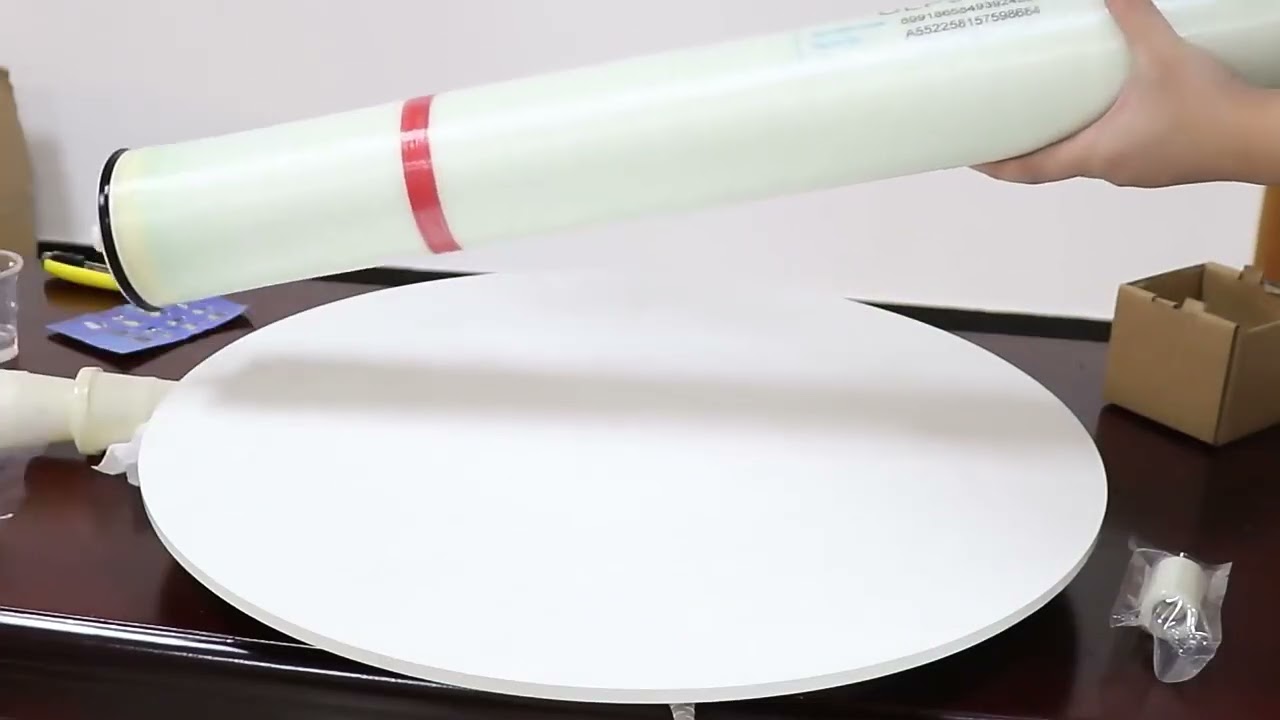
What is a reverse osmosis membrane?
Автор: DoBestFilters-Lily zhu
Загружено: 2026-01-13
Просмотров: 10
Reverse osmosis (RO) membrane is a selectively permeable semipermeable membrane that allows water molecules to pass through under pressure, while retaining most dissolved salts, organic matter, colloids, bacteria, and other impurities, thus achieving water purification and desalination.
1) What it is (Materials and Structure)
Materials: Commonly *polyamide (PA)* aromatic composite membranes (currently the most mainstream), also cellulose acetate (CA), etc.
Structure: Usually a "composite membrane," composed of multiple layers:
Ultra-thin active layer (separation layer): Determines retention rate and flux, very thin (nanometer scale).
Porous support layer: Provides mechanical strength and channels.
Non-woven fabric base layer: Enhances overall strength.
Form: Spiral-wound (most common, used for brackish water/seawater desalination, pure water), hollow fiber, plate type, etc.
2) Its Core Function: Separation and Purification
Under sufficient feed water pressure, water molecules pass through the membrane to form permeate water (product water/pure water); salts and most pollutants are retained to form concentrate water (wastewater/brine).
Main functions include:
Desalination/TDS reduction: Removal of dissolved salts (Ca²⁺, Mg²⁺, Na⁺, Cl⁻, etc.).
Removal of organic matter: Retention of most small molecule organic matter (depending on molecular weight and membrane type).
Removal of particles/colloids: Reduction of turbidity and suspended solids.
Removal of microorganisms: Bacteria and viruses are largely retained (but usually still requires disinfection and pretreatment as a safety barrier).
Reduction of hardness and scaling ions: Reduces the risk of scaling from CaCO₃, CaSO₄, BaSO₄, SrSO₄, etc. (scaling prevention measures are still needed).
3) Details of the Working Principle (Why it can "only let water through")
Reverse osmosis is not simple filtration, but closer to a "dissolution-diffusion" or "preferential adsorption-capillary flow" mechanism:
Selectivity: The membrane has a higher affinity for water and a lower affinity for salt ions/organic matter.
Pressure-driven: Pressure must be applied to overcome osmotic pressure to allow water to continuously pass through.
The higher the salinity of the feed water, the greater the pressure required (seawater desalination requires much higher pressure than brackish water). Retention Mechanisms:
1) Size exclusion: Pore size effect (but RO membranes are not as simple as a "sieve" concept).
2) Charge repulsion (common in polyamide membranes): Stronger repulsion of charged ions.
3) Adsorption/diffusion differences: Water and solutes diffuse at different rates within the membrane.
4) Key Performance Indicators (what you care about most when selecting/operating):
Desalination rate/Rejection rate: Commonly expressed as "desalination rate %," e.g., 99.5% (higher means stricter, but flux often decreases and costs increase).
Water production/Flux: Water production per unit area (e.g., m³/h・m² or gfd). High flux may lead to faster fouling/scaling.
Operating pressure: Related to influent TDS, temperature, and membrane type.
Recovery rate: Water production/influent flow rate. Higher recovery rate means more concentrated brine, making scaling and fouling more likely.
Tolerance indicators: pH range, maximum temperature, chlorine/oxidant tolerance, anti-fouling ability, etc.
5) "Details" in Operation (determining lifespan and effectiveness):
Pre-treatment is crucial: RO membranes are very susceptible to fouling.
Suspended solids/colloids → will clog the membrane (SDI/turbidity must be controlled).
Hardness/scaling ions → will cause scaling (requires scale inhibitors or softening/acid addition, etc.).
Residual chlorine/oxidants → will oxidize and degrade polyamide membranes (usually requires activated carbon/sodium bisulfite for removal).
Brine side must have flow: Cannot be "pressure-locked," otherwise it can easily damage the membrane and accelerate scaling.
Cleaning (CIP): Fouling will manifest as increased pressure difference, decreased flux, and decreased desalination rate; requires cleaning with acid/alkali/enzyme formulations to restore performance.
Temperature effect: As temperature increases, flux usually increases and viscosity decreases; however, the membrane's temperature limit must also be considered.
6) Common Applications:
Industrial pure water/ultrapure water (electronics, pharmaceuticals, boiler feedwater)
Drinking water purification, brackish water desalination
Seawater desalination
Wastewater reuse, material concentration (some scenarios)
Доступные форматы для скачивания:
Скачать видео mp4
-
Информация по загрузке: