Running a Java GUI Application in Docker: A Step-by-Step Guide to Success
Автор: vlogize
Загружено: 2025-08-12
Просмотров: 12
Learn how to run your Java GUI application using Swing and Frame as a Docker image effortlessly! This guide covers everything from setting up your Dockerfile to overcoming common issues.
---
This video is based on the question https://stackoverflow.com/q/65117987/ asked by the user 'Daniel Coyle' ( https://stackoverflow.com/u/14752530/ ) and on the answer https://stackoverflow.com/a/65145854/ provided by the user 'Daniel Coyle' ( https://stackoverflow.com/u/14752530/ ) at 'Stack Overflow' website. Thanks to these great users and Stackexchange community for their contributions.
Visit these links for original content and any more details, such as alternate solutions, latest updates/developments on topic, comments, revision history etc. For example, the original title of the Question was: Trying to get a Java GUI application using Swing and Frame to run as a docker image
Also, Content (except music) licensed under CC BY-SA https://meta.stackexchange.com/help/l...
The original Question post is licensed under the 'CC BY-SA 4.0' ( https://creativecommons.org/licenses/... ) license, and the original Answer post is licensed under the 'CC BY-SA 4.0' ( https://creativecommons.org/licenses/... ) license.
If anything seems off to you, please feel free to write me at vlogize [AT] gmail [DOT] com.
---
Running a Java GUI Application in Docker: A Step-by-Step Guide to Success
Java is a powerful programming language, and with its Swing and AWT libraries, creating graphical user interfaces (GUIs) can be quite seamless. However, running a Java GUI application as a Docker image may not be as straightforward. In this guide, we’ll discuss common challenges faced when attempting to dockerize a Java GUI application, specifically around connecting to an X11 window server, and we will provide a detailed solution.
The Problem
Imagine you have developed a collaborative whiteboard application in Java, which runs perfectly on your local machine. The application uses socket programming over port 8888, and everything is in place. You decide to containerize this application using Docker for better portability, but you encounter the following error when trying to run your Docker image:
[[See Video to Reveal this Text or Code Snippet]]
This error suggests that the Java application cannot connect to the graphical display needed to render the GUI, causing frustration for many developers who are new to both Java and Docker.
The Solution: Step by Step
Initial Setup
In the beginning, you might have created a Dockerfile similar to the following:
[[See Video to Reveal this Text or Code Snippet]]
This file sets the base image, defines the working directory, copies the JAR file, exposes the necessary port, and attempts to execute the application.
Update the Dockerfile
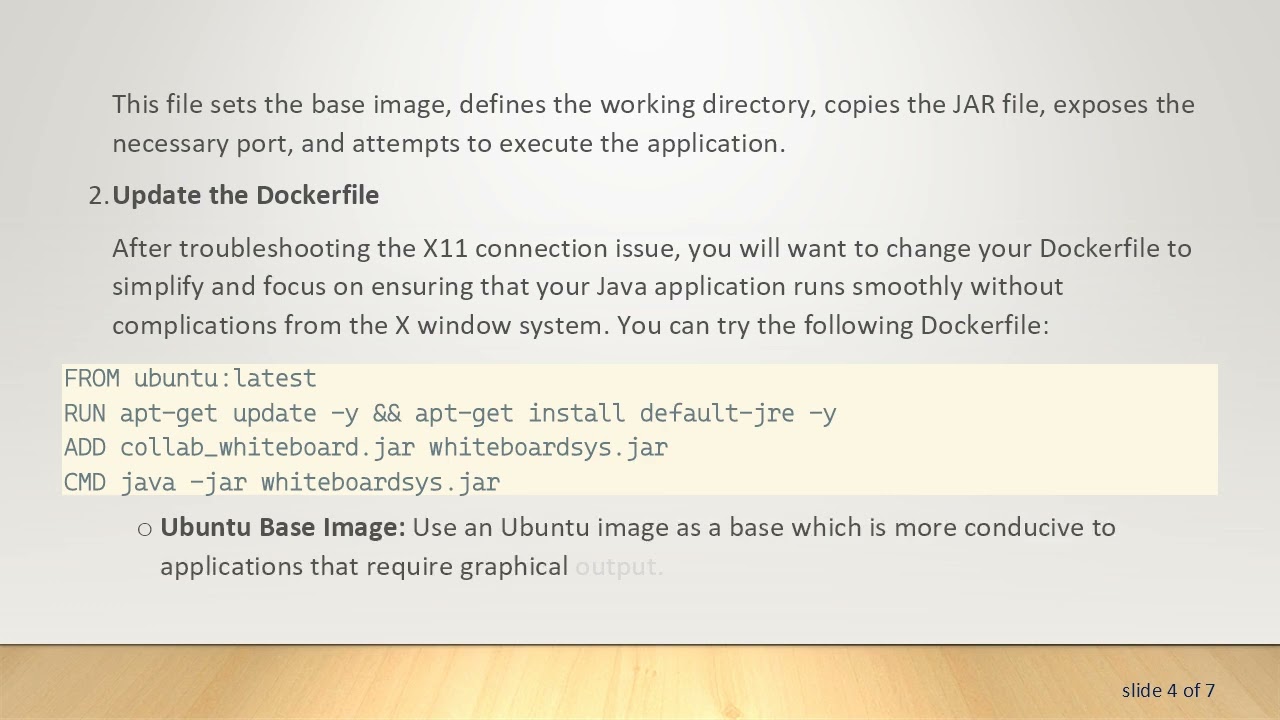
After troubleshooting the X11 connection issue, you will want to change your Dockerfile to simplify and focus on ensuring that your Java application runs smoothly without complications from the X window system. You can try the following Dockerfile:
[[See Video to Reveal this Text or Code Snippet]]
Ubuntu Base Image: Use an Ubuntu image as a base which is more conducive to applications that require graphical output.
Install Java Runtime: Installs the default Java Runtime Environment (JRE) which is necessary to execute your Java application.
Add Your JAR File: The ADD command ensures that your JAR file is included in the container.
Build and Run the Docker Image
After updating your Dockerfile, you can build your Docker image with the following command:
[[See Video to Reveal this Text or Code Snippet]]
Next, run the Docker container:
[[See Video to Reveal this Text or Code Snippet]]
Granting Access to X11
If you still face issues related to the DISPLAY environment variable and X server access, consider using the following command to run your container with X11 support:
[[See Video to Reveal this Text or Code Snippet]]
This grants your Docker container access to your X server, allowing it to display the GUI correctly.
Troubleshooting Common Errors
AWT Errors: If you run into any AWT related errors, make sure the DISPLAY variable is properly configured and that X11 forwarding is enabled.
Null Pointer Exceptions: These can occur due to issues in font configuration or missing font files in the Docker container. Ensure that you have all necessary font files available in your image.
Conclusion
Creating a Docker image for a Java GUI application can be tricky, especially with graphical components involved. However, by utilizing the right base image, properly configuring your Dockerfile, and guaranteeing access to the X server, you can successfully dockerize your Java applications.
By following the steps laid out in this guide, you should be well on your way to running your Java GUI application in a Docker container. Remember, each problem you encounter is a learning opportunity in your journey of mastering Docker and Java!
Доступные форматы для скачивания:
Скачать видео mp4
-
Информация по загрузке:


![Курс Python с Абсолютного нуля! [12 часов из 80] Python курс - качественный старт для начинающих!](https://image.4k-video.ru/id-video/lYMLLI-MJek)


![Python - Полный Курс по Python [15 ЧАСОВ]](https://image.4k-video.ru/id-video/cfJrtx-k96U)