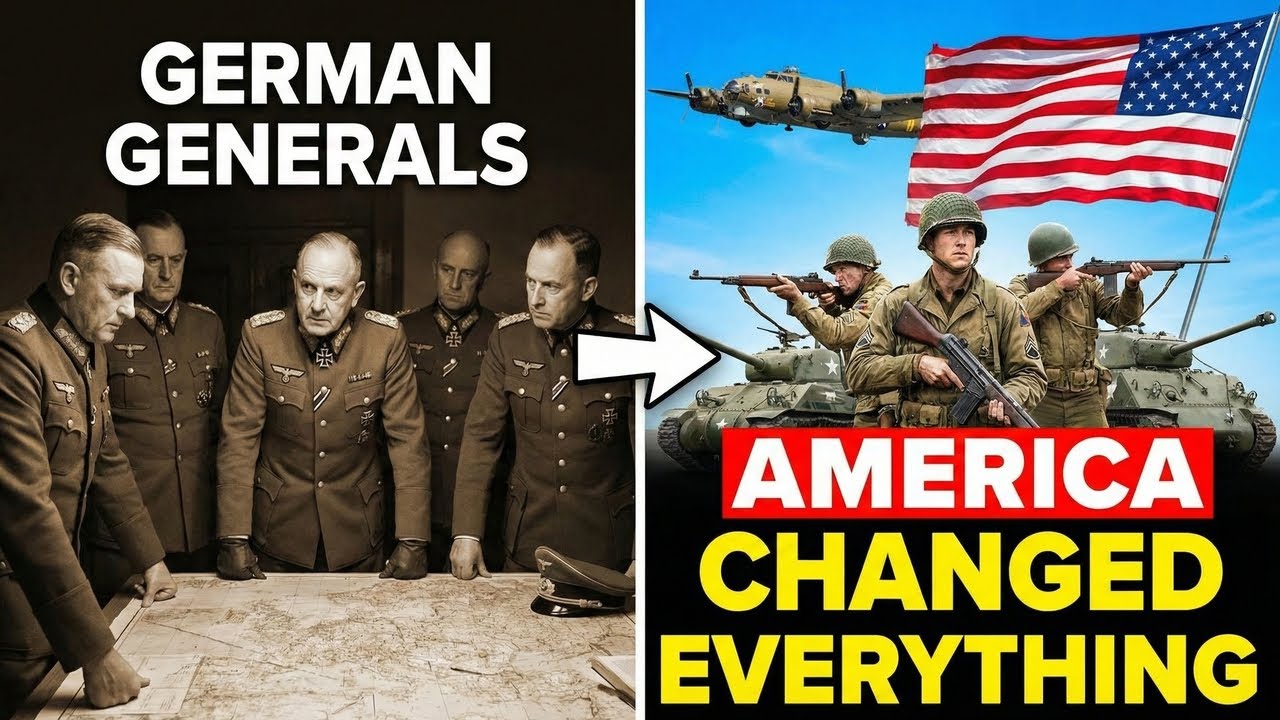
When German Generals Realized America Changed Everything | WW2 Story
Автор: WW2 STORY
Загружено: 2026-01-18
Просмотров: 335
This comprehensive historical narrative chronicles the moment when German military leadership confronted the undeniable reality that American entry into World War II had fundamentally transformed the conflict from one they might win through tactical excellence into one they could not possibly win due to overwhelming material disadvantage. Beginning with an intelligence briefing at OKH headquarters on December 12, 1941—just five days after Pearl Harbor and four days after Hitler's declaration of war on the United States—the story follows multiple German commanders as they realized, through different experiences and at different times, that America had changed everything.
The narrative opens with General Franz Halder, Chief of the General Staff, listening to economic officers present updated assessments of American industrial capacity. The numbers were staggering: the United States produced 60 million tons of steel annually—more than Germany, Britain, and the Soviet Union combined. American automobile factories could be converted to produce tanks and trucks at scales that made European production appear artisanal. Oil production comparisons were almost absurd: America pumped more petroleum in weeks than Germany produced in a year. Field Marshal Walther von Brauchitsch listened with the expression of a man watching disaster unfold, understanding that Germany was already stretched fighting Britain and the Soviet Union, and Hitler had just added an enemy whose industrial base alone outproduced the entire Axis.
Through the perspectives of General Georg Thomas, whose War Economy and Armaments Office had warned for years about resource constraints, the story explores how pessimistic pre-war assessments were suddenly validated in the worst possible way. Thomas had calculated that Germany could not sustain prolonged conflict against major industrial powers, had argued against invading the Soviet Union on economic grounds, and had been dismissed or ignored. Now, with America formally joining Germany's enemies, the economic impossibility of Axis victory was becoming undeniable even to the most optimistic officers.
The narrative follows multiple commanders confronting American impact through direct experience. Field Marshal Erwin Rommel in North Africa watched American tanks, trucks, and aircraft arrive in Egypt in growing numbers, his Afrika Korps facing increasing material superiority in every engagement. General Friedrich Paulus on the Eastern Front received reports of Soviet forces increasingly equipped with American Lend-Lease supplies—trucks, jeeps, aviation fuel, communication equipment—enabling the Red Army to focus industrial production on tanks and artillery while America provided logistical support.
Admiral Erich Raeder and Admiral Karl Dönitz understood immediately what American entry meant for the Battle of the Atlantic. The U-boat campaign that had been gradually succeeding now faced American destroyer escorts, American aircraft, and American shipbuilding replacing losses faster than submarines could sink them. The production race between building submarines and merchant ships had shifted decisively against Germany—calculations showed needing to sink 700,000 tons monthly just to match American construction, a figure exceeding German capacity even under optimal conditions.
The story explores General Heinz Guderian's realization through production statistics: German tank production for 1942 totaled approximately 6,000 vehicles, American production exceeded 25,000, British added 8,000, and Soviet production—despite losing major industrial areas—remained around 24,000. The Axis powers combined could not match Allied tank production, and the gap would widen annually as American factories reached full capacity.
Доступные форматы для скачивания:
Скачать видео mp4
-
Информация по загрузке: