How to Handle Browser Autofill in Your Ionic/React App
Автор: vlogize
Загружено: 2025-09-24
Просмотров: 0
Learn effective solutions to Capture values from user input when autofilled by browsers in your Ionic React applications. Let's solve your login issues!
---
This video is based on the question https://stackoverflow.com/q/60608505/ asked by the user 'Hani Honey' ( https://stackoverflow.com/u/661078/ ) and on the answer https://stackoverflow.com/a/62632871/ provided by the user 'johan' ( https://stackoverflow.com/u/1547504/ ) at 'Stack Overflow' website. Thanks to these great users and Stackexchange community for their contributions.
Visit these links for original content and any more details, such as alternate solutions, latest updates/developments on topic, comments, revision history etc. For example, the original title of the Question was: Ionic/React - How to get value from input item when it is auto-filled by the browser?
Also, Content (except music) licensed under CC BY-SA https://meta.stackexchange.com/help/l...
The original Question post is licensed under the 'CC BY-SA 4.0' ( https://creativecommons.org/licenses/... ) license, and the original Answer post is licensed under the 'CC BY-SA 4.0' ( https://creativecommons.org/licenses/... ) license.
If anything seems off to you, please feel free to write me at vlogize [AT] gmail [DOT] com.
---
Handling Browser Autofill in Ionic/React Applications
When building authentication features in your Ionic/React app, you may encounter a frustrating problem: browser autofill. Users expect their saved credentials to fill automatically, but unfortunately, this functionality often does not trigger the designated input events in your React components. This can leave you with blank fields in your state and issues during user login. This guide will delve into the problem and present an elegant solution, ensuring that your user experience remains seamless.
Understanding the Issue
When an input field in an Ionic/React app is autofilled by the browser, the onChange event that updates your component’s state may not be triggered. This means that if the user’s email or password is pre-filled, you won't capture that data. This can lead to scenarios where blank credentials are sent to your authentication backend and consequently, your users may face login issues.
Example Scenario
Consider this component structure for a login form:
[[See Video to Reveal this Text or Code Snippet]]
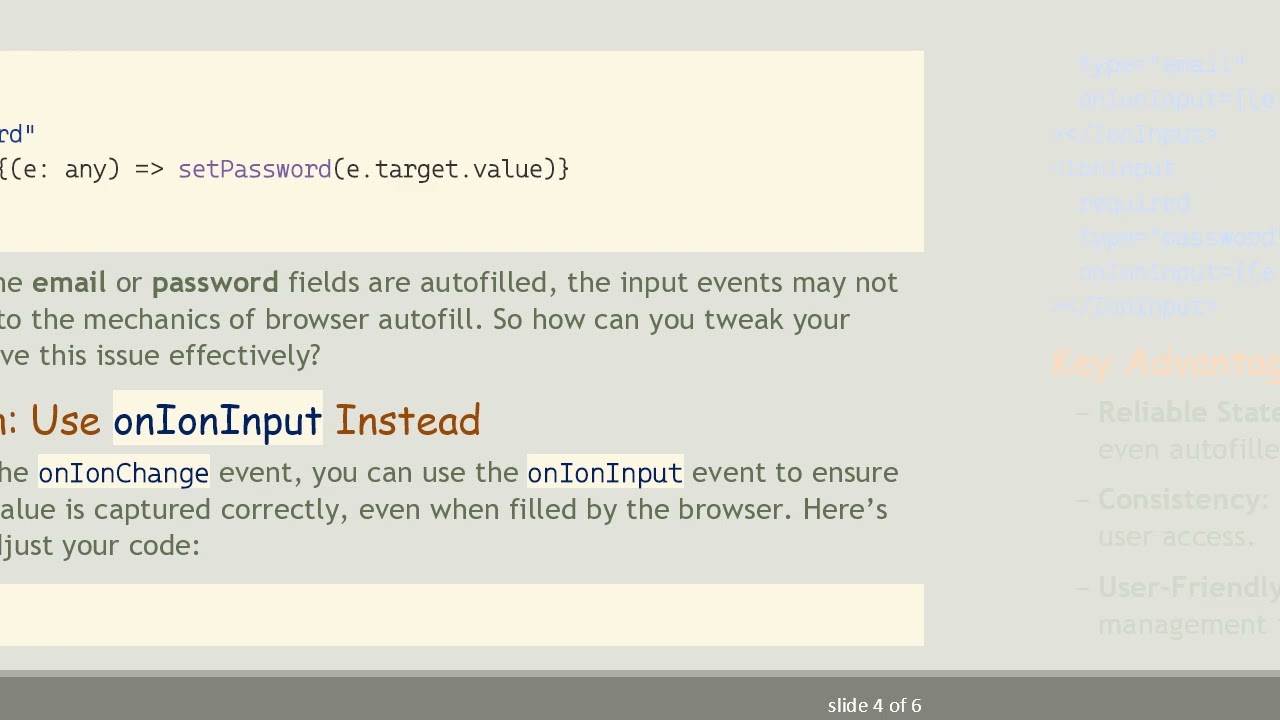
In this setup, if the email or password fields are autofilled, the input events may not be captured due to the mechanics of browser autofill. So how can you tweak your approach to resolve this issue effectively?
The Solution: Use onIonInput Instead
Instead of using the onIonChange event, you can use the onIonInput event to ensure that the input’s value is captured correctly, even when filled by the browser. Here’s how you might adjust your code:
[[See Video to Reveal this Text or Code Snippet]]
Key Advantages of onIonInput
Reliable State Updates: onIonInput triggers with every input event, ensuring that even autofilled values are captured.
Consistency: Your login and registration flow remains consistent, allowing smooth user access.
User-Friendly: Users will appreciate being able to utilize their browser's password management features effectively.
Conclusion
Handling autofill inputs in your Ionic/React app doesn’t have to be a hassle. By switching to onIonInput, you can effectively capture user credentials filled by the browser, ensuring that they are stored correctly in your component's state. This small change can lead to a far better user experience and efficient authentication flows.
By implementing this simple solution, you allow users to benefit from their browser’s convenience, while you maintain control over the data flow in your application. Happy coding!
Доступные форматы для скачивания:
Скачать видео mp4
-
Информация по загрузке:





![Python - Полный Курс по Python [15 ЧАСОВ]](https://image.4k-video.ru/id-video/cfJrtx-k96U)