#1 Hack for Better Melodies
Автор: Hack Music Theory
Загружено: 2021-07-01
Просмотров: 54564
Learn how to make better melodies with this game-changing hack!
►FREE Book: https://HackMusicTheory.com/Books
►Online Courses: https://HackMusicTheory.com/Courses
►Songwriting & Producing PDF: https://HackMusicTheory.com/Bestsellers
0:00 Introduction
1:17 The Hack: Explanation
1:56 The Hack: Example
3:09 The Fault
4:51 The Rule
6:58 The Example
7:26 The Djend
THE HACK
First, to clarify. A fault is not a mistake. A fault is a weakness. In other words, an area for improvement. So, how do you know if your melody has faults?
Easy, you use our Melody Test, which is simply to play your melody on the piano. Yes, it really is that simple. Because, by stripping away all the fancy sound design, you’re left with just the bare notes. This exposes any and all faults in your melody. Then after fixing them, you change the instrument back to your fancy sound, and now you have a melody that doesn’t just sound good, it actually is good!
Alright, so let’s run our example through the Melody Test and see what faults are exposed. And please note, it’s absolutely essential that you hear the melody in its harmonic context, so always play the root note of each chord in your progression below your melody. Our example is in the key of A minor, which is all the white notes from A to A, and the chords in our progression are: Am, Cmaj, Gmaj, Fmaj.
As you can tell, stripping away the fancy sound design removes all distractions and forces our ears to focus exclusively on the notes. We can now hear that our melody has a lot of good qualities already, like its contour, motifs, and rhythm. And by the way, rhythm is usually the most overlooked element of a melody, so be sure to pay extra attention to that. And if you need help, just use our Melody Rhythm Rule.
THE FAULT
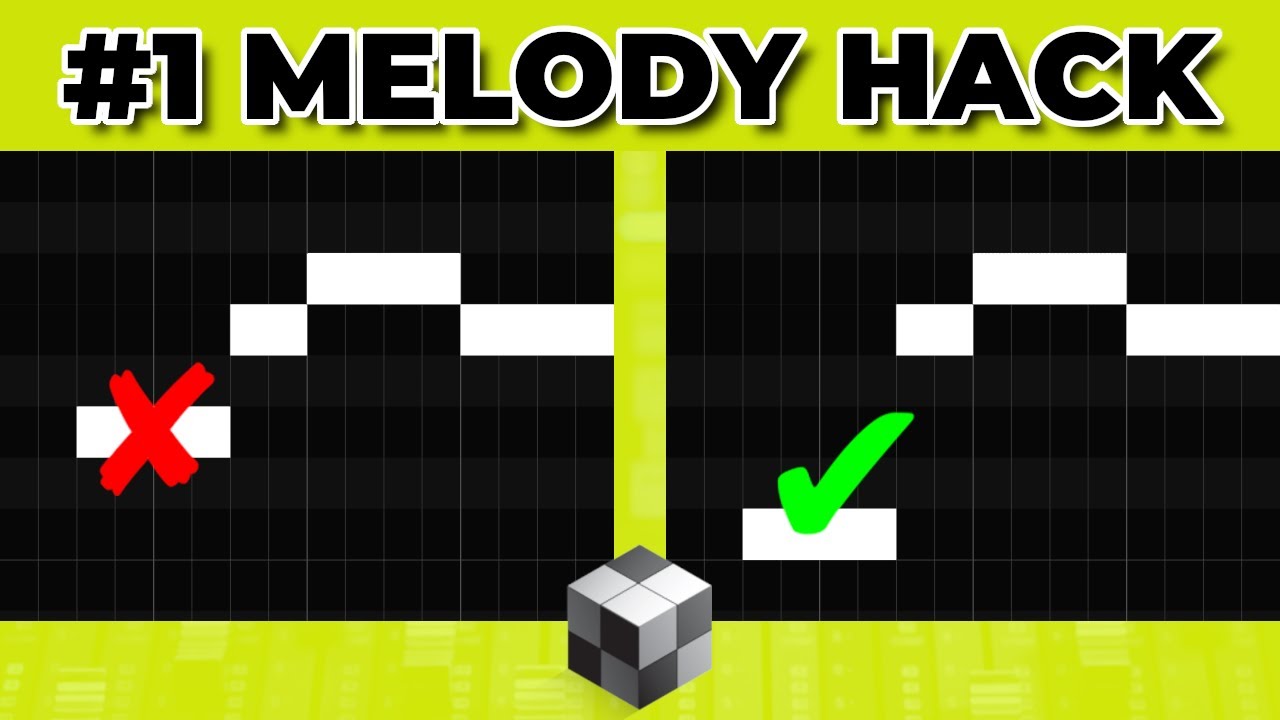
Okay that’s enough about the good qualities of our melody, let’s get to the fault. By using the Melody Test, we can now clearly hear (and feel) our melody’s fault. What is it? Our melody is lacking emotion! So, how do you add emotion to a melody? Easy, you use the 3rd note of each chord. You see, the 3rd note is the magic note that actually creates the happy sound in a major chord and the sad sound in a minor chord, so by playing 3rds in your melody, you strengthen it by emphasizing that emotional power!
For example, in our first chord, Am, the 3rd note is C, which we’re not playing. So, by simply moving the D (4) down to C (♭3), we emphasize the sadness of that underlying minor chord. Next, we added 3rds into our melody over the Cmaj and Gmaj chords as well, which emphasizes the uplifting nature of those major chords. In this melody, we felt that it would be “too much of a good thing” to emphasize the happiness of three major chords in a row, so we didn’t use the 3rd (A) in our melody over Fmaj. This neutral approach of not using the 3rd in our melody slightly dilutes the uplifting nature of that underlying major chord.
THE RULE
And that is a really important lesson. So important, in fact, that it’s part of our crucial 3rds Melody Rule, which is: In your melodies, use a 3rd to emphasize a major chord’s happiness or a minor chord’s sadness, and avoid using a 3rd when you want to dilute the underlying chord’s emotion.
It goes without saying that every note has an emotion, not just the 3rd. But, not all notes have the same level of emotional power, and the note that pulls at our heartstrings the most, is the 3rd. Remember though, a good melody must have a wide variety of notes, because a melody consisting of only 3rds may be strong in terms of its emotional power, but it will be utterly mind-numbingly boring!
Lastly, this test is super useful for all the other layers of your music too, which is why we also refer to it as the Piano Test. For example, if you want to know if your bass line has any faults, simply change the sound on your bass track to a piano, then solo it up and hit play. Once again, by stripping away the fancy sound design, you’re left with only the bare notes, which exposes any and all faults in your bass line. Then after you’ve fixed those faults, just change the sound back, and now you have a bass line that doesn’t just sound good, it actually is good!
---
ABOUT
Hack Music Theory is the fast, easy and fun way to make music. Taught by award-winning music lecturer Ray Harmony, and his protégé wife Kate. Ray has been teaching music theory for 25 years, and along the way he's made music with Serj Tankian (System Of A Down), Tom Morello (Rage Against The Machine), and many more!
COPYRIGHT & CREDITS
© 2021 Revolution Harmony
Revolution Harmony is Ray Harmony & Kate Harmony
Script & all music in video by Revolution Harmony
Book promo filmed & edited by Maurits Nienhuis
All stock footage courtesy of Pexels
Доступные форматы для скачивания:
Скачать видео mp4
-
Информация по загрузке: