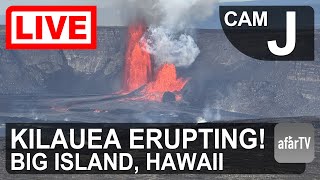
A Sacred Hawaiian Peak. Is Mauna Kea Really Earth's Tallest Mountain? Hiking to the Peak. 🌄✨
Автор: Roamapf
Загружено: 2025-10-04
Просмотров: 29
A Sacred Hawaiian Peak. Is Mauna Kea Really Earth's Tallest Mountain? Hiking to the Peak. 🌄✨
Introduction
HAWAIIAN VOLCANO OBSERVATORY MONTHLY UPDATE
USGS
Thursday, October 2, 2025, 8:14 AM HST
MAUNA KEA (VNUM #332030)
19°49'12" N 155°28'12" W, Summit Elevation 13802 ft (4207 m)
Current Volcano Alert Level: NORMAL
Current Aviation Color Code: GREEN
No significant activity was detected at Mauna Kea volcano during the past month. Seismic activity remained low, and was representative of background activity levels at the volcano; all earthquakes were of small magnitudes (below M2.0).
Background: Mauna Kea is a shield volcano in the post-shield stage; it last erupted about 4,600 years ago. Monitoring is conducted by one GPS instrument and three seismometers on the volcano, plus instruments on adjacent Kohala volcano and denser geodetic and seismic networks on the north flank of Mauna Loa volcano to the south. With a summit at 13,803 feet above sea level, Mauna Kea is the tallest mountain in the State of Hawaii, and it is the tallest mountain on Earth when measured from its base on the ocean floor.
The U.S. Geological Survey (USGS) monitors Mauna Kea through its Hawaiian Volcano Observatory (HVO), though the volcano is currently dormant. Its last eruption occurred approximately 4,500 years ago, and its long quiet periods stand in contrast to Hawaii's more active volcanoes like Kīlauea and Mauna Loa.
Key geological and monitoring facts
Volcanic state: Mauna Kea is a post-shield stage volcano, meaning its most vigorous eruptive period has passed. It is considered dormant but not extinct, as it will likely erupt again in the distant future.
Size: Measured from its base on the ocean floor, Mauna Kea is Earth's tallest mountain, rising over 33,500 feet.
Geologic history:
Hamakua Volcanics: Between 200,000 and 65,000 years ago, the volcano erupted mainly basaltic lavas.
Laupahoehoe Volcanics: From 65,000 to 4,500 years ago, cooler and thicker lavas were erupted. Since this period, the volcano has been quiet.
Glacial activity: Due to its height, Mauna Kea was once capped by glaciers during colder climatic periods. Glacial deposits are still visible near its summit.
For Native Hawaiians, Mauna Kea is a deeply sacred place with profound spiritual significance. Revered in Hawaiian traditions, it is considered a home to gods, a domain of powerful deities, and a living ancestor. The spiritual aspects of the mountain are inseparable from Native Hawaiian history, cosmology, and identity.
Piko of Hawaiʻi
Mauna Kea is known as the piko (navel or umbilical cord) of Hawaiʻi Island, symbolizing the origin point where life begins.
It is considered the firstborn son of Wākea (Sky Father) and Papa (Earth Mother), the progenitors of the Hawaiian people.
This connection establishes a genealogical link between the Hawaiian people and the land itself, making the mountain a living elder (kupuna) to be honored.
A sacred temple
The summit of Mauna Kea is regarded as the most sacred of all the volcanoes in Hawaiʻi and is considered a temple for the supreme being.
In ancient times, a kapu (sacred law) decreed that only the highest-ranking chiefs (aliʻi) and priests (kahuna) could journey to its summit for important ceremonies.
For practitioners, climbing the mountain is a spiritual journey. The higher one goes, the closer their heart is to the heavens, and the protocol is to listen rather than speak in the house of the creator (akua).
Deities of Mauna Kea
Several deities are associated with the mountain, reflecting its unique environment.
Poliʻahu: The goddess of snow, who resides on the summit and is responsible for its mantle of snow and ice.
Pele: The goddess of volcanoes, who is also a sister and rival to Poliʻahu. While Pele's power is displayed in the fire and lava of volcanoes like Mauna Loa and Kīlauea, Poliʻahu's realm is the cold and ice of Mauna Kea.
Other deities: The goddesses of fine mist (Līlīnoe) and subterranean water (Waiau) are also connected to the mountain.
Sacred Lake Waiau
Near the summit is Lake Waiau, a sacred site of deep cultural importance.
Its waters are associated with the god Kāne and are used for healing and ceremonies by cultural practitioners.
Traditionally, some Native Hawaiians brought their children's umbilical cords (piko) to be deposited at the lake.
Connection to the heavens
Mauna Kea's height makes it an ideal location for astronomy, a science that ancient Hawaiians practiced to navigate the seas and inform spiritual practices.
For many practitioners, this pursuit of knowledge from the cosmos is not separate from their spirituality. Their "knowledge-based" spiritual practice sees the gods and goddesses as scientific observations related to the mountain's environment and climate.
The conflict over the construction of more telescopes is seen by some Native Hawaiians not as being anti-science, but as protecting the land and spiritual beliefs from further desecration and colonial disregard.

Доступные форматы для скачивания:
Скачать видео mp4
-
Информация по загрузке: