Structured Concurrency in Java 21 : Why It Matters and How It Works
Автор: LearningFromExperience
Загружено: 2025-09-08
Просмотров: 185
🚀 Structured Concurrency in Java: Why It Matters & How to Use It 🚀
Traditional concurrency (a.k.a. unstructured concurrency) often leads to problems:
❌ Failures in one task don’t cancel others
❌ Parent task cancellations don’t propagate to subtasks
❌ Wasted time when slow or blocked tasks keep running
In this tutorial, I’ll show you *why structured concurrency is needed**, demonstrate these issues with code, and then walk through **Java’s StructuredTaskScope API* (introduced in Java 21 as a preview feature). You’ll see how it simplifies error handling, cancellation, and observability—all while making your concurrent Java code more reliable.
🎓 SPECIAL OFFER: Enroll in my complete Java Virtual Threads & Structured Concurrency with Spring Boot course on Udemy at a discount!
Course Link: https://www.udemy.com/course/java-vir...
👉 Explore all my courses with discount links:
https://j2eeexpert2015.github.io/lear...
🚨 WANT A COUPON CODE?
📢 Please request via email or Slack as early as possible!
📧 Email: j2eeexpert2015@gmail.com
💬 Slack: https://join.slack.com/t/learningfrom...
🎯 Discounts are not public — they're sent on request only. Act early!
WHAT YOU'LL LEARN IN THIS VIDEO:
✅ THE PROBLEM: Witness the chaos of "unstructured concurrency" firsthand. We'll demonstrate three common failure scenarios:
Failure in one subtask doesn't cancel the others.
Cancellation of a parent task doesn't propagate to its children.
A failing task combined with a slow task leads to massive resource and time wastage.
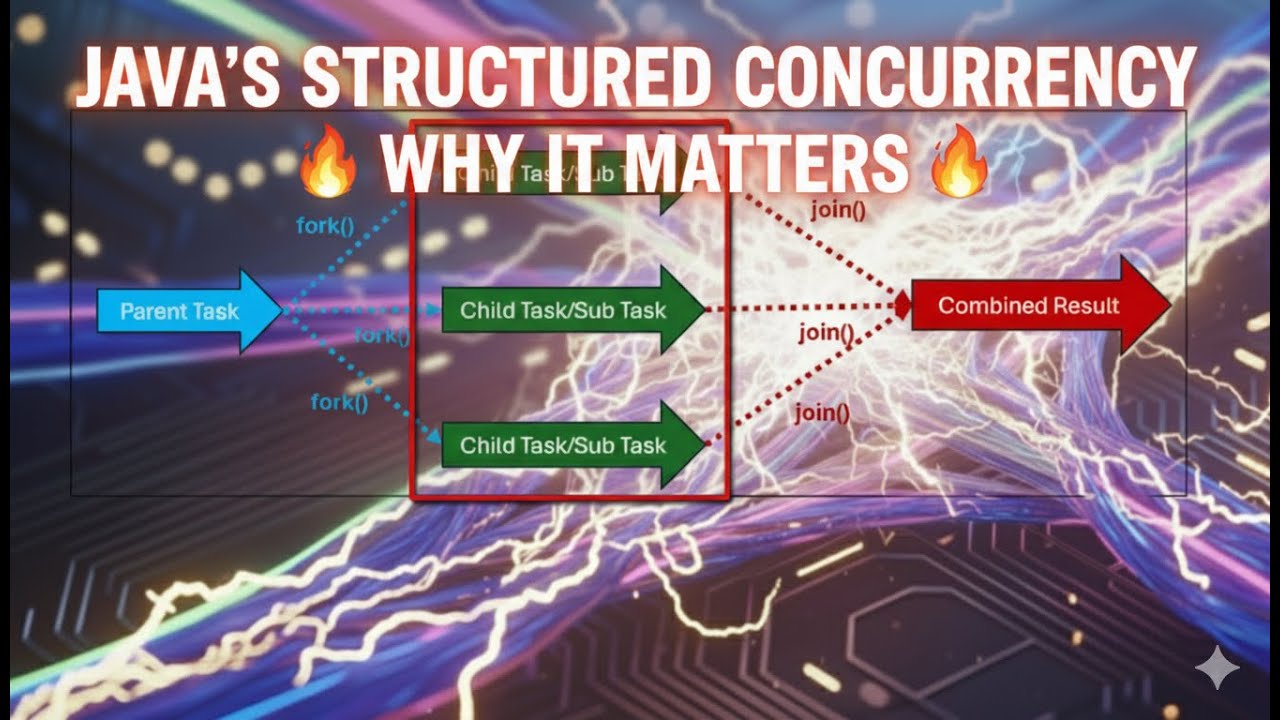
✅ THE SOLUTION: Understand the core principles of Structured Concurrency—treating a group of related concurrent tasks as a single unit of work.
✅ THE StructuredTaskScope API: Learn how to use this powerful Java 21+ preview feature to manage the lifecycle of virtual threads spawned as subtasks.
✅ CANCELLATION POLICIES: Master the two key strategies for managing concurrent tasks:
ShutdownOnFailure: If one task fails, cancel all others immediately. Perfect for "all-or-nothing" operations.
ShutdownOnSuccess: As soon as one task succeeds, cancel the rest. Ideal for redundant calls or finding the fastest result.
✅ LIVE CODE DEMO: Watch me refactor a fragile, unstructured program into a robust, structured one, solving all the problems we identified.
✅ DEBUGGING & OBSERVABILITY: Learn how to create and analyze thread dumps with jcmd and use your IDE's debugger to inspect the state of your structured tasks.
TECHNOLOGIES & CONCEPTS COVERED:
Java 21+ Structured Concurrency (Project Loom)
Unstructured vs. Structured Concurrency
StructuredTaskScope API (fork(), join(), throwIfFailed())
ShutdownOnFailure & ShutdownOnSuccess Policies
Virtual Threads
Error Handling & Cancellation Propagation
Debugging with jcmd and IDE Breakpoints
KEY TAKEAWAYS:
Structured Concurrency enforces a clear parent-child relationship, binding the lifecycle of subtasks to a defined code block.
It eliminates resource leaks by ensuring that all subtasks are completed or cancelled before the main task proceeds.
Error handling is simplified: a failure in one task can automatically trigger a clean shutdown of all related tasks.
Cancellation is reliable: interrupting the parent scope guarantees interruption of all its children.
📌 *Exclusive Discounts on My Udemy Courses!*
👉 View all my discounted courses here:
github.com/j2eeexpert2015/learningfromexperience-courses/blob/main/README.md
#java #virtualthreads #structuredconcurrency #springboot #springbootexample
Доступные форматы для скачивания:
Скачать видео mp4
-
Информация по загрузке: