How to Pass InforProps Extending RouteComponentProps { id: string } in TypeScript
Автор: vlogize
Загружено: 2025-09-23
Просмотров: 0
A step-by-step guide to setting default props in React components when working with TypeScript and RouteComponentProps.
---
This video is based on the question https://stackoverflow.com/q/63501477/ asked by the user 'Sean2014' ( https://stackoverflow.com/u/11242567/ ) and on the answer https://stackoverflow.com/a/63548022/ provided by the user 'furitetepporaa' ( https://stackoverflow.com/u/12812303/ ) at 'Stack Overflow' website. Thanks to these great users and Stackexchange community for their contributions.
Visit these links for original content and any more details, such as alternate solutions, latest updates/developments on topic, comments, revision history etc. For example, the original title of the Question was: How to pass InforProps that extends RouteComponentProps { id: string} in TypeScript
Also, Content (except music) licensed under CC BY-SA https://meta.stackexchange.com/help/l...
The original Question post is licensed under the 'CC BY-SA 4.0' ( https://creativecommons.org/licenses/... ) license, and the original Answer post is licensed under the 'CC BY-SA 4.0' ( https://creativecommons.org/licenses/... ) license.
If anything seems off to you, please feel free to write me at vlogize [AT] gmail [DOT] com.
---
How to Pass InforProps Extending RouteComponentProps<{ id: string }> in TypeScript
TypeScript can sometimes be tricky, especially when it comes to working with props in React components. If you’ve stumbled upon an error stating that certain properties are missing from your defined interface, you're not alone. Many developers encounter this issue, particularly those who are new to writing tests in TypeScript for React components. This guide will walk you through the solution step-by-step, ensuring you can navigate the complexities of props and interfaces in TypeScript without a hitch.
The Problem
In your test code, you're attempting to pass props to the Login component that extends RouteComponentProps<{ id: string }> by using an interface defined as ILoginInfoProps. However, you're running into the error:
[[See Video to Reveal this Text or Code Snippet]]
This indicates that your Login component is expecting certain properties defined in ILoginInfoProps, but they are not provided when you instantiate the component in your tests.
Understanding the Interface
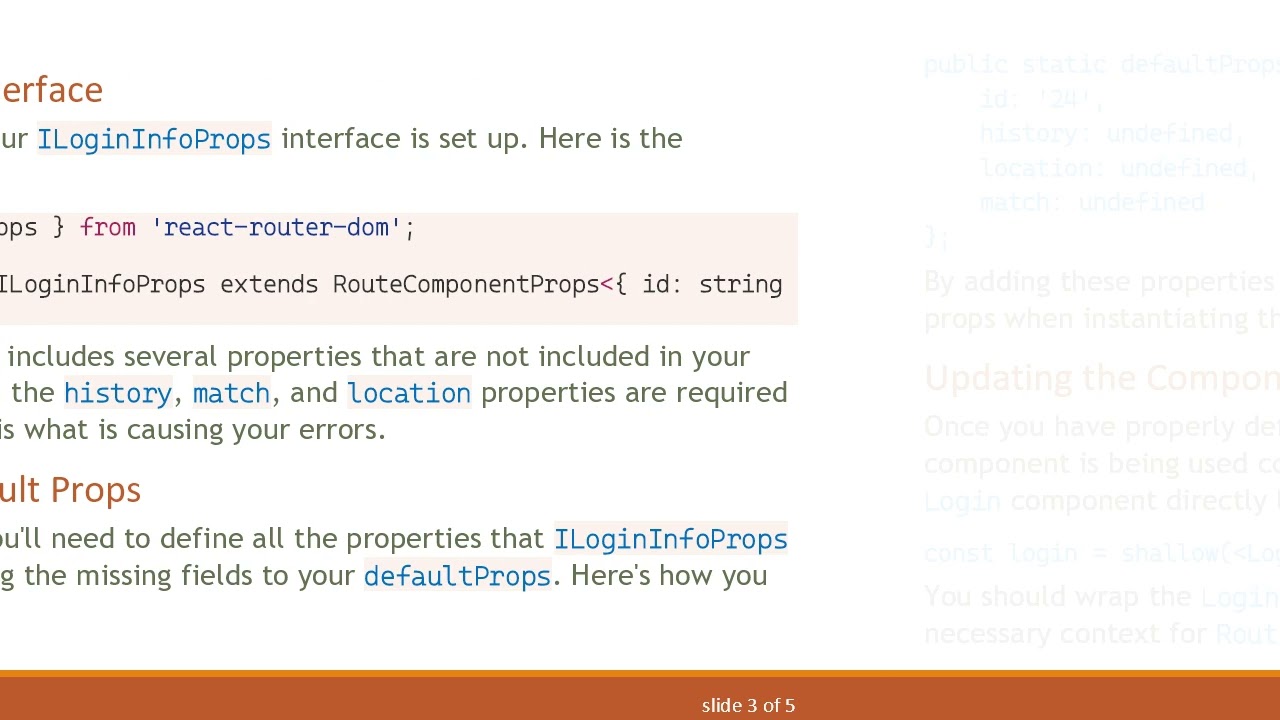
Let’s take a look at how your ILoginInfoProps interface is set up. Here is the relevant code snippet:
[[See Video to Reveal this Text or Code Snippet]]
The RouteComponentProps includes several properties that are not included in your current setup. Specifically, the history, match, and location properties are required but currently absent. This is what is causing your errors.
Solution: Setting Default Props
To resolve this problem, you'll need to define all the properties that ILoginInfoProps requires, specifically adding the missing fields to your defaultProps. Here's how you can do it:
[[See Video to Reveal this Text or Code Snippet]]
By adding these properties with default values, you effectively provide the required props when instantiating the Login component.
Updating the Component Usage in Tests
Once you have properly defined your defaultProps, it’s important to ensure that your component is being used correctly in your tests. Instead of shallow-mounting the Login component directly like this:
[[See Video to Reveal this Text or Code Snippet]]
You should wrap the Login component within a <Route> component to provide the necessary context for RouteComponentProps. Here’s an example of how to do this:
[[See Video to Reveal this Text or Code Snippet]]
Summary
Handling props in React components with TypeScript can seem daunting at first, especially when adhering to the strict type definitions provided by TypeScript. However, the solution lies in ensuring that all required properties are passed correctly. In summary, remember the following steps:
Define all required props in your component's defaultProps.
Wrap components using Route in your tests to provide context.
With these methods in place, you can alleviate those annoying type errors and get back to building robust React applications with TypeScript!
Доступные форматы для скачивания:
Скачать видео mp4
-
Информация по загрузке: