How to Implement a Private Helper Function in C+ + without Modifying the Header File
Автор: vlogize
Загружено: 2025-08-24
Просмотров: 3
Discover how to efficiently implement a private helper function in C+ + that requires access to protected members of a class without altering the default header file.
---
This video is based on the question https://stackoverflow.com/q/64220414/ asked by the user 'wiorz' ( https://stackoverflow.com/u/14398419/ ) and on the answer https://stackoverflow.com/a/64220485/ provided by the user 'StPiere' ( https://stackoverflow.com/u/1201701/ ) at 'Stack Overflow' website. Thanks to these great users and Stackexchange community for their contributions.
Visit these links for original content and any more details, such as alternate solutions, latest updates/developments on topic, comments, revision history etc. For example, the original title of the Question was: C+ + : How to implement private helper function that requires access to protected members of a class without altering header file?
Also, Content (except music) licensed under CC BY-SA https://meta.stackexchange.com/help/l...
The original Question post is licensed under the 'CC BY-SA 4.0' ( https://creativecommons.org/licenses/... ) license, and the original Answer post is licensed under the 'CC BY-SA 4.0' ( https://creativecommons.org/licenses/... ) license.
If anything seems off to you, please feel free to write me at vlogize [AT] gmail [DOT] com.
---
Solving the Dilemma of Private Helper Functions in C+ +
Introduction
In the world of C+ + programming, we often encounter situations where we need to extend a class's functionality without modifying its header file. This can become particularly challenging when we want to implement a helper function that requires access to the protected members of that class. Today, we'll explore a common problem encountered by C+ + developers: how to implement a private helper function that accesses protected members without altering the original header file.
The Problem
Consider a scenario where you have a Node class that is part of a tree structure. You might need to add a recursive function, like insertNode, to this class to facilitate inserting nodes. However, you can only link to the default header file without any modifications. This means you cannot declare new member functions in the Node class since doing so would lead to redefinition errors.
Key Challenges:
You cannot modify the original header file.
You need to access protected members of Node such as data, left, and right.
Standard getters are available, but there are no setters for the Node or Tree class.
Solution Overview
While the limitations may seem restricting, there are two potential approaches that can help you implement the required functionality:
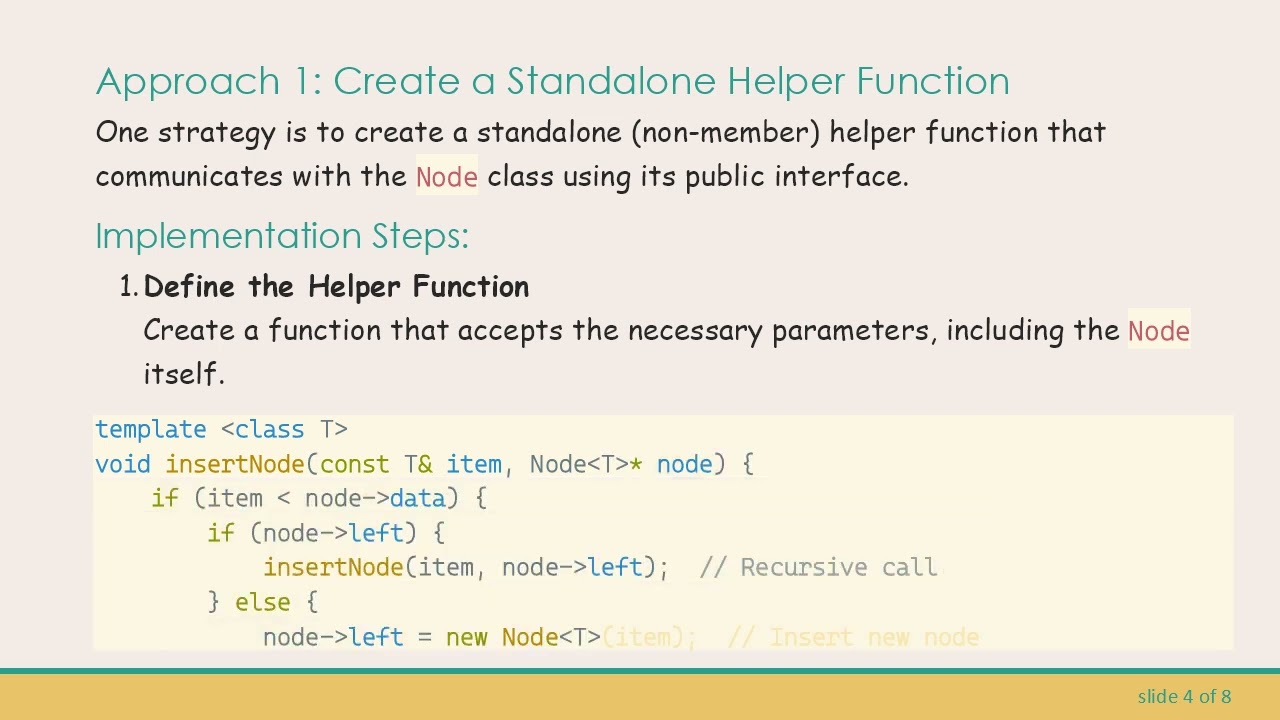
Approach 1: Create a Standalone Helper Function
One strategy is to create a standalone (non-member) helper function that communicates with the Node class using its public interface.
Implementation Steps:
Define the Helper Function
Create a function that accepts the necessary parameters, including the Node itself.
[[See Video to Reveal this Text or Code Snippet]]
Utilize the Public Interface
Ensure that you are using public methods to interact with the Node class to avoid accessing protected members directly.
Approach 2: Create a Wrapper Class
If the operations you need to perform are extensive and require frequent access to protected members, consider creating a wrapper class.
Implementation Steps:
Define the Wrapper Class
Create a new class that inherits from Node, allowing access to the protected members.
[[See Video to Reveal this Text or Code Snippet]]
Implementing Logic
The logic inside the insertNode method can be customized to fit your application needs while still having access to the Node's protected members.
Conclusion
Although you cannot modify the original header file, you can still successfully implement a helper function that requires access to protected class members in C+ + . By using a standalone function or a wrapper class, you can overcome the limitations imposed and ensure that your program remains robust and functional.
By understanding and applying these techniques, you can effectively manage class functionality in C+ + , demonstrating flexibility and creativity in your coding approaches.
Доступные форматы для скачивания:
Скачать видео mp4
-
Информация по загрузке: