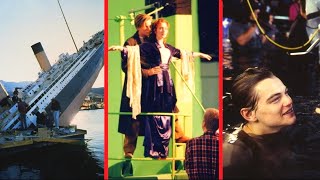
TITANIC SHIP |TITANIC MOVIE |VINEETH ADAPA PODCAST
Автор: Adapa Talks
Загружено: 2025-07-11
Просмотров: 433
This article is about the passenger liner. For the film by James Cameron, see Titanic (1997 film). For other uses, see Titanic (disambiguation).
RMS Titanic departing Southampton for the only time on 10 April 1912
Map
Wikimedia | © OpenStreetMap
Location of Titanic wreck
History
United Kingdom
Name RMS Titanic
Namesake Titans
Owner White Star Line
Operator White Star Line
Port of registry United Kingdom of Great Britain and Ireland Liverpool, England
Route Southampton to New York City
Ordered 17 September 1908
Builder Harland and Wolff, Belfast
Cost £1.5 million (£180 million in 2023)
Yard number 401
Way number 400
Laid down 31 March 1909
Launched 31 May 1911
Completed 2 April 1912
Maiden voyage 10 April 1912
In service 10 April 1912
Out of service 15 April 1912
Identification
UK official number 131428[1]
Code letters HVMP[2]
Wireless call sign MGY
Fate Foundered 15 April 1912 after striking an iceberg
Status Wreck
General characteristics
Class & type Olympic-class ocean liner
Tonnage 46,329 GRT, 21,831 NRT
Displacement 52,310 tonnes
Length 882 ft 9 in (269.1 m) overall
Beam 92 ft 6 in (28.2 m) @ntvtelugu @Spotify @BBCNewsTelugu @TeluguGeeks @ThinkTeluguPodcast @TeluguDesamPartyOfficial @etvtelangana @PrimeVideoIN @BBC @TITANIC-GAMER12 @TitanicMovie @AmericanShipping @Third_Rail
Height 175 ft (53.3 m) (keel to top of funnels)
Draught 34 ft 7 in (10.5 m)
Depth 64 ft 6 in (19.7 m)
Decks 9 (A–G)
Installed power 24 double-ended and five single-ended boilers feeding two reciprocating steam engines for the wing propellers, and a low-pressure turbine for the centre propeller;[3] output: 46,000 HP
Propulsion Two three-blade wing propellers and one centre propeller
Speed
Service: 21 kn (39 km/h; 24 mph)
Max: 23 kn (43 km/h; 26 mph)
Capacity 2,453 passengers and 874 crew (3,327 in total)
Notes Lifeboats: 20 (sufficient for 1,178 people)
RMS Titanic was a British ocean liner that sank in the early hours of 15 April 1912 as a result of striking an iceberg on her maiden voyage from Southampton, England, to New York City, United States. Of the estimated 2,224 passengers and crew aboard, approximately 1,500 died (estimates vary), making the incident one of the deadliest peacetime sinkings of a single ship.[4] Titanic, operated by White Star Line, carried some of the wealthiest people in the world, as well as hundreds of emigrants from the British Isles, Scandinavia, and elsewhere in Europe who were seeking a new life in the United States and Canada. The disaster drew public attention, spurred major changes in maritime safety regulations, and inspired a lasting legacy in popular culture. It was the second time White Star Line had lost a ship on her maiden voyage, the first being RMS Tayleur in 1854.
Titanic was the largest ship afloat upon entering service and the second of three Olympic-class ocean liners built for White Star Line. The ship was built by the Harland and Wolff shipbuilding company in Belfast. Thomas Andrews Jr., the chief naval architect of the shipyard, died in the disaster. Titanic was under the command of Captain Edward John Smith, who went down with the ship. J. Bruce Ismay, White Star Line's chairman, managed to get into a lifeboat and survived.
The first-class accommodations were designed to be the pinnacle of comfort and luxury. They included a gymnasium, swimming pool, smoking rooms, fine restaurants and cafes, a Victorian-style Turkish bath, and hundreds of opulent cabins. A high-powered radiotelegraph transmitter was available to send passenger "marconigrams" and for the ship's operational use. Titanic had advanced safety features, such as watertight compartments and remotely activated watertight doors, which contributed to the ship's reputation as "unsinkable".
Titanic was equipped with sixteen lifeboat davits, each capable of lowering three lifeboats, for a total capacity of 48 boats. Despite this capacity, the ship was scantly equipped with a total of only twenty lifeboats. Fourteen of these were regular lifeboats, two were cutter lifeboats, and four were collapsible and proved difficult to launch while the ship was sinking. Together, the lifeboats could hold 1,178 people — roughly half the number of passengers on board, and a third of the number of passengers the ship could have carried at full capacity (a number consistent with the maritime safety regulations of the era). The British Board of Trade's regulations required fourteen lifeboats for a ship of 10,000 tonnes. Titanic carried six more than required, allowing 338 extra people room in lifeboats. When the ship sank, the lifeboats that had been lowered were only filled up to an average of 60%.
Background
Duration: 6 minutes and 42 seconds.6:42
Gaumont newsreel containing the only known footage of Titanic, 1912
The name Titanic derives from the Titans of Greek mythology. Built in Belfast, Ireland, in what was then the United

Доступные форматы для скачивания:
Скачать видео mp4
-
Информация по загрузке:

![«ФАНТОМАС»🎭😃Как создавали Легендарный фильм с Луи де Фюнесом [Съемки Факты Интересности]](https://ricktube.ru/thumbnail/IHSXCZ6uiTg/mqdefault.jpg)