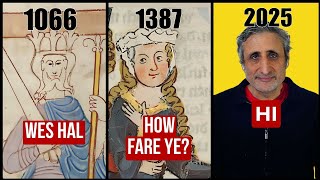
What Medieval English ACTUALLY Sounded Like - 1395
Автор: Metatron's Academy
Загружено: 2025-07-22
Просмотров: 180261
Get you Metatron plushie limited pedantic edition now!
https://www.makeship.com/products/met...
Available for a limited time only. Thank you for your support!
English in the 1400s—commonly referred to as Middle English—was a transitional phase of the language spoken between the Norman Conquest (1066) and the early Renaissance. It retained many grammatical structures and vocabulary from Old English but was heavily influenced by Norman French, particularly in legal, religious, and courtly vocabulary. The syntax was more flexible than today, spelling was highly inconsistent, and regional dialects varied so much that a Londoner might struggle to understand someone from northern England. The pronunciation was closer to what we now consider "continental" European languages: vowels were more stable and pure (e.g., “name” would be pronounced /ˈnaːmə/, with both vowels clearly enunciated), final “e”s were often pronounced, and consonants like “k” and “gh” were still articulated in many cases.
One of the most important developments at the tail end of this period was the Great Vowel Shift (GVS), a massive phonological transformation that gradually altered the pronunciation of English long vowels between roughly 1400 and 1700. Before the GVS, English vowels were pronounced similarly to those in modern Italian or German—pure and not diphthongized. For example, the word “bite” would have been pronounced /biːtə/, not /baɪt/. During the GVS, long vowels began to "raise" (move higher in the mouth), and those at the top became diphthongs. So /iː/ (as in “bite”) became /aɪ/, /uː/ (as in “house”) became /aʊ/, and so forth. This shift is responsible for many of the irregularities between English spelling and pronunciation today, since spelling had begun to standardize just as pronunciation was evolving.
In essence, English in the 1400s sounded far more foreign to modern ears than Shakespearean English does today. It was richly inflected, rhythmically varied, and just beginning to undergo one of the most radical pronunciation shifts in linguistic history.

Доступные форматы для скачивания:
Скачать видео mp4
-
Информация по загрузке: