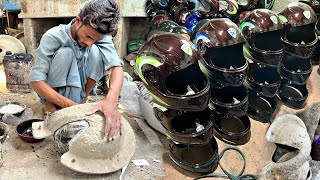
Corinthian Helmet,Mould Making,Art Workshop,Fiberglass on Model Plug Part 1
Автор: NickVenture1
Загружено: 2022-12-17
Просмотров: 292
The Corinthian helmet originated in ancient Greece and took its name from the city-state of Corinth. It was a helmet made of bronze which in its later styles covered the entire head and neck, with slits for the eyes and mouth. A large curved projection protected the nape of the neck.
Out of combat, a Greek hoplite would wear the helmet tipped upward for comfort. This practice gave rise to a series of variant forms in Italy, where the slits were almost closed, since the helmet was no longer pulled over the face but worn cap-like. Although the classical Corinthian helmet fell out of use among the Greeks in favour of more open types, the Italo-Corinthian types remained in use until the 1st century AD, being used, among others, by the Roman army.
The Corinthian helmet was depicted on more sculpture than any other helmet; it seems the Greeks romantically associated it with glory and the past. The Romans also revered it, from copies of Greek originals to sculpture of their own. Based on the sparse pictorial evidence of the republican Roman army, in Italy the Corinthian helmet evolved into a jockey-cap style helmet called the Italo-Corinthian, Etrusco-Corinthian or Apulo-Corinthian helmet, with the characteristic nose guard and eye slits becoming mere decorations on its face.
An aspis (Ancient Greek: ἀσπίς, plural aspides, ἀσπίδες), or porpax shield, sometimes mistakenly referred to as a hoplon (Greek: ὅπλον)(a term actually referring to the whole equipment of a hoplite), was the heavy wooden shield used by the infantry in various periods of ancient Greece.
Hoplites (/ˈhɒplaɪts/ HOP-lytes) (Ancient Greek: ὁπλίτης : hoplítēs) were citizen-soldiers of Ancient Greek city-states who were primarily armed with spears and shields. Hoplite soldiers used the phalanx formation to be effective in war with fewer soldiers. The formation discouraged the soldiers from acting alone, for this would compromise the formation and minimize its strengths.The hoplites were primarily represented by free citizens – propertied farmers and artisans – who were able to afford a linen armour or a bronze armour suit and weapons (estimated at a third to a half of its able-bodied adult male population).Most hoplites were not professional soldiers and often lacked sufficient military training. Some states maintained a small elite professional unit, known as the epilektoi ("chosen") since they were picked from the regular citizen infantry. These existed at times in Athens, Argos, Thebes, and Syracuse, among others. Hoplite soldiers made up the bulk of ancient Greek armies.
In the 8th or 7th century BC, Greek armies adopted the phalanx formation. The formation proved successful in defeating the Persians when employed by the Athenians at the Battle of Marathon in 490 BC during the First Greco-Persian War. The Persian archers and light troops who fought in the Battle of Marathon failed because their bows were too weak for their arrows to penetrate the wall of Greek shields that comprised the phalanx formation. The phalanx was also employed by the Greeks at the Battle of Thermopylae in 480 BC and at the Battle of Plataea in 479 BC during the Second Greco-Persian War.
The word hoplite (Greek: ὁπλίτης hoplítēs; pl. ὁπλῖται hoplĩtai) derives from hoplon (ὅπλον : hóplon; plural hópla ὅπλα), referring to the hoplite's equipment.In the modern Hellenic Army, the word hoplite (Greek: oπλίτης : oplítîs) is used to refer to an infantryman.
The fragmented political structure of Ancient Greece, with many competing city-states, increased the frequency of conflict, but at the same time limited the scale of warfare. Limited manpower did not allow most Greek city-states to form large armies which could operate for long periods because they were generally not formed from professional soldiers. Most soldiers had careers as farmers or workers and returned to these professions after the campaign. All hoplites were expected to take part in any military campaign when called for duty by leaders of the state. The Lacedaemonian citizens of Sparta were renowned for their lifelong combat training and almost mythical military prowess, while their greatest adversaries, the Athenians, were exempted from service only after the age of 60. This inevitably reduced the potential duration of campaigns and often resulted in the campaign season being restricted to one summer.
Armies generally marched directly to their destination.In some cases the battlefield was agreed to by the contestants in advance. Battles were fought on level ground, and hoplites preferred to fight with high terrain on both sides of the phalanx so the formation could not be flanked. An example of this was the Battle of Thermopylae, where the Spartans specifically chose a narrow coastal pass to make their stand against the massive Persian army. The vastly outnumbered Greeks held off the Persians for seven days.
When battles occurred, they were usually set piece and intended to be decisive.
(Wikipedia)

Доступные форматы для скачивания:
Скачать видео mp4
-
Информация по загрузке: