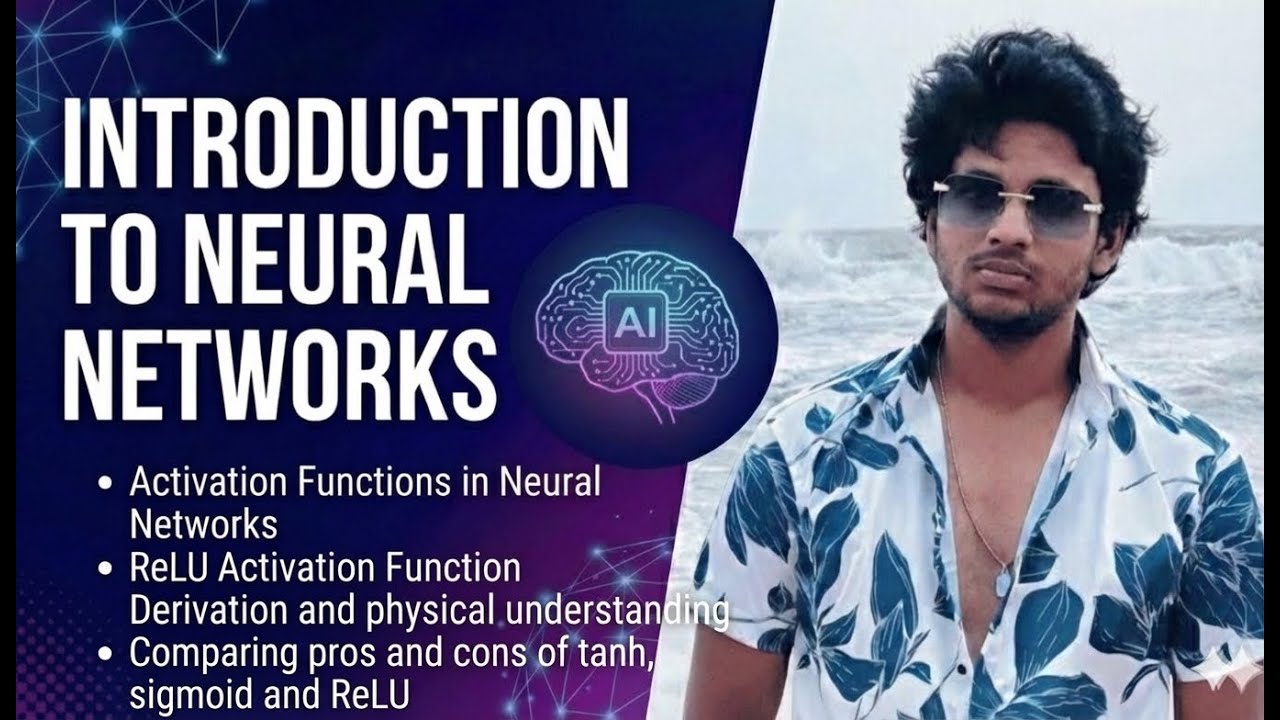
Introduction to Neural Networks (Lecture 14)
Автор: Gautam Goel
Загружено: 2025-12-21
Просмотров: 30
#AI #Python #NeuralNetworks #DeepLearning #ReLU
Welcome to the fourteenth lecture of my Deep Learning series! 🧠
In this video, we complete our trilogy of Activation Functions. We have mastered the S-curves of Sigmoid and Tanh, but today we tackle the absolute king of modern Deep Learning: the Rectified Linear Unit (ReLU).
At first glance, ReLU looks deceptively simple—it’s just a straight line that gets cut off at zero. You might wonder: "How can something that looks linear solve complex, non-linear problems?" or "Why do state-of-the-art models like Transformers and CNNs prefer this over the smooth curves of Tanh?"
In this lecture, we don't just look at the code; we break down the intuition. We analyze why ReLU is computationally superior and how it solves the dreaded Vanishing Gradient problem that plagued earlier neural networks.
In this video, we cover:
✅ De-mystifying ReLU: Understanding the formula: f(x)=max(0,x). We visualize the graph and understand how a piecewise linear function introduces the necessary non-linearity into our network.
✅ Linear vs. Non-Linear: We answer the big question: "Have we actually introduced non-linearity?" We explore how combining two linear behaviors (on/off) creates the complexity needed for learning.
✅ Solving Vanishing Gradients: Unlike Sigmoid and Tanh, which squash large inputs to 1, ReLU allows positive gradients to flow through the network unchanged. We discuss why this allows for faster and deeper learning.
✅ Efficiency & The "Dying ReLU": We discuss the pros (sparse activation, cheap computation without exponentials) and the cons (the "dying neuron" problem when inputs are negative).
✅ The Ultimate Comparison: A comprehensive summary table comparing Sigmoid vs. Tanh vs. ReLU. We break down the formula, characteristics, pros, cons, and use cases for each to finalize our theory.
Resources:
🔗 GitHub Repository (Code & Notes): https://github.com/gautamgoel962/Yout...
🔗 Follow me on Instagram: / gautamgoel978
Subscribe to continue the journey! We have now wrapped up the theory behind the mathematical engines of neurons. In the next video, we stop the theory and start the engine—we will write the Python code to implement these activation functions directly into our Micrograd library! 💻🔥
#deeplearning #Python #Micrograd #ReLU #ActivationFunctions #MathForML #NeuralNetworks #Backpropagation #Hindi #AI #MachineLearning #VanishingGradient #DataScience
Доступные форматы для скачивания:
Скачать видео mp4
-
Информация по загрузке: