Mastering Highest Common Factors and Lowest Common Multiples: GCSE Maths Edexcel Revision
Автор: Math Revision LM
Загружено: 2026-01-12
Просмотров: 1
3 Elegant Math Tricks You Forgot (But Are Smarter Than You Remember)
Do you have a vague memory of terms like "Highest Common Factor" (HCF) and "Lowest Common Multiple" (LCM) from your school days? Beneath the surface of these seemingly routine topics lie some surprisingly elegant and clever problem-solving techniques. This article rediscovers three impactful ideas from this corner of mathematics that are worth a second look.
1. Every Number Has a Unique Prime "Fingerprint"
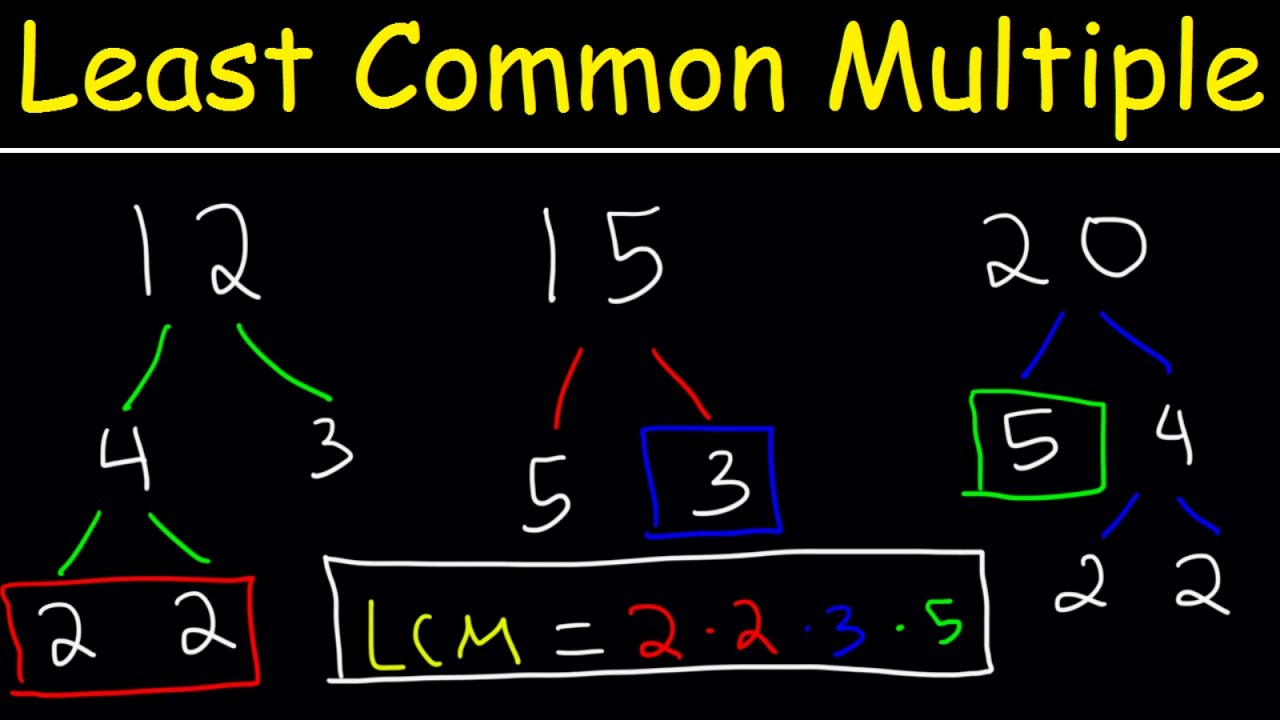
While listing out all the factors of a number can work, a more powerful method is to break numbers down into their "product of prime factors." This is like finding the fundamental building blocks of a number—its unique DNA or fingerprint. The advantage of this approach is that it is "more efficient for large numbers" than simple listing.
For example, the prime factorization of 120 is:
120 = 2 × 2 × 2 × 3 × 5
What makes this idea so powerful is that it reveals a deeper, more fundamental structure in numbers, moving beyond a simple list of their divisors.
2. A Simple Diagram Can Solve a Complex Problem
This is where the prime "fingerprint" from our first takeaway becomes incredibly useful. By using those fundamental building blocks, we can use a Venn diagram—a surprisingly visual and intuitive tool for finding the HCF and LCM.
The method is straightforward:
1. First, break the numbers down into their prime factors.
2. Place the common prime factors in the overlapping section of the two circles (the intersection).
3. Place the remaining unique prime factors for each number in the non-overlapping parts of their respective circles.
Let's see this in action with 64 and 100. First, we break down our two numbers into their prime factors:
64 = 2 × 2 × 2 × 2 × 2 × 2
100 = 2 × 2 × 5 × 5
Now, we can see they share two prime factors: 2 and 2. These go in the intersection. This simple visual sorting exercise does the hard work for us, revealing two elegant rules:
To find the HCF: Multiply only the numbers in the intersection.
To find the LCM: Multiply all the numbers across the entire diagram.
For our example, the common prime factors in the intersection are 2 × 2, so the HCF is 4. The LCM is the product of all the numbers in the diagram: 2 × 2 × 2 × 2 × 2 × 2 × 5 × 5 = 1600. The process transforms an abstract arithmetic problem into a simple, visual sorting exercise.
3. HCF and LCM Are Two Sides of the Same Coin
The Venn diagram method also reveals an elegant relationship between the HCF and LCM. The HCF represents the shared essence of the numbers—the product of their common prime factors in the intersection. The LCM, in contrast, represents the complete combination of the numbers—the product of all prime factors required to build both.
The core concepts are defined as follows:
The Highest Common Factor (HCF) is the greatest factor that will divide into the selected numbers. The Lowest Common Multiple (LCM) is the lowest multiple that is common to two or more numbers.
By visualizing the numbers this way, it becomes obvious that HCF and LCM aren't separate chores but two sides of the same coin, born from the same set of prime factors.
Conclusion: Beyond the Calculation
The methods for finding HCF and LCM are more than just rote procedures; they are windows into the elegant structure of numbers. By making a simple shift in perspective—from listing numbers to visualizing their core components—a complex problem can become clearer and more intuitive.
What other ideas from our school days might be worth revisiting to find the simple elegance we missed the first time around?
Доступные форматы для скачивания:
Скачать видео mp4
-
Информация по загрузке: