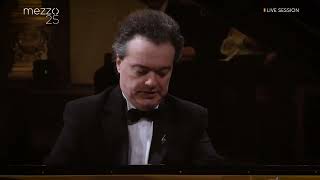
Menahem Pressler Masterclass - Brahms: Sonata No. 2 in F# Minor, Op. 2 / Kathy Kim / (9/28/92)
Автор: Marlin Owen
Загружено: 2025-11-19
Просмотров: 27
Brahms: Sonata No. 2 in F# Minor, Op. 2
00:00 Allegro non troppo ma energico
Kathy Kim, USC https://www.classicalconnect.com/Kath...
04:59 (51) It’s in p, and he uses the word espressivo. He doesn’t say appassionata. He doesn’t say F. It is (Sings 50) and he resolves it into something tender. You don’t play it tenderly. Play it exactly what he’s asking.
05:40 MPD (52) Make a dim.
06:05 MPD I personally, would play (Sings) And the second time he doesn’t give us the the ta-ta-ta / ta-ta-ta- / accompaniment. He gives the ‘agitato’ figurations. But follow him. Let him build you through the excitement.
06:49 (56) Piano, piano at 58. Do you see a F? You play so loud here. It’s so harsh. Do you see a sight of a F? The only thing you do see is p, and a little swell and right back, a little swell and a dim, a piu agitato, and then the next sign you see is a p. Alright, you are free to create some waves, your own waves, but not outside the sphere of which it’s written. And there’s plenty of force and fire and brimstone and everything coming up. Yes? The kitchen sink, everything is coming up.
08:00 (51) Especially the high B.
08:24 Now, can I ask one thing about sensitivity is concerned. Each time he has B - G# F# EE D# At 60 it’s B G natural. Can you respond to that change? I wouldn’t do it on the high B . Do it on the G.
09:50 (28) If anything, you might crescendo. He wants you to land grandioso. (75) Each time we have triplets ya ta ta DAH, ya ta ta DAH, and then Climax.
10:47 Give us the leading note - the D# has to go to the E. The bass is underneath. That’s marvelous how he wrote that and brought both of them together here.
11:45 (90) Play the LH once alone. Now both hands. And especially bring out the LH when there is a long note that is held in the RH. (Sings)
12:47 (100) That’s so hard. Play the RH alone. That’s the idea.
13:44 I wish you would save that big crescendo for when he asks for it. It’s a shame, because generally, one has to tell people to do more. But in any case, it’s better to have to tell people to do less. But on the other hand, if it is already so far apart from what score is, then I have to ask you to really read it so that you are clear where you transgress, because right now don’t know it crescendos and that’s not good. When you do it with a purpose, you say, “Oh, here I just feel a bigger crescendo. OK, he has asked for it, but you do it all over the place. So let us once be religious, and then you will see that there are really some places that you will try to do more. But on the other hand, he has really built it very carefully into the piece that it is. It’s a marvelous masterpiece.
15:45 (108) Once I’d like you to say 1 2 3. Play it once in time. Come in on 3 with the beat. Now play it free, but you know where the 3rd beat is. Isn’t that much nicer? It has more structure.
16:43 (92) Once more, that famous place.
17:38 (119) Can I have a beat once? (Sings 119) You will owe so much money, your personal debt will be bigger than the debt of the whole country. I mean, your personal debt to Brahms! You lose so many beats.
18:20 (112) There is no crescendo. Now, what you feel is very good. I like it. But I would like it if you could say it softer. Say exciting things (Sings) but say it inside, that it is contained so that you can play a bigger line. Not that everything is two-bar phrases and everything explodes after two bars if he has it or he hasn’t it.
19:20 (119) No. You make it an exercise. Roll the chord. (122) The E# is a leading note to 123 (Sings) What can we do? It’s a dead note. (Sings) But you can still feel and drive to the downbeat.
20:29 Once more. You’re a half hour early?. Take the foot off so that we have a pause that refreshes. And then start poco sostenuto. It starts under tempo. Even the key is unexpected. MPD 21:15
21:55 Make that crescendo and then drive. You start a little slower, then poco a poc rit and then (Sings) It’s a STRUGGLE! Let me see you struggle. That’s right. And then we have a feeling of accomplishment and arrival.
23:19 (131) Could you take off the foot after the chord, and we can now hear a climax? The second thing is how he slows you down. He has you in 16ths, and then he has triplets, and in the triplets, he becomes heavy. (Sings)
24:33 (144) The F# after the C# is a resolution.
25:15 The last chord resolves. Can I have a variation in sonority? (Sings) What is the dynamic? It’s piano and you know it!
26:30 Sensitive to the C natural (164). Not that much. Just so I feel this is a person who is aware, who relates, for whom a key change also means a mood change. That’s right.
27:10 No crescendo. Not yet. Not yet. And now!
27:45 What should we hear? The LH with the chords on top supporting. What does he say? “Emphasize the bass.” Why would he say that? Because it’s the first voice. MC Ends.
Crowell Hall, Biola University - La Mirada, CA (9/28/92)

Доступные форматы для скачивания:
Скачать видео mp4
-
Информация по загрузке: