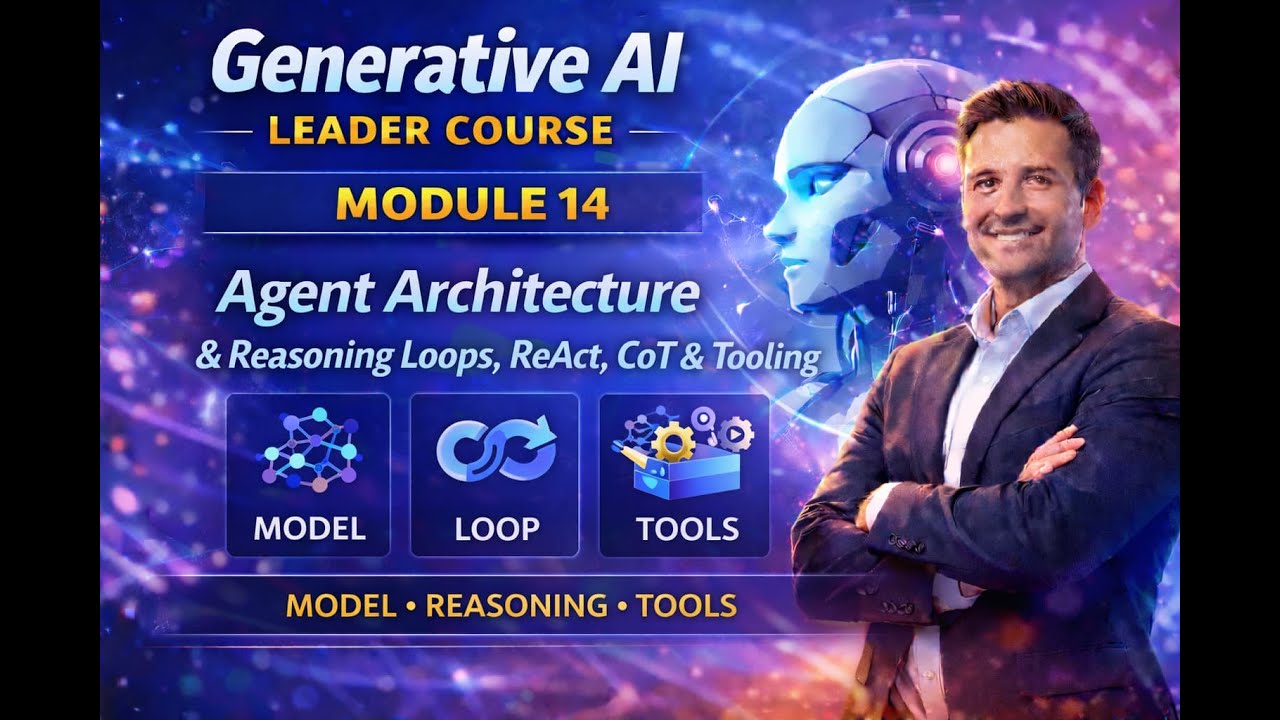
Generative AI Leader (Module 14): Agent Architecture, Reasoning Loops, ReAct, CoT & Tooling
Автор: Cloud-Edify
Загружено: 2026-01-21
Просмотров: 7
Welcome to Module 14: Generative AI Agent Architecture and Engineering — one of the most technical and high-value modules in the Generative AI Leader journey.
In this module, we go deep into how modern AI agents are actually built, engineered, and tuned in production environments. You’ll move beyond “LLMs that talk” and understand agents as full systems composed of models, reasoning loops, and tools that can observe, decide, and act.
What you’ll learn in Module 14
🧠 Evolution of AI Agents
Deterministic (rule-based) agents vs Generative agents
Why traditional decision trees fail at edge cases
How RAG (Retrieval Augmented Generation) transformed agents
Hybrid agents: combining deterministic logic + LLM reasoning
🧩 Core Architecture of a Generative AI Agent
Every modern agent is built on three pillars:
Foundational Model (LLM like Gemini)
Reasoning Loop (decision-making engine)
Tools (APIs, functions, data stores, plugins)
You’ll see how these components work together to achieve real goals.
🔁 Engineering the Reasoning Loop
Learn how agents “think” and decide what to do next:
Iterative reasoning and goal evaluation
Tool selection and orchestration
Internal decision-making vs external actions
Prompt Engineering for Agent Logic
Role prompting
Few-shot prompting
Metaprompting (using AI to generate better prompts)
🧠 Advanced Reasoning Frameworks
Understand and compare the two most important agent frameworks:
Chain-of-Thought (CoT)
Step-by-step internal reasoning
Better accuracy and explainability
Ideal for complex logical problems
ReAct (Reason + Act)
Thought → Action → Observation loop
Dynamic interaction with tools and real-world data
Reduced hallucinations and higher trust
You’ll also see how CoT and ReAct can be combined for powerful hybrid agents.
🔧 Agent Tooling: From Text to Action
Agents become truly useful when they can act.
Tool categories covered:
Extensions (APIs)
Functions
Data Stores
Plugins
You’ll learn how tools fit into the agent’s operational cycle with a clear, real-world example (appointment scheduling).
☁️ Google Cloud Services for Agent Tooling
Build production-ready agents using Google Cloud:
Cloud Storage
Cloud SQL, Firestore, Spanner
Cloud Functions & Cloud Run
Vertex AI as an agent-to-agent tool
Pre-built AI APIs as Agent Tools
Speech-to-Text / Text-to-Speech
Translation & Document Translation
Document AI
Vision & Video Intelligence
Natural Language API
📍 Practical example: Meeting location planner using Document AI + Maps + Cloud Functions.
🎛️ Controlling Model Behavior
Master sampling parameters to tune agent behavior:
Token count
Temperature
Top-P / Top-K
Output length
Safety settings
Understand when to use low creativity vs high creativity depending on the task.
🧪 Experimentation Platforms
Compare:
Google AI Studio → fast prototyping, learning, experimentation
Vertex AI Studio → enterprise-grade, scalable, production systems
You’ll know exactly where to start and when to upgrade.
📌 Free Study Guide & Exam Resources
Access structured notes, diagrams, and exam-aligned explanations here:
👉 https://www.cloud-edify.com/google/ge...
🔥 Discounts & Course Deals
Verified coupons and bundles available at:
👉 https://www.cloud-edify.com/sale
🎯 By the end of this module, you’ll understand how AI agents are engineered end-to-end — from reasoning loops and prompt frameworks to tools, cloud services, and model tuning.
👍 Like, subscribe, and comment:
Which agent framework do you find more powerful — CoT, ReAct, or a hybrid approach?
#GenerativeAI #AIAgents #ReAct #ChainOfThought #PromptEngineering #GoogleCloud #VertexAI #Gemini #CloudEdify #GenerativeAILeader
Доступные форматы для скачивания:
Скачать видео mp4
-
Информация по загрузке: