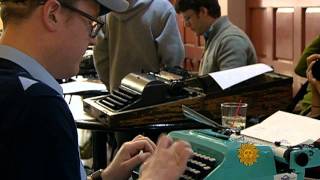
A Chinese Typewriter in Silicon Valley
Автор: Google TechTalks
Загружено: 2012-02-23
Просмотров: 20378
Google Tech Talk
December 5, 2011
A Chinese Typewriter in Silicon Valley: What 150 Years of Chinese Information Technology can Teach the Alphabetic World
Presented by Thomas S. Mullaney.
ABSTRACT
In 1862, an eccentric Frenchman published two essays about telegraphy: the first, a proposal for a Chinese telegraph code, and the second, a critique of Morse Code. Inspired by his study of Chinese, he argued that symbolic languages like Morse and other telegraph codes failed to measure up to the brilliance and power of the physical technology of the telegraph. Whereas the telegraph-as-machine was an immense achievement that granted humans a power bordering on the god-like, the semiotic architecture of telegraph codes remained crude and bounded to the languages out of which they were developed (namely English -- but also alphabetic languages more broadly). What was needed, he argued, was a symbolic interface that transcended existing human language, a human-machine interface that would unlock rather than inhibit the awesome potential of new communication technologies. I will show, this Frenchman's call to action was picked up and examined to a far greater extent than in any other part of the world. As compared to the Euro-American world of information technology, wherein ever-more sophisticated apparatuses of information technology were developed, Chinese experimentation centered on questions of semiotic interface, user-machine interaction, and mediation for some 150 years. This focus was not coincident, moreover, but rather emerged out of the specifically tortuous process by which Chinese engineers proceeded to "translate" alphabet-centered technologies like the telegraph and typewriter so as to make them useful within a culture and civilization whose script was not alphabetic, but character-based. Examining three Chinese character information technologies -- the Chinese telegraph, the Chinese typewriter, and the Chinese computer -- I will examine the ways in which questions of interface were central to the history of modern Chinese information technology from the start, and will show that the history of China has involved something like the inverse of the Frenchman's critique: namely, that those working in the Chinese character information environment went on to develop interfaces and systems of mediation that far outstripped the capacities of existing apparatuses, only becoming usable (and remarkably powerful) with the rise of electrical automation and modern computing. The presentation will conclude with a reflection on a recent achievement in Chinese history: the development of a Chinese input method that posts speeds faster than in alphabetic typing, a feat that was unimaginable only decades earlier.
Speaker Info:
Thomas S. Mullaney is Assistant Professor of Modern Chinese History at Stanford University. His first book, Coming to Terms with the Nation: Ethnic Classification in Modern China (2010) examines the process by which Chinese social scientists and Communist state authorities decided which of the country's minority groups to recognize, and how this transformed the modern Chinese nation-state. He is also principal editor of Critical Han Studies: Understanding the Largest Ethnic Group on Earth (forthcoming 2011), an edited volume that brings together path breaking new research on China's ethnic majority. His current book project, The Chinese Typewriter: A Global History of Technolinguistic Modernity, examines China's nineteenth- and twentieth-century development of a character-based information infrastructure encompassing Chinese telegraphy, typewriting, character retrieval systems, shorthand, Braille, word processing, and computing. His website can be found at www.tsmullaney.com.

Доступные форматы для скачивания:
Скачать видео mp4
-
Информация по загрузке:




![Как сжимаются изображения? [46 МБ ↘↘ 4,07 МБ] JPEG в деталях](https://ricktube.ru/thumbnail/Kv1Hiv3ox8I/mqdefault.jpg)