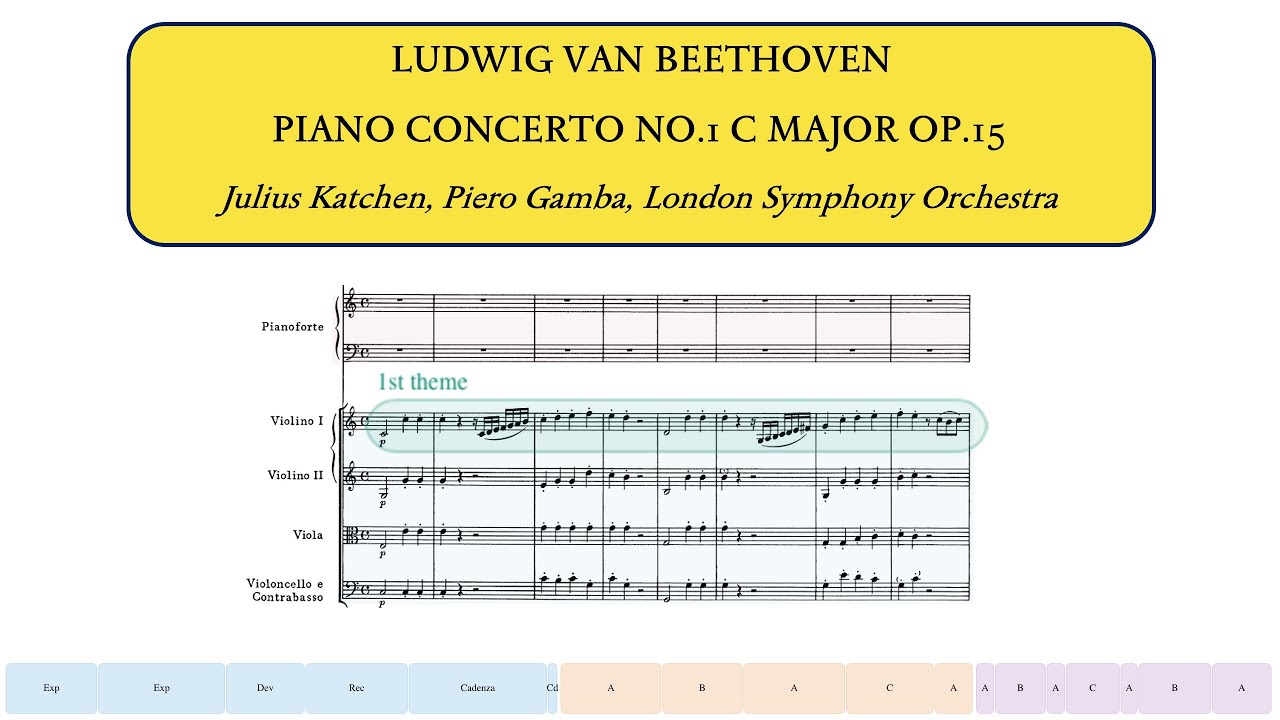
Beethoven, Piano Concerto No.1, Op.15 (Julius Katchen, Piero Gamba, London Symphony Orchestra)
Автор: ScoreMan
Загружено: 2026-01-17
Просмотров: 207
L.v.Beethoven's Piano Concerto No.1 in C major, Op.15, with a theme-and-structure analysis and synchronized sheet music (score)
Performance: Julius Katchen (piano), Piero Gamba (conductor), London Symphony Orchestra, 1965/01 Stereo, Walthamstow Assembly Hall, London
Analysis, Score Editing, Synch: ScoreMan
00:00 Movement 1: Allegro con brio
16:30 Movement 2: Largo
28:51 Movement 3: Rondo. Allegro scherzando
The performer chose the longest and most difficult version among the cadenzas composed by Beethoven himself.
OVERVIEW
Beethoven’s Piano Concerto No. 1 in C major, Op. 15, is officially his first published piano concerto, even though it was composed after what we now call Piano Concerto No. 2.
It is written for piano and orchestra and stands at the point where Beethoven is still working within the Classical tradition while already beginning to assert a more personal and assertive voice.
The concerto is brilliant, confident, and outwardly cheerful, yet it already hints at the dramatic contrasts and strong individuality that would later define Beethoven’s style.
HISTORICAL CONTEXT
Beethoven composed this concerto mainly in the mid-1790s, shortly after settling in Vienna, where he was building his reputation primarily as a virtuoso pianist.
At this time, Vienna was still dominated by the legacy of Mozart and Haydn, and Beethoven was very conscious of measuring himself against these towering figures.
The concerto was designed in part as a vehicle for his own performances, allowing him to impress audiences with both compositional skill and pianistic brilliance.
It reflects a young composer who is ambitious, confident, and eager to be recognized as Mozart’s equal, or even his successor.
MUSICAL SIGNIFICANCE
Musically, the concerto follows the Classical concerto model, especially that of Mozart, but Beethoven treats the piano in a more assertive and sometimes confrontational way.
The solo part is more muscular and demanding, with bold gestures, rapid passagework, and dramatic interruptions of the orchestra.
The first movement is expansive and energetic, already showing Beethoven’s love for strong rhythmic drive and sudden contrasts.
The slow movement introduces a more inward and lyrical world, with a calm, almost suspended atmosphere that contrasts strongly with the outer movements.
The finale is lively and playful, but it also carries a sharp wit and rhythmic vitality that feels distinctly Beethovenian rather than purely Classical.
LEGACY
Although it is often overshadowed by Beethoven’s later piano concertos, the First Piano Concerto remains an important work because it shows Beethoven at the moment of transition.
It bridges the Classical elegance of Mozart with the emerging Romantic intensity that Beethoven would later develop more fully.
Pianists and listeners often hear it as the sound of a young composer testing boundaries, confident in his abilities and already pushing against convention.
As such, the concerto stands not only as an impressive early achievement but also as a clear sign of the revolutionary musical voice that was about to transform the concerto genre itself.
• J.S.Bach's Masterpieces
• J.S.Bach - 6 Cello Suites
• D.Scarlatti - Keyboard Sonatas
• W. A. Mozart - Piano Sonatas
• L. v. Beethoven's Masterpieces
• L. v. Beethoven - 9 Symphonies
• L. v. Beethoven - Piano Sonatas
• F. Schubert - Piano Sonatas
• F. Chopin's Masterpieces
• F. Chopin - 19 Mazurkas
• F. Chopin - 19 Polonaises
• F. Chopin - 22 Nocturnes
• F. Chopin - 19 Waltzes
• R. Schumann's Masterpieces
• F. Liszt's Masterpieces
• J. Brahms's Masterpieces
• P. I. Tchaikovsky's Masterpieces
• C. Debussy's Masterpieces
• M. Ravel's Masterpieces
• S. Prokofiev's Masterpieces
• S. Prokofiev - Piano Sonatas
• Piano Sonata Collections
• Piano Concerto Collections
• Violin Concerto Collections
Доступные форматы для скачивания:
Скачать видео mp4
-
Информация по загрузке:
![Beethoven, Piano Concerto No.1, Op.15 [Piano Part] (Martha Argerich, Giuseppe Sinopoli)](https://imager.clipsaver.ru/L2jiNBu0m9M/max.jpg)