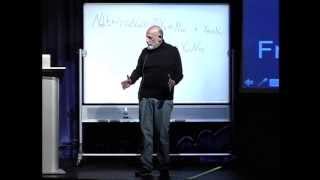
George F.R. Ellis, On the Nature of Cosmology Today (2012 Copernicus Center Lecture)
Автор: Copernicus
Загружено: 2013-01-28
Просмотров: 28986
Cosmology is today a precision science with masses of high quality data every increasing our understanding of the physical universe, but paradoxically theoretical cosmology is simultaneously increasingly proposing theories based on ever more hypothetical physics, or concepts that are untestable even in principle (such as the multiverse). We are also seeing ever more dogmatic claims about how scientific cosmology can solve philosophical problems that have been with us for millenia. This talk comments in these trends, carefully distinguishing what is and what is not testable in scientific cosmology, and relating this solid scientific background to some of the recent philosophical claims made about how scientific cosmology relates to issues of meaning.
The fourth Copernicus Center Lecture - "On the Nature of Cosmology Today" - was delivered by Professor George Ellis, a famous cosmologist, mathematician, philosopher of science as well as researcher of the relationship between science and religion, currently Emeritus Distinguished Professor of Complex Systems in the Department of Mathematics at the University of Cape Town in South Africa. The 2012 Copernicus Center Lecture was part of the 16th Kraków Methodological Conference - "The Causal Universe", which was co-organized by the Copenicus Center for Interdisciplinary Studies.
Conference website: http://causal-universe.philosophyinsc...
Photos of the conference:http://adamwalanus.pl/2012/cc120517.html
Organizers' comment:
To date, the natural sciences provide extremely detailed description of how Universe functions by providing a set of scientific laws. These laws reflect regularities in nature and allow for the explanation and prediction of the observed phenomena. What seems to escape the power of contemporary science entirely, however, is the answer to the question of why the Universe is. Such an inquiry demands the use of a fundamental philosophical category of causality. Inasmuch as the "how" causality is associated with the determinism of scientific laws, the "why" causality reaches beyond the scientific discourse. In other words, one wishes to know why the Universe is and why it is as it is. The conference offers a unique opportunity to broaden our understanding of how to combine our vast knowledge of the laws governing the Universe in the quest for the ultimate explanation of its existence and specificity.
As George Ellis states in his famous article On the Nature of Causation in Complex Systems, the problem of causality may be found not only in the field of philosophy but also in physics and other empirical sciences:
The nature of causation is a core issue for science, which can be regarded as the move from a demon-centered world to a world based on reliable cause and effect, tested by experimental verification.
(...) Physics is the basic science, characterized by mathematical descriptions that allow predictions of physical behavior to astonishing accuracy and underlies the other sciences. The key question is whether other forms of causation such as those investigated in biology, psychology, and the social sciences are genuinely effective, or are they rather all epiphenomena grounded in purely physical causation?
(...) I will claim here that there are indeed other types of causation at work in the real world, described quite well by Aristotle's four types of causes. There are of course many contexts in which different kinds of causality are experienced: in physics and chemistry, where particles and forces interact in a way described by variational principles and symmetries; in biochemistry and cell biology, where information is important and adaptation takes place; in zoology, where purpose, planning, and anticipation are important; and in psychology and sociology, where analytic reflection, symbolic understanding, values and meaning all are causally effective.

Доступные форматы для скачивания:
Скачать видео mp4
-
Информация по загрузке: