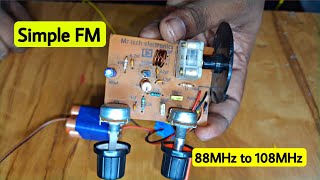
Radio receiver FM 88 - 108 MHZ. Synchrodyne
Автор: DZ - About technique
Загружено: 2023-04-30
Просмотров: 7336
Synchrodyne receiver
In this type of receiver, to increase the reception sensitivity, a local oscillator is used. The frequency generated by this oscillator is equal to the frequency of the received signal. Practically, the local oscillator generates the frequency of the signal of the received station (carrier signal), and by mixing the useful signal (audio) is obtained. In other words, by synchronizing the 2 types of signals, the demodulated signal is directly obtained (the useful signal, audio).
In specialized literature, this type of receiver is also known as a zero intermediate frequency receiver; receiver with direct mixing.
Another essential aspect in the operation of this type of receiver, consists in the fact that the received signal influences the frequency of the local oscillator, "pulling" it up to total synchronization (in phase).
In the present case, the essential element of the receiver is the synchronizable oscillator, built with transistors T1 and T2.
The frequency generated by this oscillator follows the frequency changes of the received signal.
The oscillator is tuned in the range between 87 - 108Mhz, through capacitor C2.
This oscillator is used for demodulation.
Through demodulation, the carrier signal is removed from the frequency modulated signal and the audio signal is obtained.
At the point marked on the electrical diagram with 1, the demodulated (audio) signal results, which is applied to an audio frequency amplifier, equipped with the T3 transistor.

Доступные форматы для скачивания:
Скачать видео mp4
-
Информация по загрузке: