Module 9.3 - Anticholinergic Toxicology - Lecture
Автор: Craig Cocchio
Загружено: 2026-01-07
Просмотров: 5
Welcome to Nexus Clinical!
Before diving into this lecture, I want to ensure we're all on the same page.
This is for general informational purposes only and does not constitute the practice of medicine, nursing, or other professional healthcare services, including the giving of medical advice. No doctor-patient or pharmacist-patient relationship is formed. Using this information and the materials linked to this content is at the user's risk. This is not intended to substitute for professional medical advice, diagnosis, or treatment. Users should not disregard or delay seeking medical advice for any medical condition they have, and they should consult their healthcare professionals for any such conditions.
Clinical experts created the references, content, and clinical insight. NotebookLM, a Google AI tool, created the content, which I extensively reviewed before release.
Finally, the host states that he takes all conflicts of interest seriously. Currently, there are no conflicts to disclose. For all of his disclosures and the companies he invests in or advises, he directs users to reach out independently, where he keeps an up-to-date and active list of all disclosures.
Dive into the fascinating world of Anticholinergic Toxicology! This content explores a surprisingly common type of poisoning, accounting for 15-20% of acute admissions with delirium.
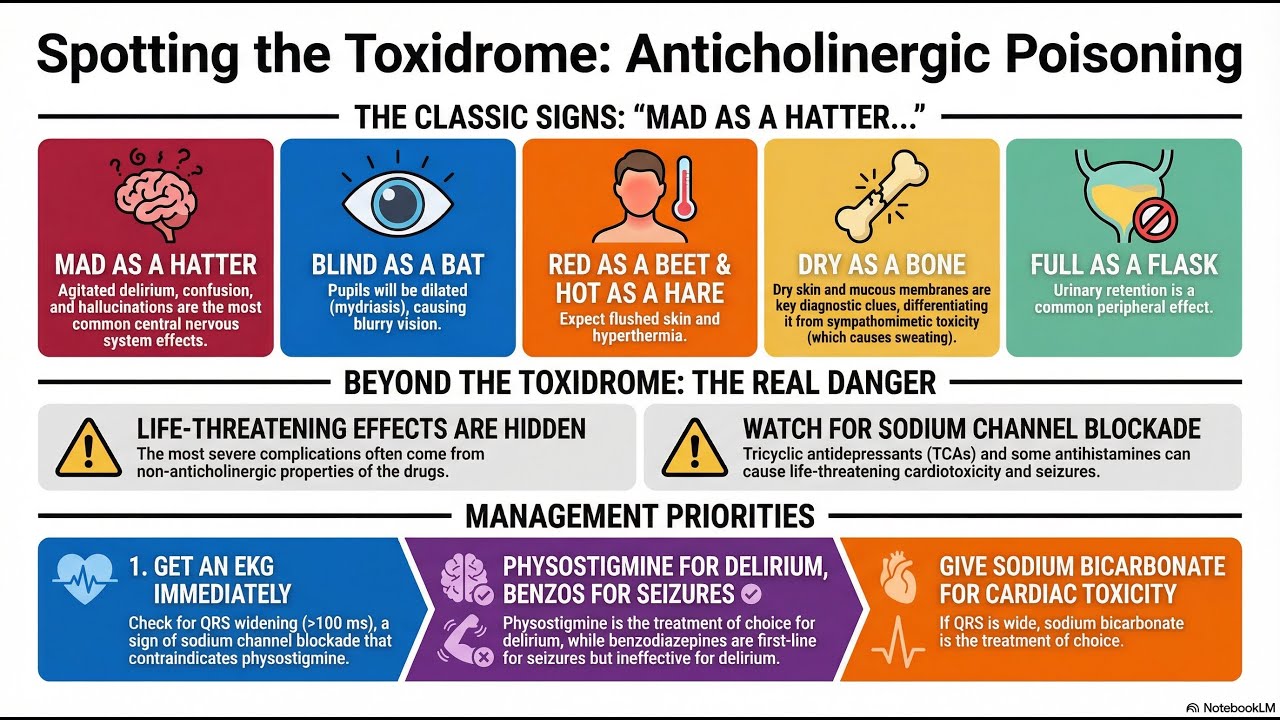
You'll learn about how these agents competitively block acetylcholine at muscarinic receptors, leading to a distinct set of symptoms known as the "anticholinergic toxidrome". Get ready to understand the classic mnemonic: "Mad as a hatter, blind as a bat, red as a beet, hot as a hare, dry as a bone, full as a flask". We'll break down the profound central effects like agitated delirium and hallucinations, as well as peripheral signs such as dilated pupils, flushed skin, hyperthermia, and urinary retention.
But here's a crucial twist: while anticholinergic effects define the toxidrome, life-threatening complications often come from other properties like sodium channel blockade found in agents such as tricyclic antidepressants (TCAs) and some first-generation antihistamines.
Diagnosis is mainly clinical, but a physostigmine challenge can confirm the toxidrome by rapidly reversing delirium. We also stress the essential role of an EKG to check for vital cardiac issues like QRS widening.
When it comes to management, general supportive care is key. You'll discover why physostigmine is the treatment of choice for central antimuscarinic delirium when not contraindicated, offering superior efficacy to benzodiazepines for reversing delirium and reducing intubation rates. We'll also cover the role of benzodiazepines for seizures (but their limitations for delirium), and explore alternatives like rivastigmine and dexmedetomidine. Don't miss out on important management for complications like QRS widening with sodium bicarbonate.
This content is perfect for anyone looking to deepen their understanding of anticholinergic intoxication, its varied presentations, critical diagnostic steps, and effective management strategies. Tune in!
Доступные форматы для скачивания:
Скачать видео mp4
-
Информация по загрузке: