How to Remove "First" Item From a Python Dictionary
Автор: vlogize
Загружено: 2025-09-17
Просмотров: 0
Discover how to effectively remove a generic item from a Python dictionary using recursion and built-in methods. Perfect for beginners looking to enhance their coding skills!
---
This video is based on the question https://stackoverflow.com/q/62997313/ asked by the user 'Raffaele de Matteis' ( https://stackoverflow.com/u/10640744/ ) and on the answer https://stackoverflow.com/a/62997370/ provided by the user 'K.Doruk' ( https://stackoverflow.com/u/7787544/ ) at 'Stack Overflow' website. Thanks to these great users and Stackexchange community for their contributions.
Visit these links for original content and any more details, such as alternate solutions, latest updates/developments on topic, comments, revision history etc. For example, the original title of the Question was: Remove "First" Item From Python Dict
Also, Content (except music) licensed under CC BY-SA https://meta.stackexchange.com/help/l...
The original Question post is licensed under the 'CC BY-SA 4.0' ( https://creativecommons.org/licenses/... ) license, and the original Answer post is licensed under the 'CC BY-SA 4.0' ( https://creativecommons.org/licenses/... ) license.
If anything seems off to you, please feel free to write me at vlogize [AT] gmail [DOT] com.
---
How to Remove "First" Item From a Python Dictionary: A Simple Guide
Removing elements from a Python dictionary can be a bit of a puzzle, especially if you're trying to work with recursion. Many new programmers face the challenge of efficiently removing an item from a dictionary without knowing its order. In this guide, we're going to break down how to remove a generic item from a dictionary and explore the concept of recursion in Python along with a handy method for manipulating dictionaries.
Understanding the Problem
A common exercise in Python is to sum the values of a dictionary. While there are straightforward methods such as using dictionary.values() or iterating through the dictionary, the challenge arises when you want to implement this using recursion. The fundamental question is:
How can we remove a "first" item from an unordered dictionary in Python?
Since dictionaries do not maintain order until Python 3.7 (and even then it's the insertion order), there isn't a way to directly access the "first" element like you would with a list.
Exploring the Initial Attempt
Here's an initial attempt at solving the problem recursively:
[[See Video to Reveal this Text or Code Snippet]]
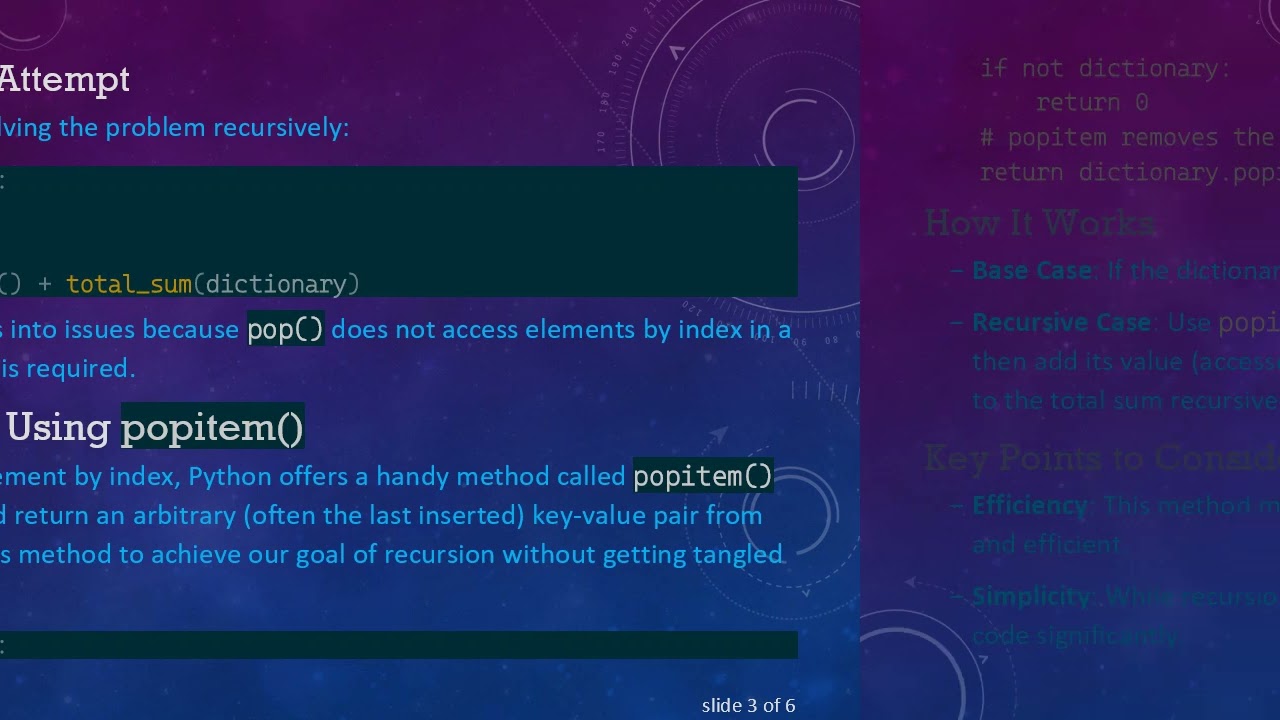
This code, while creative, runs into issues because pop() does not access elements by index in a dictionary. A better approach is required.
A Better Approach: Using popitem()
Instead of searching for an element by index, Python offers a handy method called popitem() that allows you to remove and return an arbitrary (often the last inserted) key-value pair from the dictionary. We can use this method to achieve our goal of recursion without getting tangled in complex logic:
[[See Video to Reveal this Text or Code Snippet]]
How It Works
Base Case: If the dictionary is empty, return 0. This is crucial for stopping the recursion.
Recursive Case: Use popitem() to remove the last item inserted into the dictionary. We then add its value (accessed using [1] since popitem() returns a tuple of (key, value)) to the total sum recursively computed for the reduced dictionary.
Key Points to Consider
Efficiency: This method makes use of Python's built-in capabilities, keeping the code clean and efficient.
Simplicity: While recursion might seem complex, using built-in methods can simplify your code significantly.
Unordered Nature: Remember that when using popitem(), you can retrieve and remove elements without needing to know their order.
Example in Action
Let's see how this method works with an example dictionary:
[[See Video to Reveal this Text or Code Snippet]]
This example effectively sums all the values in the dictionary, demonstrating how to remove generic items while leveraging recursion in Python.
Conclusion
The challenge of removing the "first" item from a Python dictionary can be effectively handled using the popitem() method. By understanding the structure of dictionaries and leveraging built-in methods, you can write more concise and readable recursive functions. This approach not only solves the problem but also enhances your understanding of Python’s powerful features.
If you're a beginner looking to improve your skills, experimenting with this technique will provide valuable insights into Python programming. Happy coding!
Доступные форматы для скачивания:
Скачать видео mp4
-
Информация по загрузке:











![[2026] Feeling Good Mix - English Deep House, Vocal House, Nu Disco | Emotional / Intimate Mood](https://image.4k-video.ru/id-video/cxLdtvzf2sI)

![Best of Vocal House [2025] English Deep House, Vocal House, Nu Disco, Chillout, hot mix](https://image.4k-video.ru/id-video/fideCsumVVo)