Transitioning from cv::Mat to cv::UMat in OpenCV: A Guide for Boosting Image Processing Speed
Автор: vlogize
Загружено: 2025-09-17
Просмотров: 5
Discover how to effectively use `cv::UMat` instead of `cv::Mat` in OpenCV to enhance image processing performance with OpenCL/GPU.
---
This video is based on the question https://stackoverflow.com/q/62153104/ asked by the user 'AbsurdePhoton' ( https://stackoverflow.com/u/10294357/ ) and on the answer https://stackoverflow.com/a/62225868/ provided by the user 'AbsurdePhoton' ( https://stackoverflow.com/u/10294357/ ) at 'Stack Overflow' website. Thanks to these great users and Stackexchange community for their contributions.
Visit these links for original content and any more details, such as alternate solutions, latest updates/developments on topic, comments, revision history etc. For example, the original title of the Question was: OpenCV C+ + using cv::UMat instead of cv:Mat and pointers
Also, Content (except music) licensed under CC BY-SA https://meta.stackexchange.com/help/l...
The original Question post is licensed under the 'CC BY-SA 4.0' ( https://creativecommons.org/licenses/... ) license, and the original Answer post is licensed under the 'CC BY-SA 4.0' ( https://creativecommons.org/licenses/... ) license.
If anything seems off to you, please feel free to write me at vlogize [AT] gmail [DOT] com.
---
Transitioning from cv::Mat to cv::UMat in OpenCV: A Guide for Boosting Image Processing Speed
If you're working with image processing in OpenCV, you may have come across the need to improve the performance of your applications, especially when dealing with larger datasets or real-time processing. One of the best ways to achieve this is by utilizing the power of OpenCL with cv::UMat. However, making this switch can come with challenges, especially when it comes to accessing image data. In this post, we'll explore the steps required to transition from using cv::Mat to cv::UMat, and cover what to keep in mind when accessing image data in this new format.
The Challenge: Accessing Image Data
One common issue developers face when switching from cv::Mat to cv::UMat is how to access the image data directly. Traditionally, accessing pixel data in a cv::Mat object could be done using pointers. For example:
[[See Video to Reveal this Text or Code Snippet]]
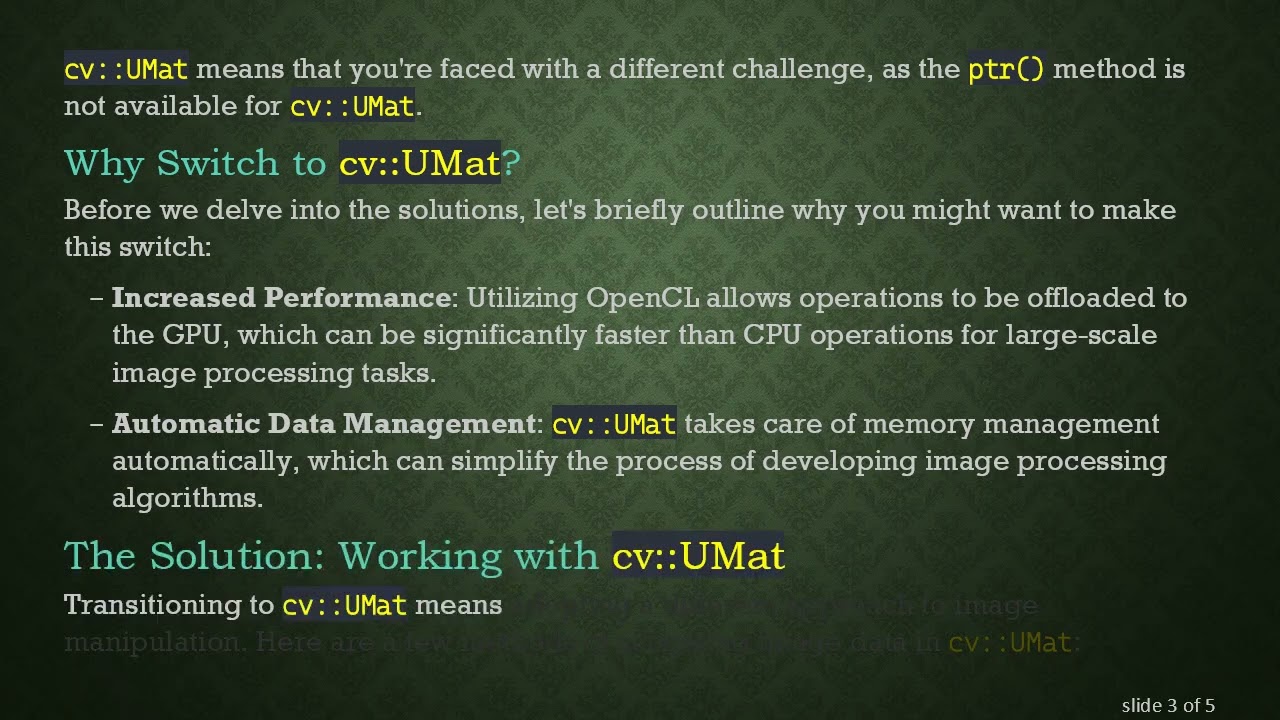
In this line, image is a cv::Mat, and y represents the line offset in the image. This method is efficient for directly manipulating pixel values. However, the switch to cv::UMat means that you're faced with a different challenge, as the ptr() method is not available for cv::UMat.
Why Switch to cv::UMat?
Before we delve into the solutions, let's briefly outline why you might want to make this switch:
Increased Performance: Utilizing OpenCL allows operations to be offloaded to the GPU, which can be significantly faster than CPU operations for large-scale image processing tasks.
Automatic Data Management: cv::UMat takes care of memory management automatically, which can simplify the process of developing image processing algorithms.
The Solution: Working with cv::UMat
Transitioning to cv::UMat means adopting a different approach to image manipulation. Here are a few methods of accessing image data in cv::UMat:
1. Utilize getMat() Method
Instead of using pointers directly, you can retrieve cv::Mat from cv::UMat for data manipulation. Use the getMat() method like this:
[[See Video to Reveal this Text or Code Snippet]]
2. Convert UMat to Mat Temporarily
Although this approach is not the most efficient (as it can introduce overhead), you may still want to convert to cv::Mat to utilize your existing code. Here’s how to do it:
[[See Video to Reveal this Text or Code Snippet]]
Keep in mind that copying back and forth between cv::Mat and cv::UMat can be slow, so this should be used judiciously.
3. Use OpenCL Kernels
If you're familiar with OpenCL programming, you could write custom kernels to perform your desired image operations directly on cv::UMat. This bypasses the need to convert to cv::Mat entirely. The setup can be more complex but offers the best performance advantages.
Final Thoughts
While transitioning from cv::Mat to cv::UMat can pose some initial hurdles, mainly in data access, the performance boosts achievable through OpenCL and GPU utilization are worth the effort. By adopting functions like getMat() and considering OpenCL kernels, you can effectively tap into the enhanced capabilities of cv::UMat.
Keep experimenting with different methods to find what works best for your specific application, and embrace the power of GPU computing in your OpenCV projects!
Доступные форматы для скачивания:
Скачать видео mp4
-
Информация по загрузке:










![Как происходит модернизация остаточных соединений [mHC]](https://image.4k-video.ru/id-video/jYn_1PpRzxI)
