How to Remove Elements from a List in Python Until the First Empty String
Автор: vlogize
Загружено: 2025-09-04
Просмотров: 1
Discover how to efficiently remove elements from your Python list until you encounter the first empty string. Learn step-by-step coding solutions.
---
This video is based on the question https://stackoverflow.com/q/64722194/ asked by the user 'Jean Khechfe' ( https://stackoverflow.com/u/9618984/ ) and on the answer https://stackoverflow.com/a/64722213/ provided by the user 'Aplet123' ( https://stackoverflow.com/u/5923139/ ) at 'Stack Overflow' website. Thanks to these great users and Stackexchange community for their contributions.
Visit these links for original content and any more details, such as alternate solutions, latest updates/developments on topic, comments, revision history etc. For example, the original title of the Question was: Remove element of list until getting to the first empty one in Python
Also, Content (except music) licensed under CC BY-SA https://meta.stackexchange.com/help/l...
The original Question post is licensed under the 'CC BY-SA 4.0' ( https://creativecommons.org/licenses/... ) license, and the original Answer post is licensed under the 'CC BY-SA 4.0' ( https://creativecommons.org/licenses/... ) license.
If anything seems off to you, please feel free to write me at vlogize [AT] gmail [DOT] com.
---
Removing Elements from a List in Python Until the First Empty String
When working with lists in Python, you may encounter situations where you need to filter out elements until you find a specific condition, such as an empty string. This task can be particularly useful when processing user inputs or cleaning data. In this post, we'll explore how to effectively accomplish this with a well-defined function.
The Problem
You have a list of strings, and your goal is to remove all elements from the start of the list until you reach the first empty string. For example, given the list:
[[See Video to Reveal this Text or Code Snippet]]
You want to transform it into:
[[See Video to Reveal this Text or Code Snippet]]
It's important to note that you want to retain all elements that come after the first empty string.
The Initial Attempt
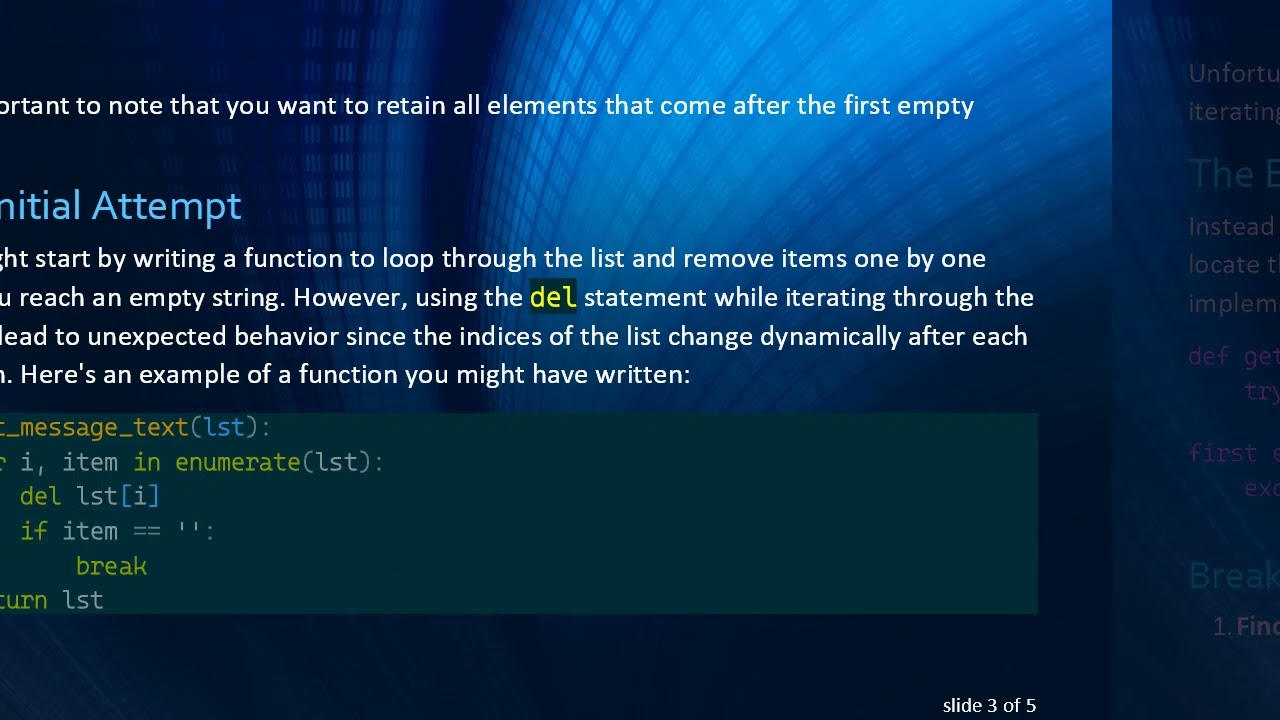
You might start by writing a function to loop through the list and remove items one by one until you reach an empty string. However, using the del statement while iterating through the list can lead to unexpected behavior since the indices of the list change dynamically after each deletion. Here's an example of a function you might have written:
[[See Video to Reveal this Text or Code Snippet]]
Unfortunately, this approach can yield incorrect results because removing elements while iterating can skip certain items or create index errors.
The Efficient Solution
Instead of modifying the list in-place, a more efficient way to achieve your goal would be to locate the index of the first empty string and slice the list accordingly. Here's how you can implement this solution:
[[See Video to Reveal this Text or Code Snippet]]
Breakdown of the Solution
Finding the Index:
We use the index() method to find the position of the first empty string (""). If it exists, it returns the index; if not, it raises a ValueError.
Slicing the List:
By utilizing Python's slicing capability, lst[index + 1:] creates a new list starting just after the first empty string.
Handling Exceptions:
The try-except block ensures that if there is no empty string in the list, the function returns an empty list, avoiding a potential error.
Conclusion
By using this approach, you can confidently filter your list to retain the desired elements while eliminating unnecessary complication. Implementing the function as shown makes your code cleaner and more efficient compared to using iterative deletion.
Feel free to test this function with various lists, and see how it performs! Happy coding!
Доступные форматы для скачивания:
Скачать видео mp4
-
Информация по загрузке:


![Курс Python с Абсолютного нуля! [12 часов из 80] Python курс - качественный старт для начинающих!](https://image.4k-video.ru/id-video/lYMLLI-MJek)


![Python - Полный Курс по Python [15 ЧАСОВ]](https://image.4k-video.ru/id-video/cfJrtx-k96U)


