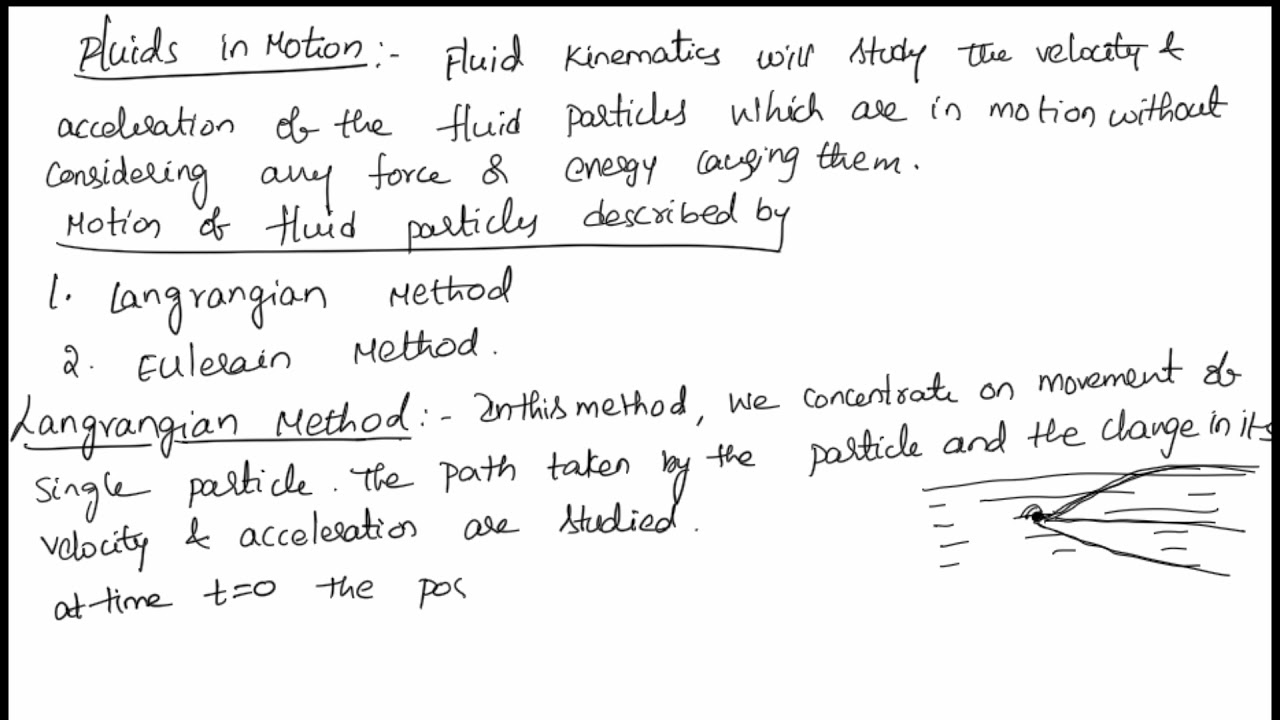
LAGRANGIAN METHOD OF FLUIDS IN MOTION || FLUID MECHANICS || LAGRANGIAN AND EULERAIN METHOD
Автор: e Tution
Загружено: 2018-03-18
Просмотров: 28781
LAGRANGIAN METHOD OF FLUIDS IN MOTION || FLUID MECHANICS || LAGRANGIAN AND EULERAIN METHOD
#LAGRANGIANMETHOD , #LAGRANGIAN , #ETUTION , #FLUIDMECHANICS
Methods of Describing Fluid Motion
1 Lagrangian description
A particle is identified by its initial position at time t0,
~x0 = (x0, y0, z0) (1.1.1)
Let
~x = ~x (~x0, t) (1.1.2)
be the position of the same particle at the later time t. By definition, at t = t0, ~x (~x0, t0) = ~x0.
Instead of the initial position ~x0, one can use any three quantities a, b, c, which are uniquely
related to ~x0:
~x0 = ~x0 ~(a) ~a ≡ (a, b, c) (1.1.3)
to identify the particle. Thus the path of a particle identified by ~a is given by :
~x = ~x(~a, t). (1.1.4)
Note that ~a, t are the independent variables, and ~x = (x, y, z) are dependent variables.
From the particle position we can calculate the particle velocity:
~q = ∂~x
∂t
Ø
Ø
Ø
Ø
Ø
~a
,
as well as the particle acceleration
Other physical quantities such as density ρ and pressure p can also be expressed in terms of
~a, t, e.g.,
ρ = ρ (~a, t), p = p (~a, t).
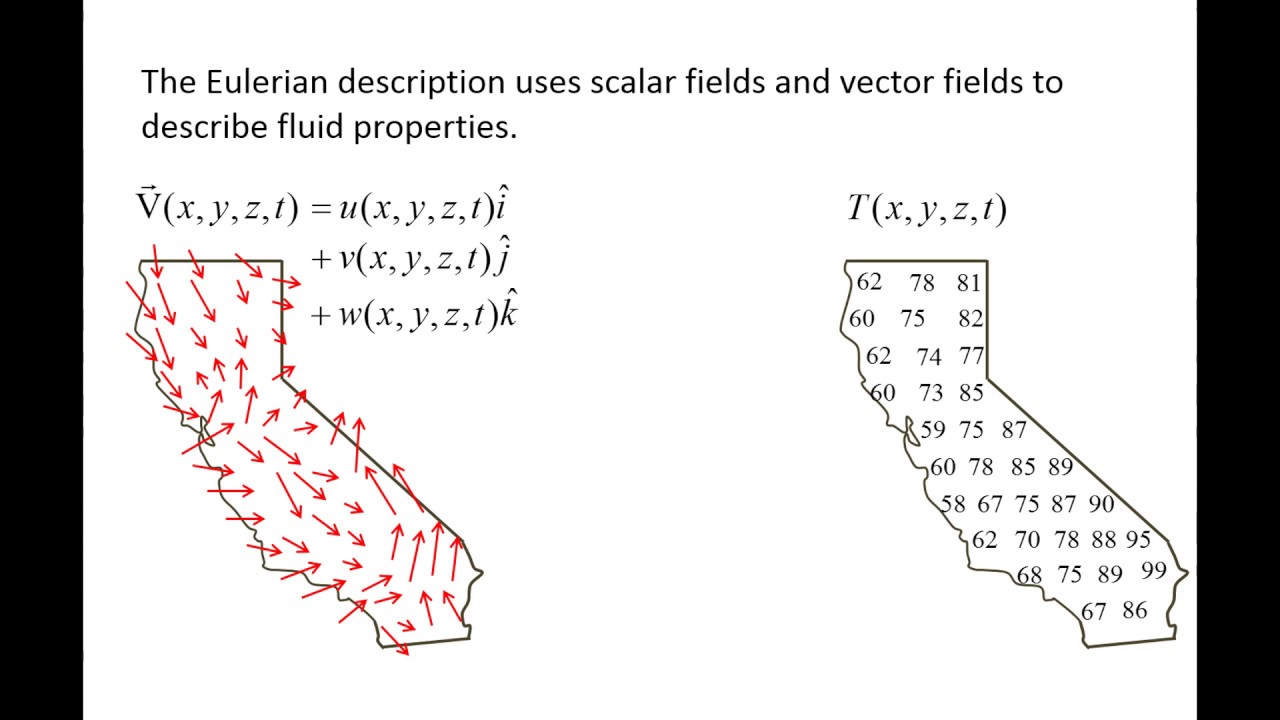
.2 Eulerian Description
Here we specify the fluid properties (density, velocity, pressure...) at a fixed point and a
chosen time. Thus we are dealing with the time records of a property at a fixed measuring
probe.
~q (~x, t) , ρ (~x, t) , p (~x, t) , etc.
Once a physical property of all particles are known at all times, how do we get the property
at all fixed points at all times? In other words, how are the Eulerian and Lagrangian systems
related? Suppose first that the Lagrangian information of the velocity of all particles are
known :
~q = ~q (~a, t)
then we can integrate the definition
∂~x
∂t = ~q (~a, t)
for to get the position of a particle,
~x = ~x (~a, t) (1.1.11)
so that ~ x(~a, 0) = ~a.
The result can be inverted in principle to get
~a = ~a (~x, t) (1.1.12)
as long as the Jacobian of transformation
J = ∂(x, y, z)
∂(a, b, c) =
∂x
∂a
∂x
∂b
∂x
∂c ∂y
∂a
∂y
∂b
∂y
∂c ∂z
∂a
∂z
∂b
∂z
∂c
6= 0.
does not vanish. Once the position of a particle at time t is known, any physical property
of a particle can be translated to the property at certain position in space. For example, by
substituting into , we get
~q = ~q (~x, t),
which gives the Eulerian velocity, i.e., the velocity field at all fixed points. Similarly from
the Lagrangian pressure p((~a, t) we get the Eulerian pressure
p((~a(~x, t), t) = p(~x, t)
Consider next that the Eulerian velocity field is known everywhere:
~q = ~q (~x, t) (1.1.15)
Since at t the particle ~a is at ~x (~a, t); the Lagrangian velocity of particle ~a is the same as the
Eulerian velocity. Therefore,
~q (~x, t) = ∂~x
∂t
This equation is a system of nonlinear ordinary differential equations. If they can be solved
for ~x = ~x (~a, t) subjected to the initial condition ~x = ~x0 (~a), t = t0, we then have
∂~x
∂t = ~q [~x (~a, t), t]
≡ ~qL(a, t) ≡ ~qLagrangian
For the rate of variations we need to calculate derivatives of some physical quantity
A (~x, t) whose Eulerian information is given. The rate of variation following a fluid particle
is ∂A
∂t
~a
,
∂A
∂t
Ø
Ø
Ø
~a = ∂A
∂t + ∂A
∂xi
∂xi
∂t
Ø
Ø
Ø
~a = ∂A
∂t + qi
∂A
∂xi
(Lagrangian) (Eulerian) (1.1.17)
The operator
D
Dt = ∂
∂t
qi
∂
∂xi
(1.1.18)
has different names: the substantial, or total, or material derivative. The second term is
referred to as the convective rate of variation since it arises because the fluid particle moves
to new places. In particular, the acceleration of a fluid particle is
∂2~x(~a, t)
∂t2 = ∂~q
∂t + ~q · ∇~q = D~q
Dt. (1.1.19)
A more physical interpretation of Df/Dt can be derived by using the Eulerian picture
directly. Consider f (~x, t). After δt, f(~x, t) is changed to f(~x + ~qδt, t + δt). Therefore, the
total change of f is
δf = f [~x + ~qδt, t + δt] − f (~x, t)
= f (~x, t) + Ã
~q · ∇f +
∂f
∂t
!
δt − f (~x, t) = Df
Dt δt.
It follows that
δf
δt
~a
= Df
Dt = ∂f
∂t + ~q · ∇f (1.1.20)
where ∂f
∂t is the instantaneous change, and ~q ·
RELATED TAGS :
lagrangian method for fluid in motion,eulerian fluid,lagrangian fluid motion,eulerian method,lagrangian and eulerian approach in fluid mechanics,difference between lagrangian and eulerian approach,lagrangian and eulerian approach,lagrangian approach,what is a lagrangian,fluid kinematics,euler lagrange equations,lagrangian mechanics,eulerian,lagrangian,eulerian equation,euler lagrange method,fluid mechanics,euler lagrange,lagrangian method for fluid in motion,eulerian fluid,lagrangian fluid motion,eulerian method,lagrangian and eulerian approach in fluid mechanics,difference between lagrangian and eulerian approach,lagrangian and eulerian approach,lagrangian approach,what is a lagrangian,fluid kinematics,euler lagrange equations,lagrangian mechanics,eulerian,lagrangian,eulerian equation,euler lagrange method,fluid mechanics,euler lagrange
Доступные форматы для скачивания:
Скачать видео mp4
-
Информация по загрузке: