HINDUISM, ISLAM, CHRISTIANITY - Understanding BASICS - Authored By Sudhir Sinha IITR'1973 using AI
Автор: MaBharti.Vision2025
Загружено: 2026-01-20
Просмотров: 162
#sanatni , #hinduism, #islam, #christian, #india
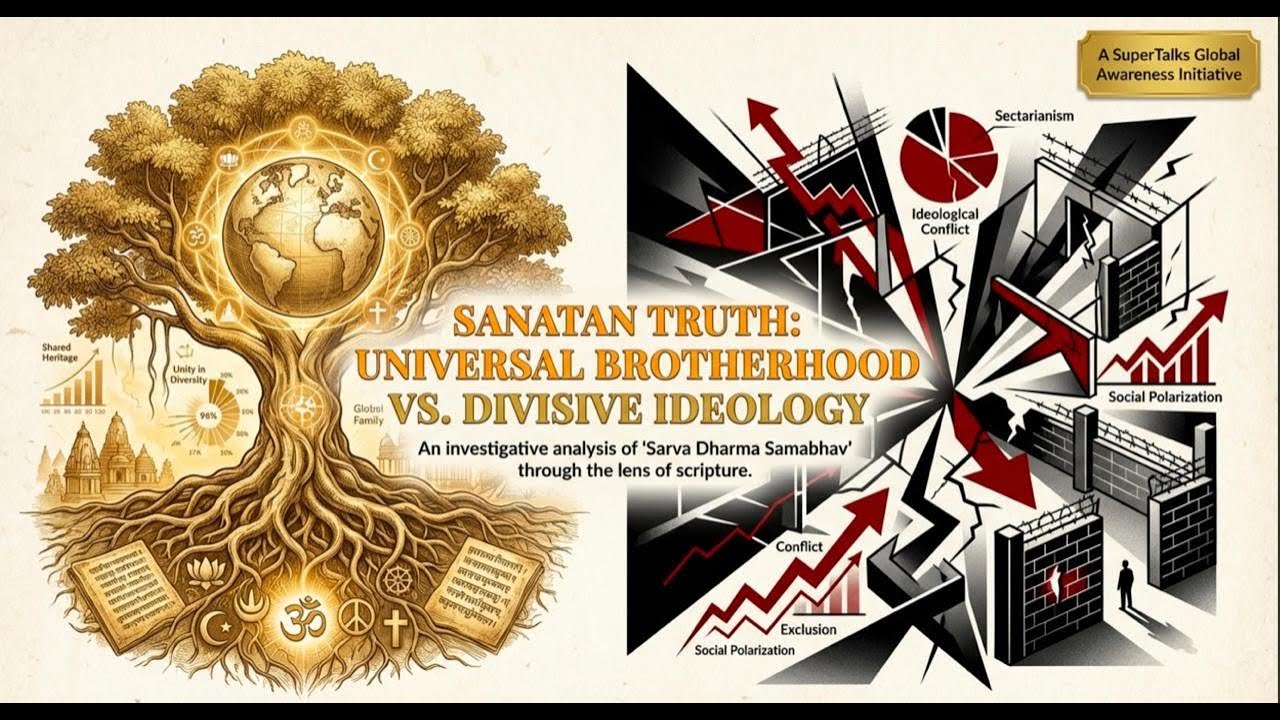
This podcast script explores the fundamental differences between Sanatan Dharma and Abrahamic faiths, focusing on the contrast between universal inclusion and ideological exclusivity. The speakers argue that while ancient Indian philosophy promotes the well-being of all humanity, certain religious texts contain divisive mandates that hinder true social harmony. By analyzing specific verses from the Quran and the Bible, the dialogue challenges the popular notion that all religions convey the same message. The discussion suggests that Sanatan Dharma values genuine acceptance of diverse paths, whereas other systems may prioritize conversion or intolerance toward outsiders. Ultimately, the source advocates for global awareness and a fact-based understanding of religious doctrines to achieve authentic peace.
How does Sanatan Dharma's inclusive worldview differ from the exclusive nature of Abrahamic faiths?
What specific scriptural passages highlight fundamental ideological conflicts between global religions and Sanatan truth?
Why does the text argue that universal brotherhood requires understanding different religious ideologies' goals?
Monday, January 19
How do sacred texts create fundamental differences between inclusive and exclusionary religious belief?
Based on the provided sources, which contain a podcast script titled "Sanatan Truth: Universal Brotherhood vs. Divisive Ideology," sacred texts create fundamental differences between inclusive and exclusionary beliefs by defining the scope of welfare, the validity of other paths, and the nature of the relationship with non-believers.
Here is how the sources analyze these textual differences:
1. Inclusive Texts: Universal Welfare and Acceptance The sources describe Sanatan Dharma as fundamentally "inclusive" because its texts advocate for the well-being of the entire world rather than a specific group.
• Universal Prayer: Sanatan texts do not ask for the welfare of only Hindus; rather, they proclaim "Vishwa Kalyan" (welfare of the world). The source cites the mantra Sarve Bhavantu Sukhinah ("May all be happy, may all be disease-free") as evidence of this universal generosity.
• The World as Family: The philosophy is rooted in the text Vasudhaiva Kutumbakam, meaning "the whole earth is one family," which rejects distinctions of "mine" vs. "yours" or "high" vs. "low".
• Acceptance vs. Tolerance: The source notes that Sanatan Dharma teaches "Acceptance" (Swikaryata), which is distinct from the mere "Tolerance" preached by other faiths.
2. Exclusionary Texts: Monotheism and Rejection of "The Other" The sources argue that Abrahamic texts promote an "exclusionary" mindset by validating only their specific deity and invalidating other forms of worship.
• Exclusivity in Worship: The source references the Islamic declaration La Ilaha Illallah, interpreting it to mean that "only Allah is worthy of worship," implying that all other gods or paths are false. This fundamental teaching makes practices like Vande Mataram (worship of the motherland) controversial because worshiping anything other than Allah is considered shirk (sin).
• Mandate for Conflict: The source cites the Quran (Surah At-Tawbah 9:5) as instructing believers to target "mushriks" (idolaters) until they convert. The speaker argues that religious education based on these texts teaches children to view those who think differently not as brothers, but as "kafirs" (infidels) or targets.
• Ideological Division: Regarding Christianity, the source challenges the notion of Jesus as a solely peaceful figure by citing the Bible (Matthew 10:34-36). The text is quoted as saying, "I came not to bring peace, but a sword," explicitly stating the intent to divide families (son against father). The source interprets this as a text aiming for "ideological division" rather than social harmony.
3. The Impact on Social Harmony The sources conclude that true brotherhood is impossible when sacred texts create an "us versus them" dynamic.
• Reciprocity: The speaker argues that brotherhood requires two hands to clap; one cannot form a bond if the other person's scripture forbids them from recognizing you as a brother.
• The Root of Conflict: Social conflict arises when people blindly accept the slogan "all religions are one" without understanding that some texts explicitly define non-believers as enemies or "lost".
Disclaimer: The information provided above is based strictly on the arguments and interpretations found in the provided podcast script "Sanatan
Доступные форматы для скачивания:
Скачать видео mp4
-
Информация по загрузке: