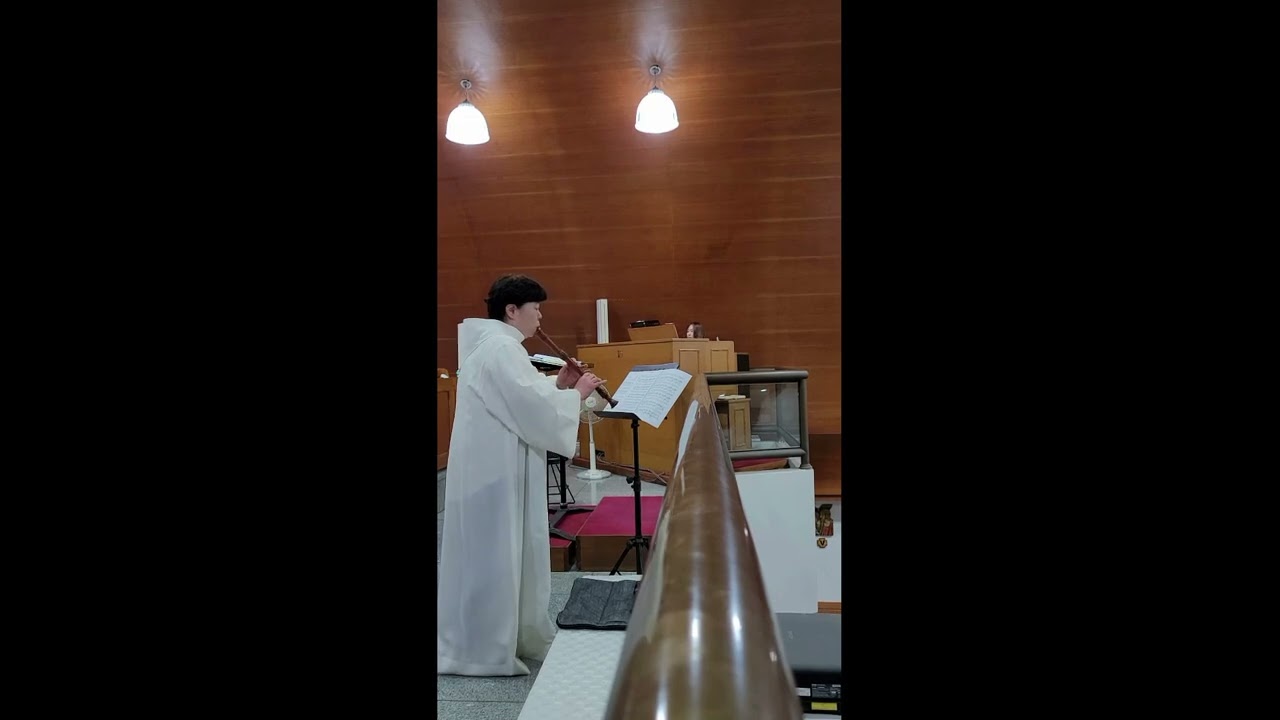
20030625 Trotto/ Pavanne Lachryme/ Fantasia No. 6 in F minor
Автор: Klara Song
Загружено: 2023-01-24
Просмотров: 230
Sang-Un Song, sop & alt recorder,
2003. June. 25
Rehearsal at Performing Arts Studio, EMORY
1. Dances of the Jongleurs in Medival Italy (15th Century) - Trotto
2. Jacob van Eyck (ca.1590-1657) - Pavanne Lachryme
from Der Fluyten Lust-hof (The Flutes Garden of Delights,1648)
3. Georg Philipp Telemann (1681-1767) - Fantasia No. 6 in F minor
[Program Notes]
1. Dances of the Jongleurs in Medieval Italy (15th Century) - Trotto
This Trotto is an example of some of the dance music played by jongleurs, who were wandering minstrels in medieval Europe. Because Jongleurs generally did not know how to write music notation, the music was dictated to monks. Jongleurs would have performed this music on a melody instrument, such as a recorder, and would have used percussion accompaniment and dromes.
2. Jacob van Eyck (ca.1590-1657) - Pavanne Lachryme from Der Fluyten Lust-hof (1648)
Der Fluyten Lust-hof remains the largest work in European history written for a wind instrument, besides being the only opus of this size not composed in the usual sense, but “dictated” by the author as he improvised. The Pavanne Lachryme is one of John Dowland’s (1562-1626) most famous songs in the renaissance period. The original name of this song is “Flow my tears” composed by Anonymus and this song was also arranged by many other composers in the renaissance and early Baroque periods. Van Eyck’s is the only one for a solo instrument with no harmony accompaniment.
3. Georg Philipp Telemann (1681-1767) - Fantasia No. 6 in F minor
The 12 Fantasias (TWV40: 2-13, published 1732-33) were written by Georg P. Telemann and were originally composed for a solo transverse flute without accompaniment. Each piece was written with 12 different keys and loosely follows the basic pattern of an Italian sonata. An introduction (fast or slow) usually leads to a movement with strongly profiled themes (often alluding to a fugue); some pieces contain extra movements after this, but all end with a movement alluding to the style and gesture of dance. Each movement of Fantasia No. 6 (in F minor) features the notes C, F, and E, generating three completely different characters: a singing Dolce, a serious, almost archaic fugue, and a spirited rondo in a teasing triple meter. The Fantasia No.6 was originally written in D minor, but transposed to F minor for the alto recorder.

Доступные форматы для скачивания:
Скачать видео mp4
-
Информация по загрузке: