Self Complementing Codes in Digital Logic Design | Explained with Examples
Автор: EE-Vibes (Electrical Engineering Lessons)
Загружено: 2025-09-13
Просмотров: 158
Self-complementing codes are a special type of weighted binary codes in which the 9’s complement (or 1’s complement in binary) of a decimal digit can be obtained just by inverting (complementing) each bit of its code word.
👉 In other words:
If a code is self-complementing, then the code for digit 𝑑 and the code for digit 9−𝑑 are bitwise complements of each other.
Key Properties
The sum of the weights of the code = 9 (this ensures the complement property works correctly).
Very useful in decimal arithmetic (e.g., subtraction using 9’s complement).
Used in digital systems for error detection and simplification of operations.
Examples of Self-Complementing Codes
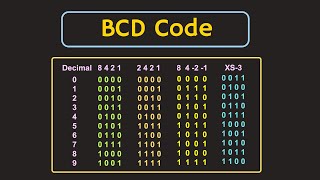
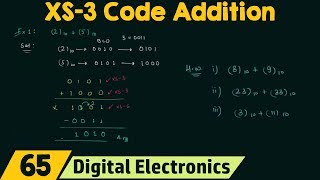
✅ Excess-3 (XS-3) Code
A non-weighted code but self-complementing.
Each decimal digit = its 8421 BCD + 3.
Example:
Decimal 2 → 0101 (Excess-3)
Decimal 7 → 1010 (Excess-3)
Notice: 2 and 7 are complements (2 + 7 = 9), and their codes are bitwise complements.
✅ 2421 Code
Weighted code with weights (2, 4, 2, 1).
Example:
Decimal 3 → 0011 (2421)
Decimal 6 → 1100 (2421)
Codes are complements.
✅ 84-2-1 Code
Weighted code with weights (8, 4, –2, –1).
Also self-complementing.
Learn about self-complementing codes in digital electronics with clear examples.
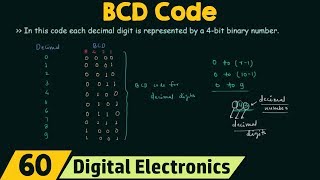
Understand why Excess-3 code, 2421 code, and 84-2-1 code are called self-complementing codes, and how they are different from BCD (8421 code). Perfect for students of Digital Logic Design (DLD), Computer Organization, and Electronics Engineering.
self complementing codes
self complementing codes in digital logic design
excess-3 code explained
2421 code in digital electronics
84-2-1 code
examples of self complementing codes
weighted and non-weighted codes
difference between BCD and excess-3 code
digital codes tutorial
DLD important questions

Доступные форматы для скачивания:
Скачать видео mp4
-
Информация по загрузке: