How to Create a Container Panel for Buttons in ExtJS
Автор: vlogize
Загружено: 2025-08-22
Просмотров: 0
Learn how to create an interactive `Container Panel` for your buttons in ExtJS, including step-by-step instructions and tips for troubleshooting.
---
This video is based on the question https://stackoverflow.com/q/64110655/ asked by the user 'user1319236' ( https://stackoverflow.com/u/13892972/ ) and on the answer https://stackoverflow.com/a/64110837/ provided by the user 'Dipen Shah' ( https://stackoverflow.com/u/1177814/ ) at 'Stack Overflow' website. Thanks to these great users and Stackexchange community for their contributions.
Visit these links for original content and any more details, such as alternate solutions, latest updates/developments on topic, comments, revision history etc. For example, the original title of the Question was: Problem creating a container Panel in ExtJS
Also, Content (except music) licensed under CC BY-SA https://meta.stackexchange.com/help/l...
The original Question post is licensed under the 'CC BY-SA 4.0' ( https://creativecommons.org/licenses/... ) license, and the original Answer post is licensed under the 'CC BY-SA 4.0' ( https://creativecommons.org/licenses/... ) license.
If anything seems off to you, please feel free to write me at vlogize [AT] gmail [DOT] com.
---
How to Create a Container Panel for Buttons in ExtJS
If you're new to ExtJS and looking to create a container panel for your buttons but facing challenges, you’re in the right place! Many beginners encounter difficulties when starting with this powerful JavaScript framework. In this post, we will walk you through the steps needed to successfully create a container panel for your buttons, ensuring it renders correctly on your page.
Understanding the Problem
Your initial attempt to create a button within a container panel didn't display anything on the screen, even though there weren’t any errors in the console. This can be quite frustrating, especially when you’re eager to see your components in action. In ExtJS, simply defining components isn't enough — they also need to be created and rendered properly to be visible in the browser.
Step-by-Step Solution
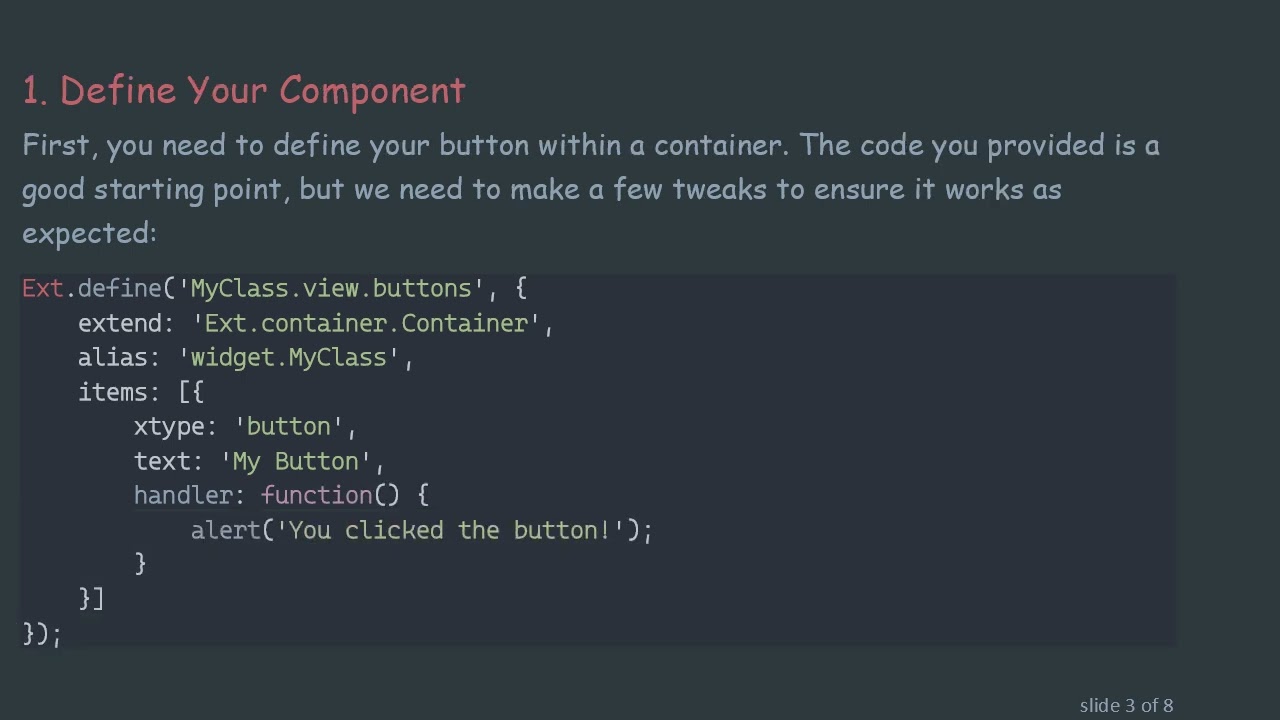
1. Define Your Component
First, you need to define your button within a container. The code you provided is a good starting point, but we need to make a few tweaks to ensure it works as expected:
[[See Video to Reveal this Text or Code Snippet]]
2. Using a Custom Button Container
To make your container more functional, consider defining another container that utilizes the first one as its item. Here’s an example:
[[See Video to Reveal this Text or Code Snippet]]
3. Render the Panel
Next, you need to create an instance of your container and render it to the DOM. This is crucial for the components to appear on your web page:
[[See Video to Reveal this Text or Code Snippet]]
4. Final Code Review
Putting it all together, here is your complete code snippet:
[[See Video to Reveal this Text or Code Snippet]]
Conclusion
Creating a container panel for buttons in ExtJS may seem tricky at first, but once you understand the structure and process, it becomes much simpler. Remember the importance of rendering your components to a designated area in the DOM, and don't forget to utilize handlers for interactive functionalities.
Key Takeaways:
Always render your components to the DOM to visualize them.
Use handler properties to add interactivity to buttons.
Reuse defined components effectively to maintain a clean code structure.
By following these steps, you can enhance the interactivity in your ExtJS applications. Happy coding!
Доступные форматы для скачивания:
Скачать видео mp4
-
Информация по загрузке: