Understanding the Difference Between null in JavaScript and None in Python
Автор: vlogize
Загружено: 2025-09-08
Просмотров: 0
Discover why `null` from JavaScript does not convert to `None` in Python and learn effective solutions to handle this issue in Django REST Framework.
---
This video is based on the question https://stackoverflow.com/q/63340607/ asked by the user 'Nimish Bansal' ( https://stackoverflow.com/u/7698247/ ) and on the answer https://stackoverflow.com/a/63340869/ provided by the user 'Masklinn' ( https://stackoverflow.com/u/8182118/ ) at 'Stack Overflow' website. Thanks to these great users and Stackexchange community for their contributions.
Visit these links for original content and any more details, such as alternate solutions, latest updates/developments on topic, comments, revision history etc. For example, the original title of the Question was: JavaScript Null does not convert to None
Also, Content (except music) licensed under CC BY-SA https://meta.stackexchange.com/help/l...
The original Question post is licensed under the 'CC BY-SA 4.0' ( https://creativecommons.org/licenses/... ) license, and the original Answer post is licensed under the 'CC BY-SA 4.0' ( https://creativecommons.org/licenses/... ) license.
If anything seems off to you, please feel free to write me at vlogize [AT] gmail [DOT] com.
---
Understanding the Difference Between null in JavaScript and None in Python
Working with web development often requires integration between different programming languages and frameworks. One common problem that developers face is handling null values in JavaScript when they are sent to a backend written in Python, particularly using Django or Django REST Framework. In this post, we will explore why JavaScript's null does not convert to Python's None and discuss effective solutions to manage this discrepancy.
The Problem at Hand
When you send form data from a JavaScript application with a key set to null, the server receives it as the string "null" rather than the actual None that Python would expect. This can lead to confusion and unintended behavior in your application.
For example, consider the following code snippet you might encounter in a Django REST Framework view:
[[See Video to Reveal this Text or Code Snippet]]
In this example, when request.data.get('key') is accessed, it yields "null", but ideally, it should yield None. This issue is not with Django or the Django REST Framework but rather with how web forms communicate data.
Understanding the Conversion Issue
Why Does This Happen?
No Concept of Null in HTTP: In HTTP form-data, there is no inherent representation of null. Instead, values might be omitted entirely or submitted as empty strings.
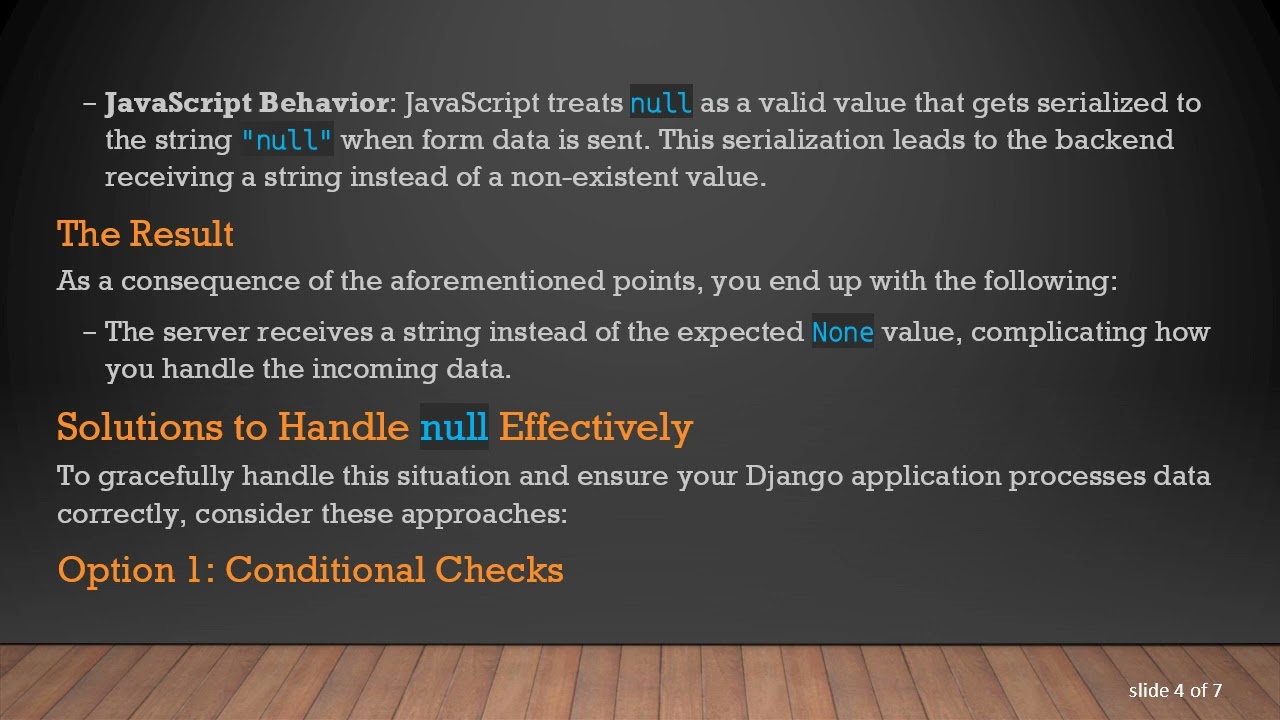
JavaScript Behavior: JavaScript treats null as a valid value that gets serialized to the string "null" when form data is sent. This serialization leads to the backend receiving a string instead of a non-existent value.
The Result
As a consequence of the aforementioned points, you end up with the following:
The server receives a string instead of the expected None value, complicating how you handle the incoming data.
Solutions to Handle null Effectively
To gracefully handle this situation and ensure your Django application processes data correctly, consider these approaches:
Option 1: Conditional Checks
You can check for the string representation of null when processing the request data. For example, you can modify your existing code as follows:
[[See Video to Reveal this Text or Code Snippet]]
While this approach works, it may not be the cleanest or most elegant solution.
Option 2: Custom Parsing Middleware
If you consistently deal with null values in your application, you can create a custom middleware to preprocess form data:
Create Middleware: Write a middleware component that intercepts the data before it hits your view functions.
Convert "null" to None: In your middleware, check for any occurrences of "null" in the request data and convert it to None.
This way, you can ensure that throughout your application, "null" values are managed before they even reach your view logic.
Option 3: Frontend Changes
If applicable, modify the JavaScript code responsible for sending the form data. Instead of sending null, you can skip the key entirely or send an empty string in cases where null would be used. This could take the following form in JavaScript:
[[See Video to Reveal this Text or Code Snippet]]
Conclusion
Understanding the way data is passed from JavaScript to Python is crucial for developing efficient web applications. By recognizing that null in JavaScript becomes a string when submitted in form data, you can implement strategies to handle this discrepancy effectively in Django or Django REST Framework. Whether through conditional checks, custom middleware, or frontend adjustments, addressing this challenge will pave the way for more reliable and intuitive application behavior.
By considering these options, you can maintain a cleaner codebase while ensuring that your application handles form data as expec
Доступные форматы для скачивания:
Скачать видео mp4
-
Информация по загрузке: