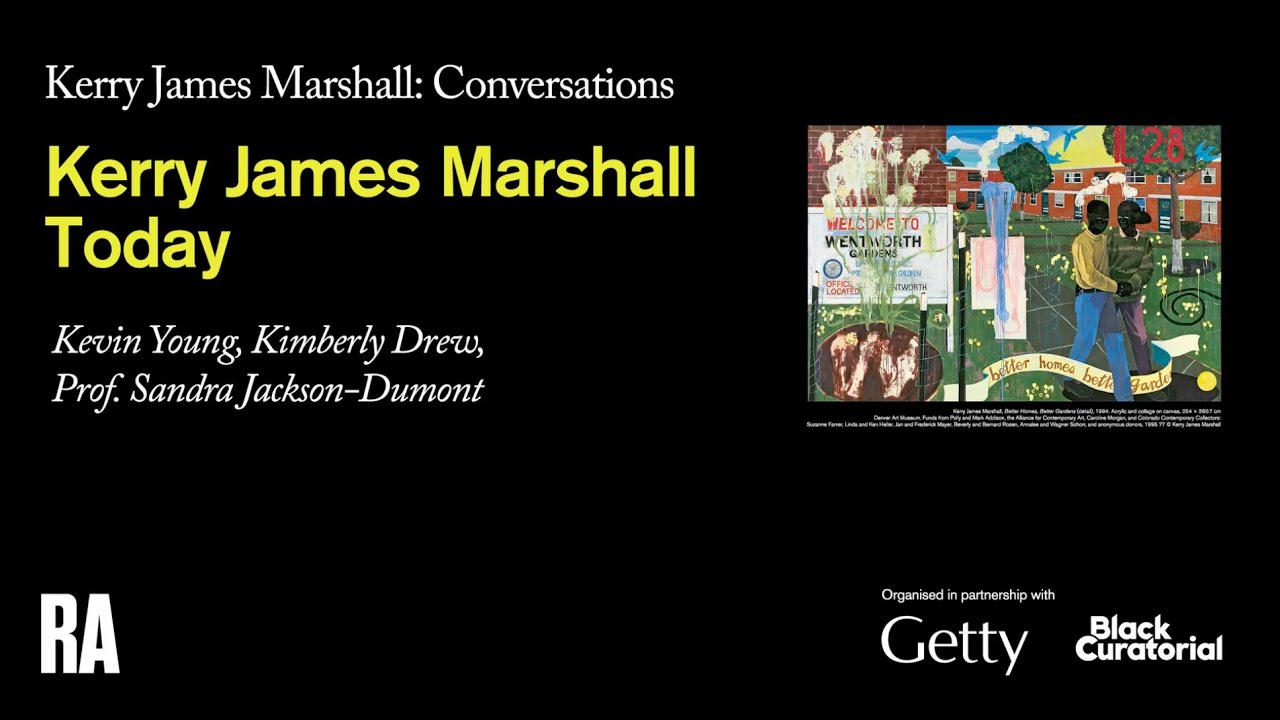
Kerry James Marshall Today | Royal Academy Symposium (Session 3/6)
Автор: Getty Research Institute
Загружено: 2026-01-15
Просмотров: 5
The symposium ‘Kerry James Marshall: Conversations’ was held at the Royal Academy of Arts in London on November 13–14, 2025. Organized in partnership with Getty and Black Curatorial.
Watch more sessions from the symposium:
• Плейлист
Speakers: Kevin Young, Kimberly Drew
Chaired by Prof. Sandra Jackson-Dumont
Marshall’s deep engagement with history, whether the history of art or American history, facilitates a way of looking at our contemporary moment. While he has previously expressed skepticism about the ability of art to affect socio-political change, Marshall’s paintings have drawn on significant cultural, political, and historical periods. The panel will explore how engagement with Marshall’s work might help us to contemplate the present moment– from reflections on ideas of beauty and agency, to the Black experience today.
Provocation, Provacature, Provoked
Presented by Prof. Sandra Jackson-Dumont
Kerry James Marshall’s work doesn’t just hang on museum walls. It speaks, interrupts, and insists. His paintings, rich with historical reference and unapologetic Black presence, ignite conversations that ripple far beyond the gallery floor. In museum spaces, where language often calcifies into curatorial convention, Marshall’s work provokes even the most seasoned professionals to pause, reconsider, and reframe. Take ‘Untitled (Policeman)’ or ‘Portrait of Nat Turner With the Head of His Master.’ These are not passive images. They demand that we confront the assumptions embedded in our interpretive frameworks: Who is the subject? What is the story? What language do we use to describe Black life, Black beauty, Black resistance? Marshall’s deep engagement with both American history and the history of art destabilizes the idea of neutrality in museum discourse. His Garden Project series, for instance, challenges the romanticization and stereotyping of public housing, while ‘Untitled (Beauty Queen)’ forces a reexamination of aesthetic hierarchies. These works do not offer easy answers. They offer friction. And in that friction, museum staff, educators, and audiences alike
find themselves asking better questions. This talk is not about solving Marshall. It’s about letting his provocations do their work, unsettling, illuminating, and ultimately
expanding the possibilities of how we see and speak in the museum.
Dark Song: the poetics of Kerry James Marshall
Presented by Kevin Young
From his early Scout series through his Gardens and memorials, including most recently at the US National Cathedral, Kerry James Marshall has engaged with poetry as well as a broader painterly poetics. This presentation explores this poetic journey through verse and song as embodied by Marshall’s lyrical work.
The Divine Feminine in the Work of Kerry James Marshall
Presented by Kimberly Drew
Within Kerry James Marshall’s canvases, women are figures of beauty and desire as well as conduits of power, mediation, and divinity. His portrayals are often infused with the syncretic spiritualities that emerged from the transatlantic slave trade, where Yoruba cosmologies intertwined with Christianity to form devotional practices across the African diaspora. Through allegory and history painting, Marshall stages these spiritual and ancestral energies in scenes that invite both recognition and reverence. His women are not confined by the reductive narratives historically imposed upon female bodies in Western art. Instead, they emerge as bearers of wisdom, custodians of cultural survival, and embodiments of the sacred. Their presence invites reflection on maternity -- not simply as a fact of biological reproduction -- but as the intellectual and emotional labor of sustaining communities and futures amid rupture.
In a world witnessing renewed assaults on women’s bodies and autonomy, Marshall’s exaltation of the divine feminine feels profoundly urgent. Within his work, womanhood is not sentimentalized but monumentalized. His engagement with orixás resists readings of Black women as muses, victims, or misandrists, instead presenting them as spiritual protagonists whose power exceeds the frame — reminding us that honoring the maternal and the mystical remains essential to Black cultural life.
______________________________________________________________________
Getty African American Art History Initiative:
https://www.getty.edu/projects/africa...
Getty Research Institute:
https://www.getty.edu/research-instit...
Доступные форматы для скачивания:
Скачать видео mp4
-
Информация по загрузке: