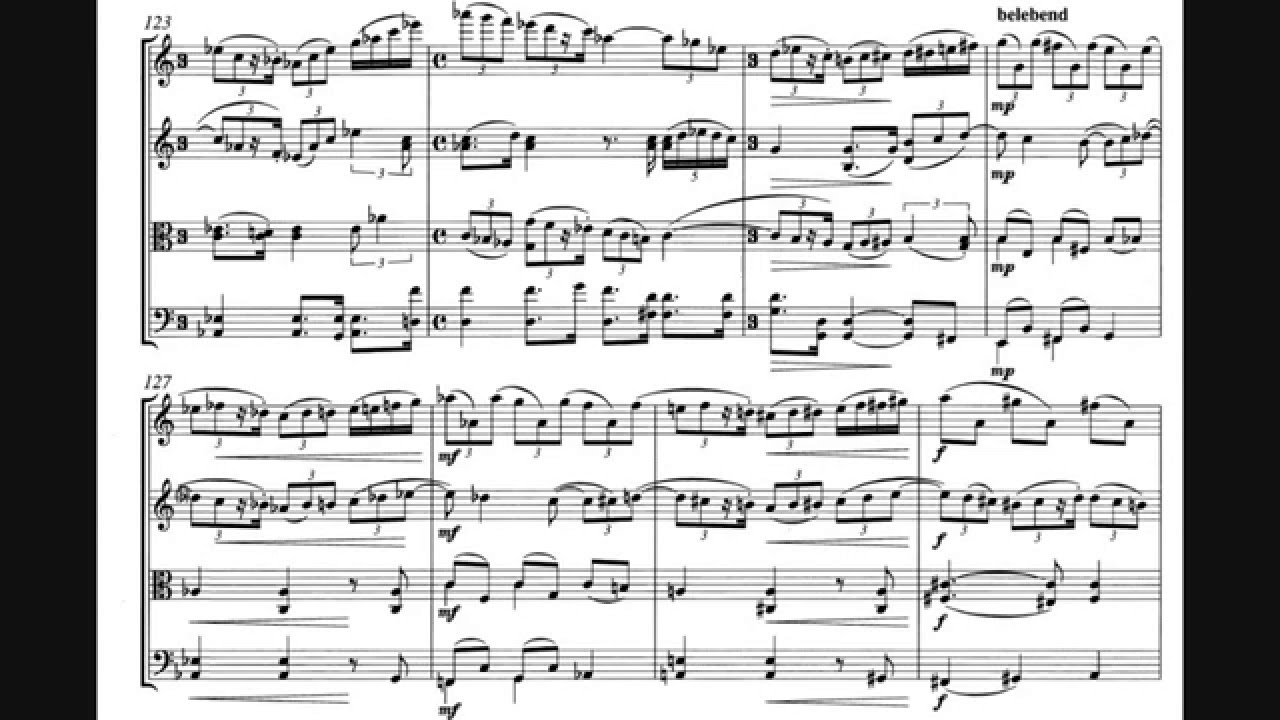
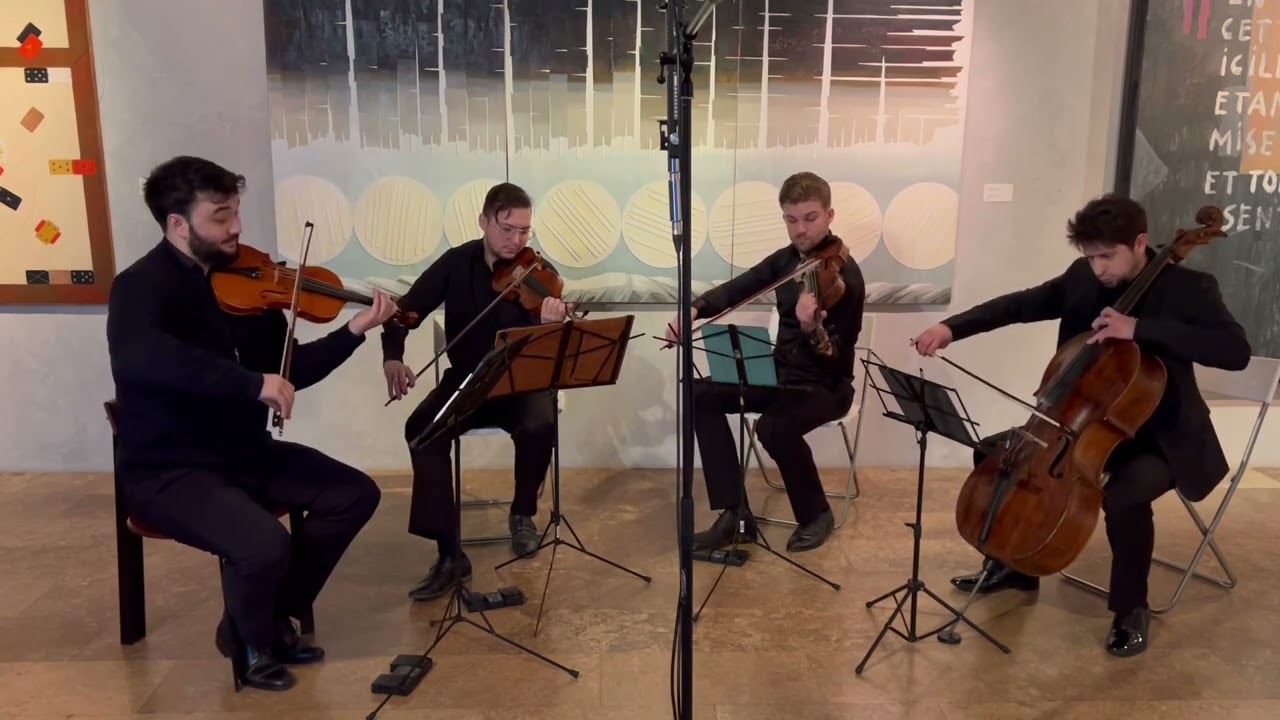
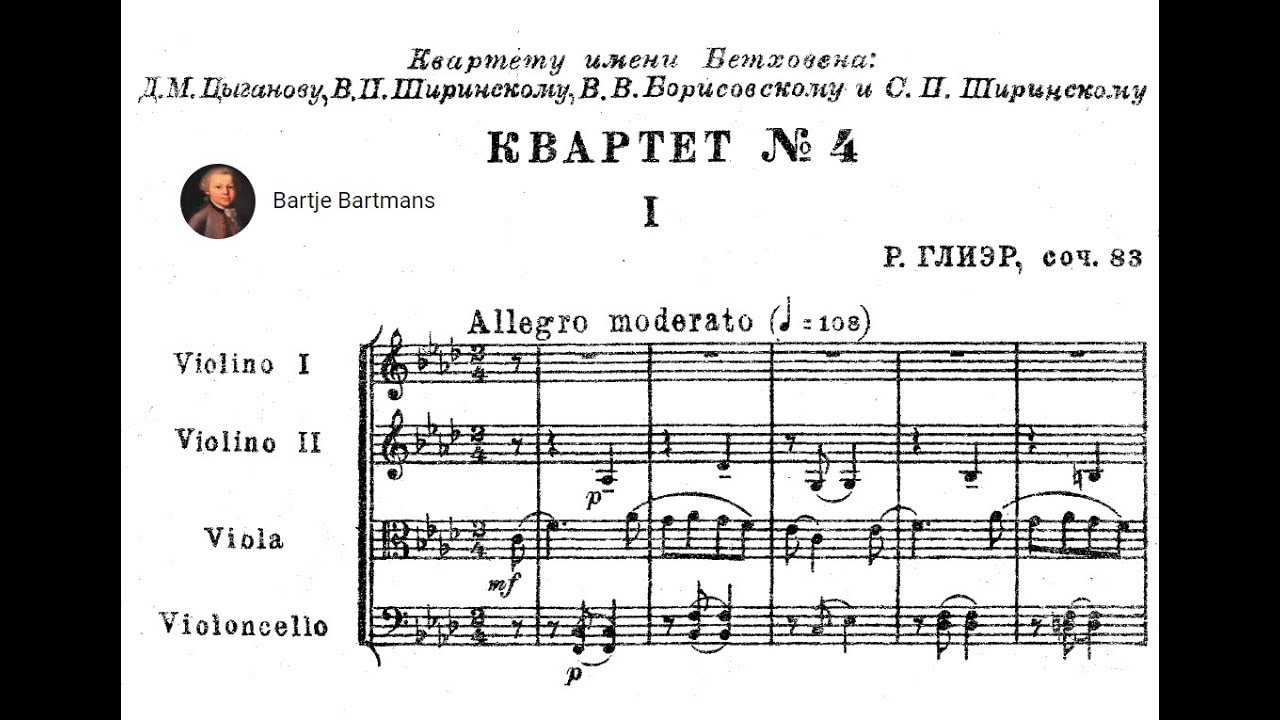
Reinhold Glière - String Quartet No. 4, Op. 83 (1943)
Автор: Bartje Bartmans
Загружено: 2020-06-12
Просмотров: 5120
Reinhold Moritzevich Glière (Russian: Рейнгольд Морицевич Глиэр, Ukrainian: Ре́йнгольд Мо́ріцевич Гліер / Reingol'd Moritsevich Glier; born Reinhold Ernest Glier, which was later converted for standardization purposes; 11 January 1875 [O.S. 30 December 1874] – 23 June 1956), was a composer in the Russian Empire and Soviet Union, of German and Polish descent.
String Quartet No. 4 in f minor, Op. 83 (1943)
Dedicated to the "Beethoven Quartet" Dmitry Tsyganov (first violin)
Vassily Shirinsky (second violin), Vadim Borisovsky (viola), Sergei Shirinsky (cello))
1. Allegro moderato
2. Vivace (8:51)
3. Andante with 10 variations (12:58)
4. Allegro (22:29)
Beethoven Quartet
Description by Theodore Servin [-]
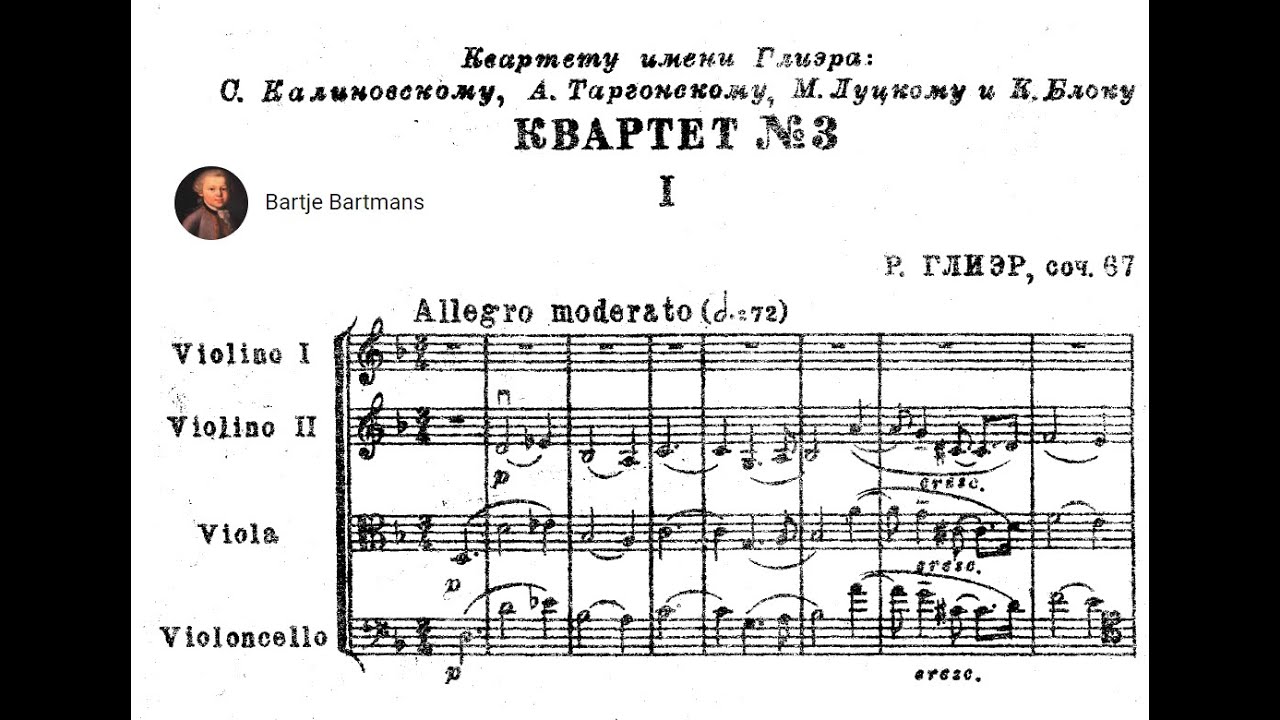
Reinhold Glière's String Quartet No. 4 in F minor was composed in 1943, 16 years after his 3rd quartet in D minor, and well into the Second World War. It was dedicated to the Beethoven Quartet, the famous Soviet ensemble, and it was awarded a Stalin prize in 1948 (he won 3 Stalin Prizes in his lifetime). It is a deeply romantic work, reminiscent of the 2nd quartet in G minor in terms of character and polyphonic texture; however, this quartet has more agitation and drama than the 2nd, and provides for an intense listening experience.
The opening movement, Allegro moderato, begins with a melancholic and Russian-sounding theme, which quickly becomes agitated. Soon after, a second, lyrical theme appears in D-flat major. The development is filled with intense but clear polyphony, leading to a very satisfying recapitulation; movement ends with a short, but ominous coda based on the first theme.
The second movement, a Vivace in B-flat major, is also very Russian in character, in a pleasant 3/8 meter. The trio in D major in a 2/8 meter has a similar character, but with muted strings, and interspersed with more lyrical lines.
The third movement, an Andante in D minor, is a deeply elegiac one, and is set as a theme with 10 variations. At times tragic, other times light, and still other times deeply tender, this movement is a truly gorgeous work of art.
The finale, an Allegro, begins with an intense and pointed fugato, before introducing a beautiful and heartfelt second theme. The piece is then transits into a dramatic and at times dissonant development, filled with fugue-like moments. The quartet ends with a vigorous and devilish coda, with fast-paced harmonic changes and sharp chords.
As with all of Glière's string quartets, the 4th is an extremely well-crafted work, deeply rooted in Russian romanticism, with a very human and deeply felt character, and it takes the listener on a beautiful and emotional roller-coaster. It is a masterpiece of late romantic chamber music, a relic from another world which managed to find itself in mid-twentieth-century Soviet Russia, and it deserves to be frequently performed by modern string quartet ensembles.
Доступные форматы для скачивания:
Скачать видео mp4
-
Информация по загрузке:








![Nikolai Medtner - Violin Sonata No. 2, Op. 44 [with score]](https://imager.clipsaver.ru/I2TNadfXxSQ/max.jpg)