Tchaikovsky, Symphony No.1, Op.13 "Winter Dreams" (Pablo Heras-Casado, Orchestra of St Luke's)
Автор: ScoreMan
Загружено: 2026-01-23
Просмотров: 93
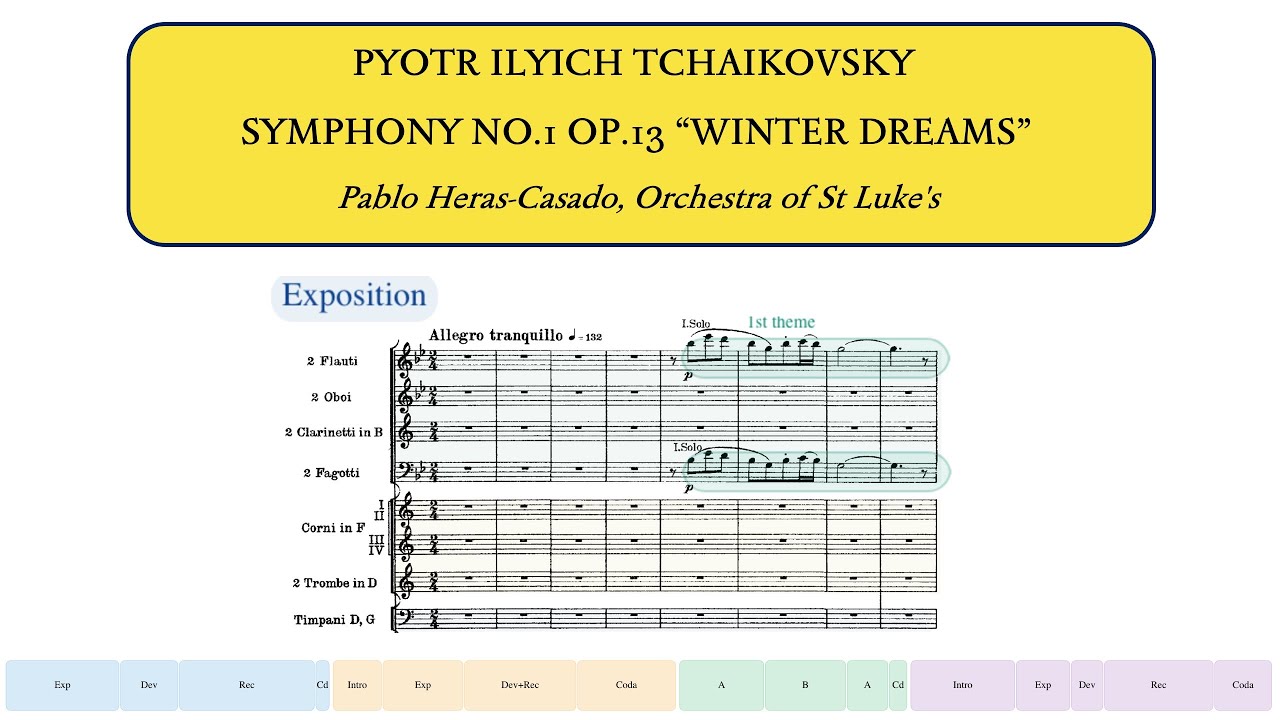
P.Tchaikovsky, Symphony No.1 in G minor, Op.13 "Winter Dreams", with with a theme-and-structure analysis and synchronized sheet music (score)
Performance: Pablo Heras-Casado (conductor), Orchestra of St Luke's, 2015/10, DiMenna Center for Classical Music, New York
Analysis, Score Editing, Synch: ScoreMan
00:00 Movement 1: Dreams of a Winter Journey. Allegro tranquillo
11:23 Movement 2: Land of Desolation, Land of Mists. Adagio cantabile ma non tanto
23:26 Movement 3: Scherzo. Allegro scherzando giocoso
31:29 Movement 4: Finale. Andante lugubre - Allegro maestoso
OVERVIEW
Tchaikovsky’s Symphony No. 1 in G minor, Op. 13, subtitled “Winter Dreams (Winter Daydreams),” is his first completed symphony and already shows many of the traits that would define his mature style.
The work combines clear symphonic structure with strong lyrical imagination, using music to evoke landscapes, moods, and emotional states associated with winter.
While it follows Classical models, its emotional openness and melodic richness are unmistakably Tchaikovskian.
HISTORICAL CONTEXT
Tchaikovsky composed the symphony between 1866 and 1868, during his early years in Moscow while teaching at the newly founded Moscow Conservatory.
The process was extremely difficult for him, causing significant emotional and physical strain.
He struggled with self-doubt and revisions, and the symphony was initially met with mixed reactions.
Despite these difficulties, the work eventually gained recognition, and Tchaikovsky himself later acknowledged its sincerity, even if he felt it lacked the technical mastery of his later symphonies.
MUSICAL SIGNIFICANCE
This symphony is significant because it marks Tchaikovsky’s first major attempt at large-scale orchestral writing.
It shows his natural gift for melody and emotional expression, as well as his early efforts to reconcile Western symphonic form with a distinctly Russian sensibility.
Many of the qualities that later make his symphonies so beloved—lush orchestration, expressive intensity, and vivid atmosphere—are already present here.
• J.S.Bach's Masterpieces
• J.S.Bach - 6 Cello Suites
• D.Scarlatti - Keyboard Sonatas
• W. A. Mozart - Piano Sonatas
• L. v. Beethoven's Masterpieces
• L. v. Beethoven - 9 Symphonies
• L. v. Beethoven - Piano Sonatas
• F. Schubert - Piano Sonatas
• F. Chopin's Masterpieces
• F. Chopin - 19 Mazurkas
• F. Chopin - 19 Polonaises
• F. Chopin - 22 Nocturnes
• F. Chopin - 19 Waltzes
• R. Schumann's Masterpieces
• F. Liszt's Masterpieces
• J. Brahms's Masterpieces
• P. I. Tchaikovsky's Masterpieces
• C. Debussy's Masterpieces
• M. Ravel's Masterpieces
• S. Prokofiev's Masterpieces
• S. Prokofiev - Piano Sonatas
• Piano Sonata Collections
• Piano Concerto Collections
• Violin Concerto Collections
• Suite Collection
• Music for Children / Childhood
Доступные форматы для скачивания:
Скачать видео mp4
-
Информация по загрузке: