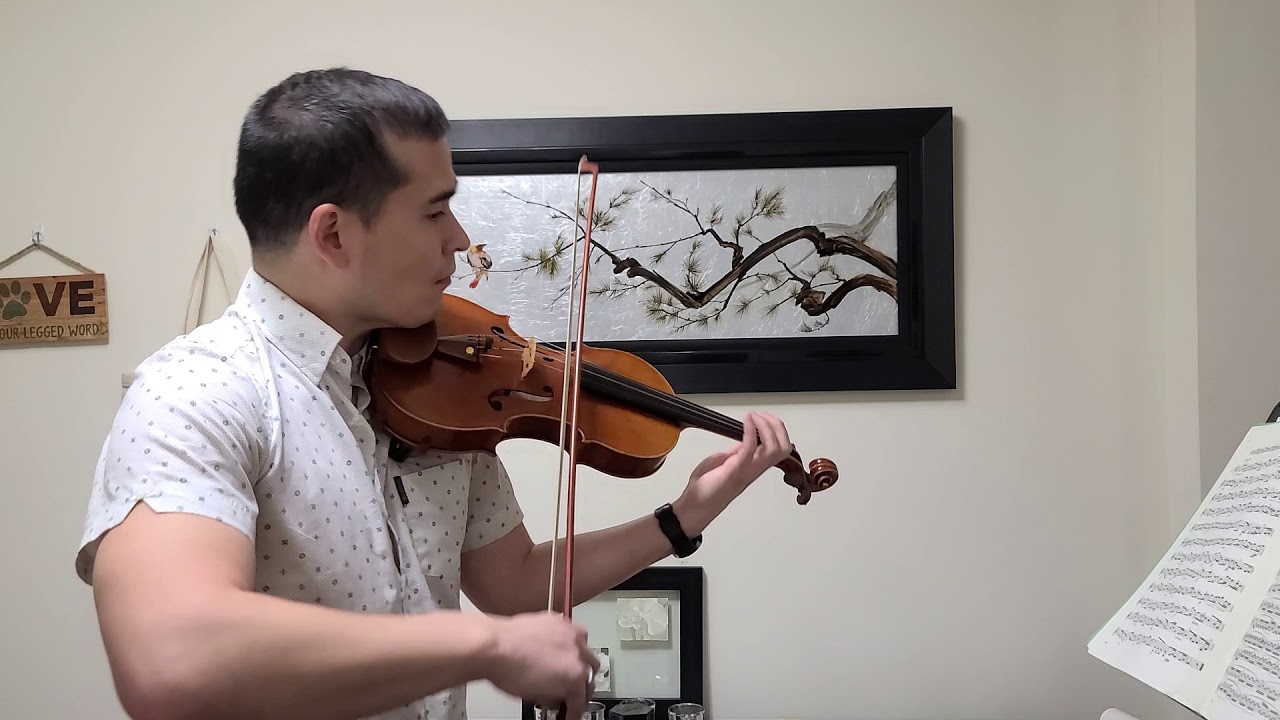
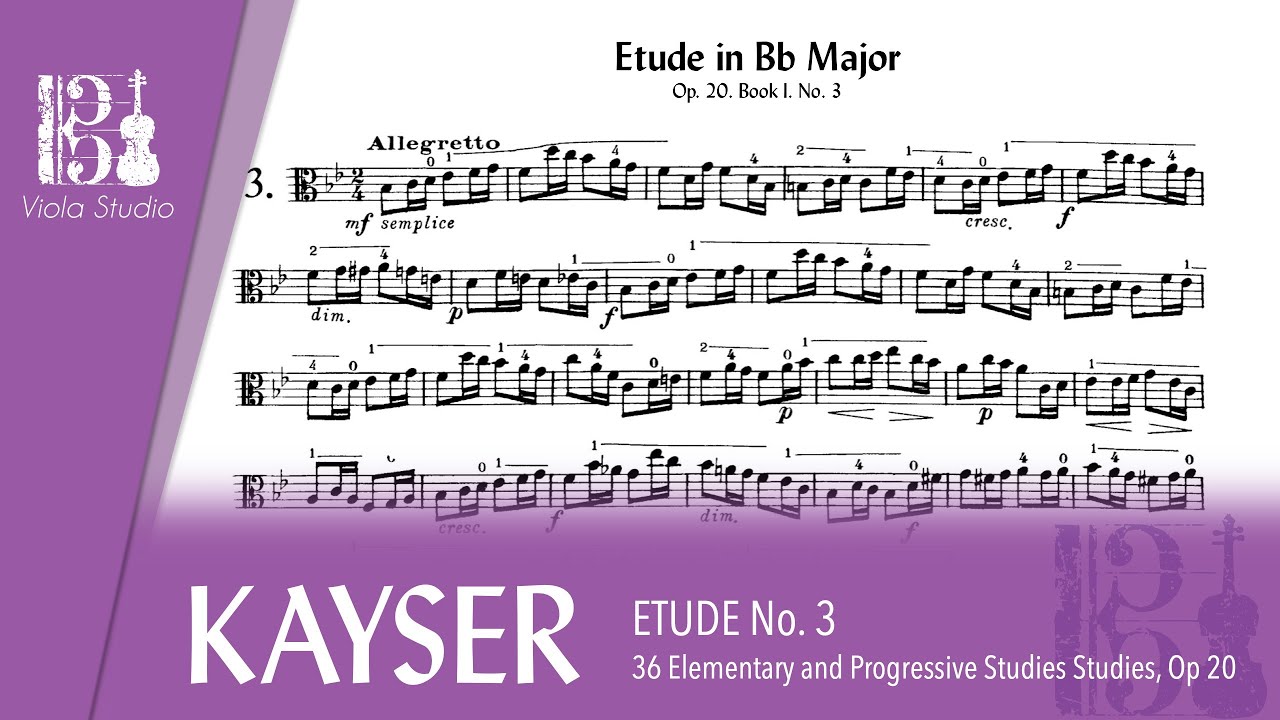
H. Kayser: Violin Etude Op. 20, No. 3/H. Kayser: Estudio para Violín Op. 20, No. 3
Автор: Master the Violin Etudes
Загружено: 2023-04-06
Просмотров: 2173
MAIN DIFFICULTIES: Bow Strokes.
OTHER DIFFICULTIES: Intonation and bow distribution.
SIMILAR ETUDES: Hermann Op. 20, No. 30, Wolfhart Op. 74, No.8 and 15 and Op. 45, No. 4
The rhythmic pattern of this etude allows for an ample variety of strokes and to work on bow distribution. A basic rule of thumb is to use more bow for the eight-notes and less for the sixteen-notes, which makes sense rhythmically. Be careful not to "compress" the bow too much, to use the same amount of bow for both sixteens, and not to use more in the down bow sixteen. The bow coordination of the sixteen notes partially depends on this concept. When we practice the etude at the M, F, and T it is helpful to think that these parts of the bow are like “mini whole bows.” This way it is ease to understand that the sixteen’s notes will alternate to be at the F and T of our imaginary “mini bow.”
The tonality together with the succession of small steps makes it quite hard to play the etude in tune. The “catchy” tune helps greatly towards this matter when starting out, but makes it harder later since the melody is so easy to recognize. Keeping the left hand fingers down after a note is played is an important practice thought the etude. It will help to keep the shape of the hand and to be prepared when the same note repeats shortly or right after another.
The variations to be practiced in this etude are very important. I believe that most of the learning falls there. So, I encourage doing them all. Playing the whole etude as if they were straight sixteen notes, making the eight note two even repeated sixteens, is my favorite starter. It helps the rhythm and the left hand coordination.
The abundant dynamics markings should be introduced early in the learning process of the etude. They required more attention and control in the bow. If a crescendo is to be played, we should do so by using more bow, and not pressing harder. Besides, it makes the practicing more fun and it is a big part when interpreting other pieces.
DIFICULTAD PRINCIPAL: Golpes de Arco.
OTRAS DIFICULTADES: Entonación y distribución de arco.
ESTUDIOS SIMILARES: Hermann Op. 20, No. 30, Wolfhart Op. 74, No.8 and 15 and Op. 45, No. 4
El patrón rítmico de este estudio permite incorporar una gran variedad de arcadas y golpes de arco y trabajar también en la distribución de arco. Una regla básica seria de usar más arco para la corchea y menos para las semicorcheas, lo cual tiene sentido rítmicamente. Atención a no comprimir el arco demasiado en las semicorcheas y asegurarse que las dos reciben la misma cantidad de arco, no siempre más arco en la del arco abajo. La coordinación de las semicorcheas depende parcialmente de este concepto. Cuando estudiemos al Medio, Talón y Punta, ayuda mucho pensar que estas partes del arco son como un arco en miniatura. De esta manera es fácil comprender que las semicorcheas se alternan a la punta y el talón de nuestro imaginario arco en miniatura.
La tonalidad junto con la sucesión de intervalos pequeños hace que este estudio sea bastante difícil de afinar. La pegadiza melodía ayuda mucho al empezar el estudio, pero a la vez hace la afinación más difícil ya que se reconoce fácilmente. Mantener el dedo de la mano izquierda abajo después de que se toque esa nota es una práctica importante durante este estudio. Esto ayudara a mantener a mantener la forma de la mano y a asegurar esa misma nota cuando se repite inmediatamente.
Estudiar todas las variaciones en este estudio es muy importante. Es mi opinión que la mayoría del aprendizaje reside en ello. Así que os animo a que las hagáis todas. Tocar todo el estudio como semicorcheas, transformando la corchea en dos semicorcheas iguales, es mi favorita. Ayuda al ritmo y a la coordinación de la mano izquierda.
La gran cantidad de dinámicas y matices deben de ser introducidas lo más temprano posible mientras aprendemos el estudio. Esto requiere más atención y control de arco. Para los crescendos y diminuendos usad más o menos arco, no apretar más con el arco. De todas formas, todo esto hace que el estudio sea más divertido y es una gran parte de interpretar otras piezas.
www.mastertheviolinetudes.com
Доступные форматы для скачивания:
Скачать видео mp4
-
Информация по загрузке: