2024/06/14-5 Sicily: Siracusa/Ortigia- Walking Around - Cattedrale di Siracusa - Palazzo delle Poste
Автор: Armindo Souza
Загружено: 2024-10-08
Просмотров: 43
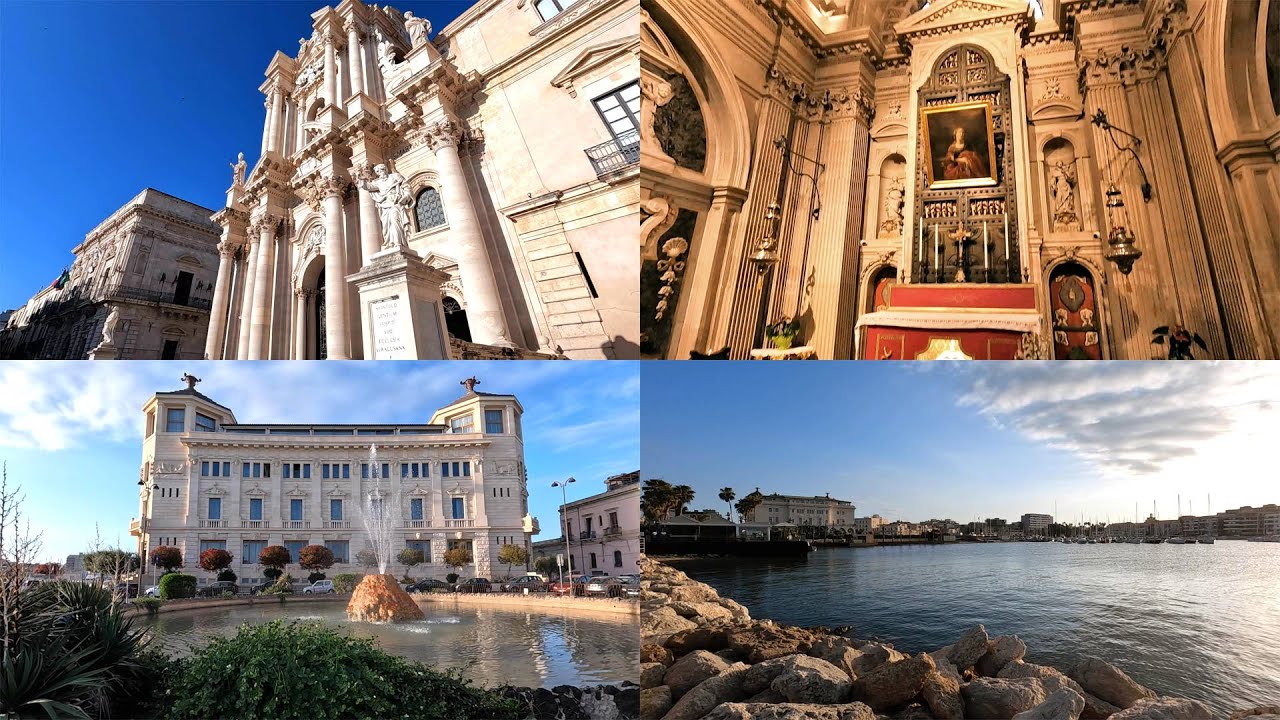
Cattedrale di Siracusa - The Cathedral of Syracuse (Duomo di Siracusa), formally the Cattedrale metropolitana della Natività di Maria Santissima (Metropolitan Cathedral of the Most Holy Nativity of Mary), is an ancient Catholic church in Syracuse, Sicily, the seat of the Catholic Archdiocese of Siracusa. Its structure is originally a Greek doric temple, and for this reason it is included in a UNESCO World Heritage Site designated in 2005.
The cathedral stands in the city's historic core on Ortygia Island.
The origins of a temple on this site date to prehistory. The great Greek Temple of Athena was built in the 6th century BC [590-580 BCE] . The temple was a Doric edifice with six columns on the short sides and 14 on the long sides. Plato and Athenaeus mention the temple, and the looting of its ornament is mentioned by Cicero, in 70 BC, as one of the crimes of the governor Verres.
Archeological site excavations by Paolo Orsi in 1907-1910 show the Greek temple to have been built on even older foundations, and uncovered a wealth of archaic and pre-Hellenic artefacts. Many are held by the Museo archeologico regionale Paolo Orsi in Syracuse.
The present cathedral was constructed by Saint Bishop Zosimo of Syracuse in the 7th century. The battered Doric columns of the original temple were incorporated in the walls of the current church. They can be seen inside and out. The building was converted into a mosque in 878, then converted back when Norman Roger I of Sicily retook the city in 1085. The roof of the nave is of Norman origin, as well as the mosaics in the apses.
As part of the increased building activity after the 1693 Sicily earthquake, the cathedral was rebuilt and the façade redesigned by architect Andrea Palma in 1725–1753. The style is classified as High Sicilian Baroque, a relatively late example. The double order of Corinthian columns on the facade provide a classic example of carved Acanthus leaves in the capitals. Sculptor Ignazio Marabitti contributed the full-length statues on the facade.
The interior of the church, a nave and two aisles, combine rustic walls and Baroque details. Features include a font with marble basin dating from the 12th or 13th century, a ciborium (an altar canopy) designed by architect Luigi Vanvitelli, and a statue of the Madonna della Neve ("Madonna of the Snow", 1512) by Antonello Gagini.
Palazzo delle Poste - The monumental historic building known as “Palazzo delle Poste”, inaugurated in 1929 on the island of Ortigia (Syracuse), has recently been the subject of a global restoration and redevelopment of its interior and exterior spaces. From this initiative was born the Ortea Palace Luxury Resort, which preserves and preserves the main historical-architectural elements, including original decorations and colors that recall the chromatic nuances of the place.
The designer and promoter Sebastiano Russotti explains how the goal was to “neast the new with the pre-existing”, on the one hand maintaining the architectural characteristics, on the other satisfying “the needs of elegance and comfort required by the customers of a luxury hotel”.
All the hotel’s 75 luxurious rooms and suites are characterized by elegance and refinement and bright and welcoming interiors, and the old parking lot of the Palace has been transformed into an internal courtyard that now serves as a hotel lobby with bars and brasseries, enclosed by an exceptional roof made with stained glass windows of Saint-Gobain Glass with solar control and reinforced thermal insulation.
Доступные форматы для скачивания:
Скачать видео mp4
-
Информация по загрузке: