Build Your First AI Mini-App with Structured JSON Output (LangChain + Pydantic)
Автор: NoteBookLearnings
Загружено: 2026-01-11
Просмотров: 2
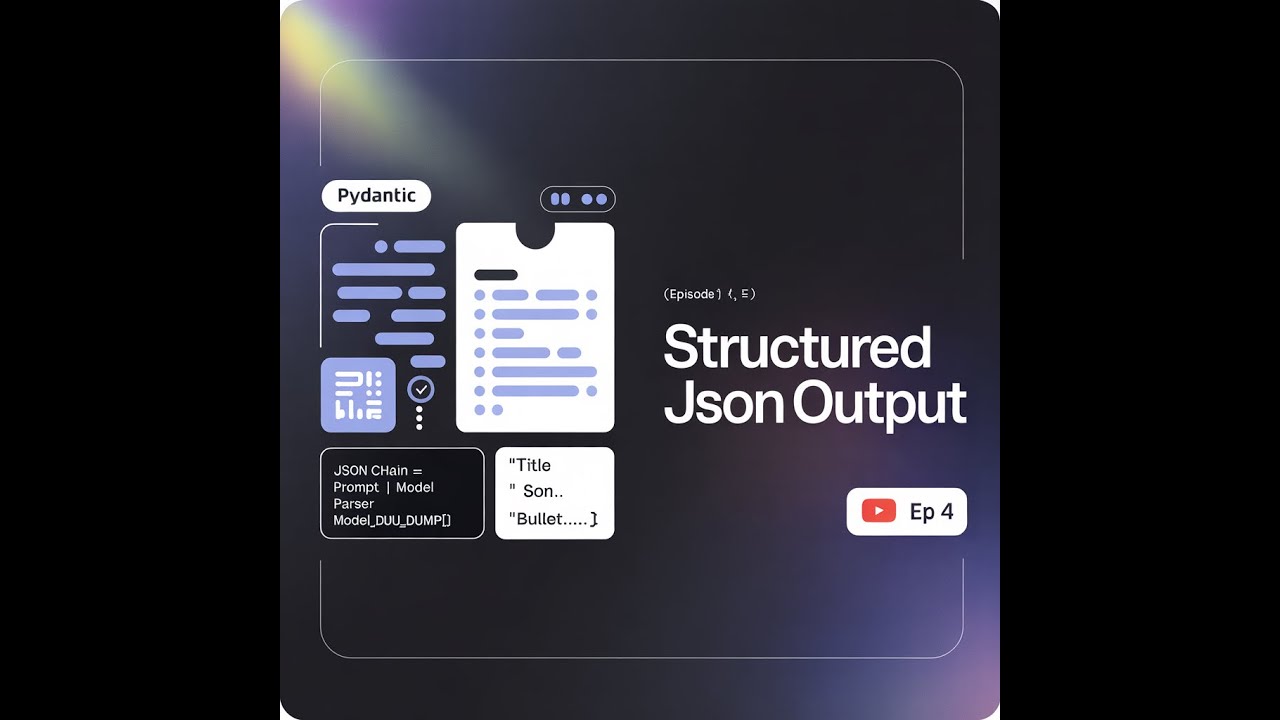
In this episode, you build a real AI mini-app that returns structured, validated JSON instead of raw text.
This is where LangChain becomes enterprise-ready.
In Episode 4 of LangChain from Zero to Production, you will learn how to:
Design Pydantic schemas as data blueprints
Use PydanticOutputParser for structured AI output
Generate validated JSON responses from LLMs
Build a complete AI mini-app interface
Convert AI output into Python objects, dictionaries, and JSON
Prepare AI data for databases, APIs, and dashboards
No fragile string parsing.
No guessing formats.
Just clean, predictable, machine-readable data.
🚀 What You’ll Build
✔ Pydantic schema for AI output
✔ Schema-aware LangChain prompts
✔ Structured output chains
✔ Type-safe Python data objects
✔ A production-ready AI mini-app
📌 Prerequisites
This video builds on:
Episode 1 – LangChain fundamentals
Episode 2 – Your first LangChain chain
Episode 3 – Turning chains into tools with memory
▶️ Start from Episode 1 if you’re new.
Timeline: 00:09 Build Your First AI Mini-App with Structured JSON Output
01:32 The Problem with Text-Only Output
03:06 Understanding Pydantic Schemas
04:32 Creating Your Pydantic Schema
06:55 Connecting the Schema to LangChain
08:48 Creating a Schema-Aware Prompt
10:57 Inspecting the Format Instructions
12:15 Building the Structured Output Chain
14:24 Creating Your Mini-App Function
16:37 Displaying Data Beautifully
18:23 Testing with Multiple Scenarios
20:42 Accessing Data Programmatically
22:36 Converting to JSON
24:06 Real-World Use Cases
25:37 What You Can Build Next
26:58 Recap, Next Steps, and Thank You
Доступные форматы для скачивания:
Скачать видео mp4
-
Информация по загрузке: