How to Plot Against Time Using ggplot in R
Автор: vlogize
Загружено: 2025-09-22
Просмотров: 0
Learn how to effectively plot Speed and Predictions against Time with ggplot in R. This guide explains the data manipulation and plotting process clearly.
---
This video is based on the question https://stackoverflow.com/q/62972668/ asked by the user 'mustafa' ( https://stackoverflow.com/u/12021156/ ) and on the answer https://stackoverflow.com/a/62972687/ provided by the user 'akrun' ( https://stackoverflow.com/u/3732271/ ) at 'Stack Overflow' website. Thanks to these great users and Stackexchange community for their contributions.
Visit these links for original content and any more details, such as alternate solutions, latest updates/developments on topic, comments, revision history etc. For example, the original title of the Question was: how to plot against time using ggplot
Also, Content (except music) licensed under CC BY-SA https://meta.stackexchange.com/help/l...
The original Question post is licensed under the 'CC BY-SA 4.0' ( https://creativecommons.org/licenses/... ) license, and the original Answer post is licensed under the 'CC BY-SA 4.0' ( https://creativecommons.org/licenses/... ) license.
If anything seems off to you, please feel free to write me at vlogize [AT] gmail [DOT] com.
---
How to Plot Against Time Using ggplot in R
When working with time series data in R, one common task is to visualize the relationship between time and various other variables. For example, you may wish to plot speed readings and predicted values over time. In this guide, we will explore how to accomplish this task using the powerful ggplot2 package in R. Let’s dive into the step-by-step process to create a visually appealing plot from your data.
Problem Statement
You have a dataset with time readings and two variables you wish to plot against these time readings: Speed5A and Predicted. Your goal is to have these two variables represented in a line plot with different colors to easily distinguish between them.
Step-by-Step Solution
Step 1: Data Preparation
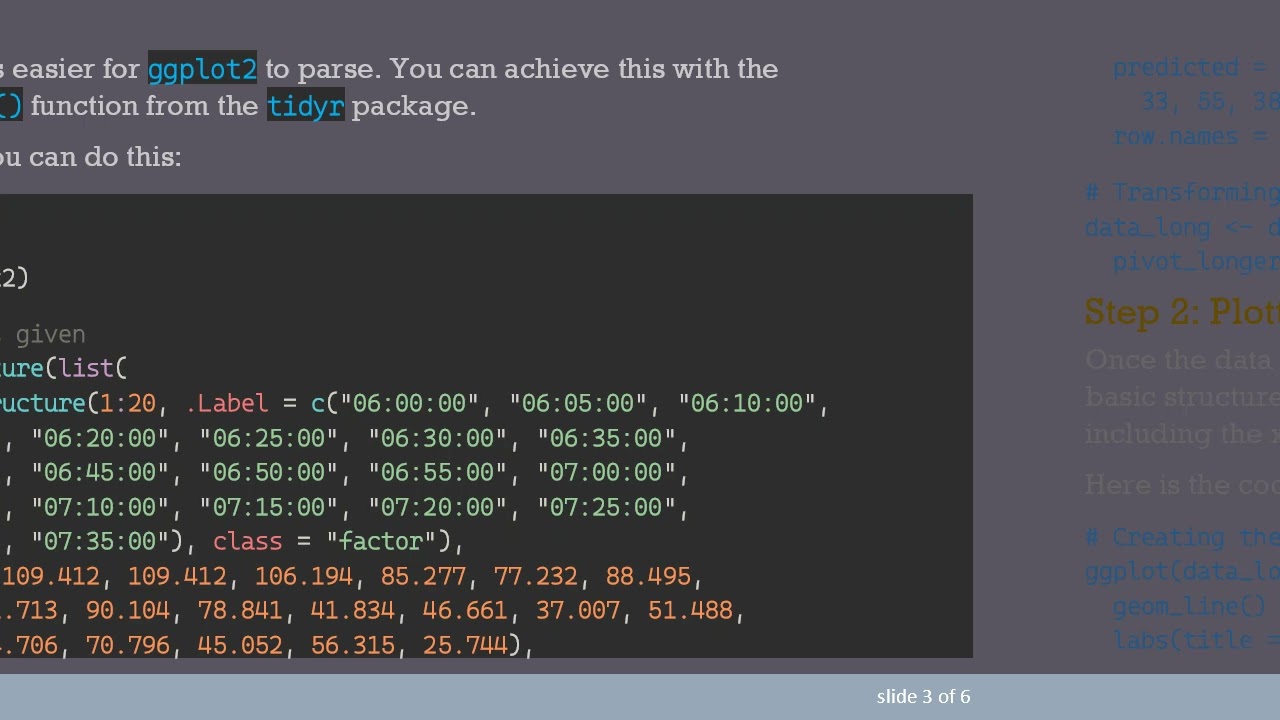
First, we need to ensure that the data is in the right format for ggplot2. The best approach is to transform the data into a long format. This means that we'll reshape the data so that it’s easier for ggplot2 to parse. You can achieve this with the pivot_longer() function from the tidyr package.
Here is how you can do this:
[[See Video to Reveal this Text or Code Snippet]]
Step 2: Plotting the Data
Once the data is prepared in long format, we can use ggplot2 to create the plot. The basic structure of a ggplot command involves specifying aesthetics (aes) for the plot, including the x and y axes, and defining how to group and color the data.
Here is the code to create the plot:
[[See Video to Reveal this Text or Code Snippet]]
Step 3: Alternative Method Using Gather
If you are familiar with an older method, you can also use gather() as an alternative to pivot_longer(). Here’s how the code looks:
[[See Video to Reveal this Text or Code Snippet]]
Conclusion
In this guide, we explored a straightforward method to visualize two variables against time using ggplot2 in R. By reshaping the data into a long format, you can effectively use ggplot to create clear and colorful line plots that highlight the differences between various data series.
Feel free to experiment with different themes and plot aesthetics in ggplot to make your final plot truly unique! Happy plotting!
Доступные форматы для скачивания:
Скачать видео mp4
-
Информация по загрузке: