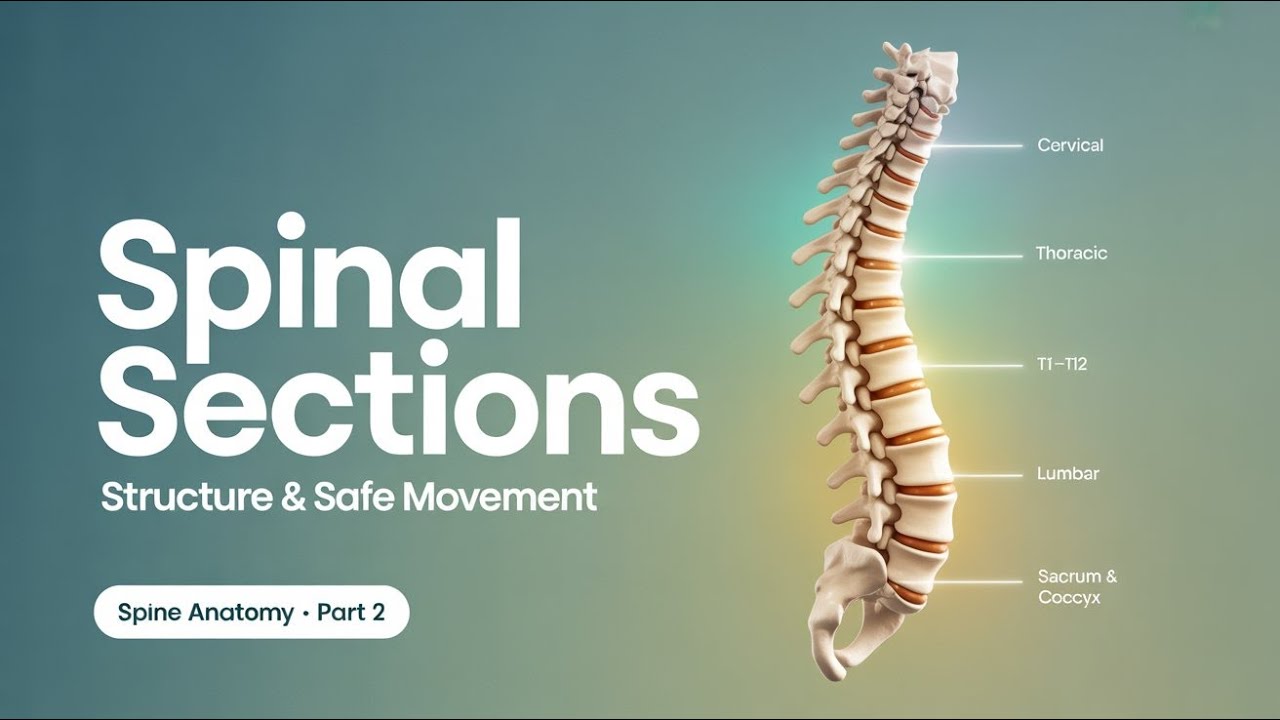
Anatomy of the Spine — Part 2 | Spinal Sections, Structure & Safe Movement
Автор: Kathryn Kuppan
Загружено: 2026-01-19
Просмотров: 7
Welcome to Anatomy of the Spine — Part 2, where we explore each section of the spine in detail and discover how structure influences movement, posture, and safe yoga practice. In this lesson, we journey through the cervical, thoracic, lumbar, sacral, and coccygeal regions, learning how each part contributes to stability, mobility, and overall spinal health.
Understanding spinal anatomy helps us teach movement with greater intelligence, awareness, and compassion for individual differences.
💪 Anatomy of the Spine — Part 2 | Spinal Sections, Structure & Safe Movement
💡 What You’ll Learn:
✅ The structure and function of the cervical spine (C1–C7)
✅ Why C1 (atlas) and C2 (axis) are unique and essential for head rotation
✅ How spinal structure supports vision, balance, and orientation
✅ The anatomy of the thoracic spine (T1–T12) and its relationship with the rib cage
✅ The role of the lumbar spine (L1–L5) in weight bearing and movement
✅ How the sacrum and coccyx connect the spine to the pelvis
✅ An introduction to the sacroiliac (SI) joint and its role in stability
🧠 Spinal Regions Overview:
• Cervical Spine — mobility, rotation, and head support
• Thoracic Spine — rib attachment, protection, and limited extension
• Lumbar Spine — stability, strength, and load-bearing
• Sacrum & Coccyx — fused vertebrae transferring weight to the pelvis
🧘♂️ Yoga Application – Backbends & Twists:
• Understand why the cervical and lumbar spine extend more easily
• Learn why the thoracic spine often needs encouragement to extend
• Explore cues for safe backbending: length before extension
• Discover how core engagement stabilizes the lumbar spine and mid-back
• Learn to protect the neck by lengthening through the cervical spine
• Understand how pelvic position affects the lower back
🌀 Twisting & the SI Joint:
• Learn why the SI joint is primarily a joint of stability
• Understand how excessive twisting may aggravate SI instability
• Discover how to twist safely by stabilizing the pelvis
• Emphasize rotation through the thoracic spine rather than the lumbar
• Explore cues for healthy twists, especially for sensitive backs
🧬 Human Variation & Spinal Differences:
• Understand that not all spines are the same
• Learn how vertebral shape and spacing affect range of motion
• Explore why some bodies move more easily into backbends than others
• Develop respect for anatomical diversity in teaching and practice
🎯 Perfect For:
• Yoga teachers & 200-hour teacher trainees
• Anatomy and movement students
• Pilates & functional movement practitioners
• Anyone curious about spinal health and safe movement
💡 Pro Tip:
There is no “perfect spine.” Structure shapes movement, and awareness allows us to move wisely within our unique anatomy.
🔗 Additional Resources:
If you’re enrolled in the 200-hour yoga teacher training, explore the self-palpation activities, movement explorations, and handouts available in the Google Classroom.
#spineanatomy #yogaanatomy #spinalhealth #postureeducation #safemovement #yogateachertraining #movementscience #somaticeducation #anatomyofyoga
Доступные форматы для скачивания:
Скачать видео mp4
-
Информация по загрузке:








![Лучше для поясницы НЕ придумаешь [ТОП комплекс в 2026]](https://imager.clipsaver.ru/vQmdkKzwPPA/max.jpg)